

It should probably go without saying that you don’t want your publishing contract to include clauses that contradict one another.
Beyond any potential legal implications, internal contradictions suggest a publisher that either doesn’t understand its own contract language well enough to spot the problem–or a publisher that simply doesn’t care. Neither is a good sign for what lies ahead.
Contradictions can be tricky to spot, especially for first-time authors who aren’t experienced in contract legalese. Here’s an example that came across my desk recently: an anthology contract from Dark Lake Publishing that provides for rights reversion 12 months after publication:

(Side note: this is a crap reversion clause, since it not only allows the publisher to keep publishing indefinitely, but doesn’t say anything about paying for that privilege. That’s not the issue I’m highlighting in this post, however.)
The wording of the clause seems pretty clear, right? All rights other than publishing rights–and this is an all-rights contract, with the publisher laying claim to “all Intellectual Property Rights subsisting, either in present or in the future, in the Book in all formats”–return to the author 12 months after the contract’s effective date, which is the date of publication. But just a few clauses down, there’s this:

But…but…if all rights other than publishing rights revert after 12 months, how can the publisher lay claim to dramatic rights for two more years? It’s a clear internal contradiction.
In practical terms, there’s probably no impact: this particular publisher has about as much ability to exploit dramatic rights as I do of space touristing to Mars. But what does it say about a publisher that it either hasn’t spotted the cognitive dissonance, or is perfectly fine with it?
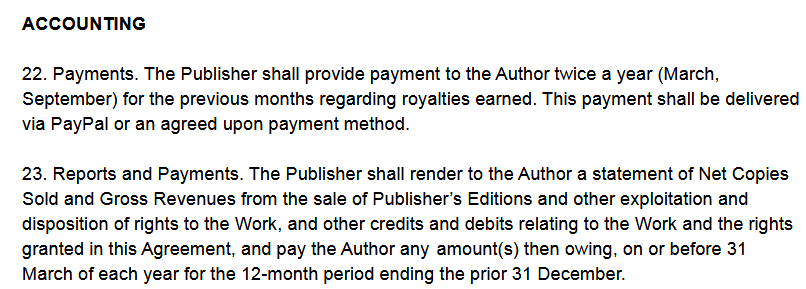
Another example I’ve seen recently involves royalties. This contract from Fractured Mirror Publishing appears to be planning to pay both twice a year and once a year:
Here’s more confusing royalties language from Beacon Publishing Group, which first promises to pay based on Net Receipts, but then cites percentages of retail price (guess which one will appear in your royalty check):

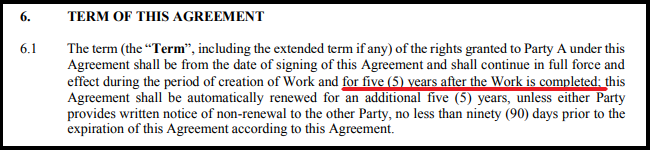
Another example: serial reading/writing app Popink, whose contract appears to extend for a limited term, but includes a Power of Attorney clause at the end of the contract that claims rights for the duration of copyright (you can read more about Popink’s awful contract here).
![POWER OF ATTORNEY
I, [redacted] ](Pseudonym:[
redacted
])am the author of the Series of [
[redacted]
(with [1] book)(hereinafter referred to as: the “Work”) and own the copyright to the Work.
I hereby grant a full, Non-exclusive License for the non-exclusive use of global copyright and intellectual
property rights to the Work to operating company INK Universe Limited (hereinafter referred to as:
“[POPINK]”) of www.popinkapp.com] website. The licensing period shall be from the date of this power of attorney until the expiration of the protection period for the copyrights and intellectual property rights to
the Work. Without the written authorization of INK Universe Limited, no one (including myself) shall exercise the foregoing rights to the Work.](https://writerbeware.blog/wp-content/uploads/2022/06/popink-power.png)
But the internal contradiction that I see most often, and most consistently, involves copyright: contracts where the grant of rights explicitly transfers copyright to the publisher, while further clauses acknowledge copyright retention by the author.
Here’s what I’m talking about. These clauses are from the contract of Histria Books.

The key wording here is “exclusively grants, assigns, and otherwise transfers to the Publisher…all right, title, and interest in and to the Work…including but not limited to all copyrights therein”. Whenever you see language like this, it means that you are agreeing to give up ownership of your copyright.
Histria’s contract includes language allowing for termination by the author under certain circumstances, so the copyright transfer is temporary rather than permanent (which doesn’t necessarily make it a better deal). However, when you transfer your copyright to someone else–even temporarily–that someone becomes the owner of all your intellectual property rights, without exception, for as long as the transfer is in force, and can do anything it wants with them, from licensing rights to third parties to creating sequels, spinoffs, and derivative works.
So you have to wonder why Histria’s copyright transfer language is followed by this:

In a contract with a conventional grant of rights–one that does not include a copyright transfer–you want to see such a clause, to make clear that the publisher can’t claim any rights that haven’t been specifically mentioned. But Histria’s contract does include a copyright transfer, which means that there are no rights remaining that can be reserved to the author. If not outright contradictory, this clause is certainly inconsistent. But then there’s this:

But wait–didn’t the Grant of Rights make Histria the owner of the copyright? So why would it register in the author’s name? To do so would be to acknowledge the author as the copyright holder, since copyright registration is made in the name of the copyright owner.
(Side note: what the hell is meant by “material contributed by the author to the Work”? Wouldn’t that be, hmmm, the work itself, given that the author wrote it? Even if nothing else in this contract were problematic, this bizarre wording would demand an explanation.)
Finally, there’s this–a pretty unambiguous acknowledgment of the author’s copyright ownership:

Bottom line: multiple clauses in Histria’s contract are inconsistent with or directly contradict the copyright transfer in Clause 1.
I have no idea what the legal ramifications are here. If there’s a dispute, whose ownership would prevail: Histria’s, per Clause 1, or the author’s, for which registration in their name provides prima facie evidence? Regardless, such inconsistencies really should not exist in a publishing contract, and their presence raises the questions posed above: does the publisher not understand its own contract? (Not a good sign of professionalism or expertise.) Does it just not care? (Ditto, and you have to wonder what else it doesn’t care about). Worth noting: I’ve heard from authors who contacted Histria about the copyright contradictions, and were brushed off.
This confusion over copyright transfer is more common than you might think. Other publishers whose contracts include it: RIZE, J. New Books, Assure Press, Silver Bow Publishing, Realmwalker Publishing Group, Walnut Springs Press, Pen-L Publishing, and the two publishers that are the subject of Michael Capobianco’s recent post (I have been asked not to use their names to avoid identifying the sources). The troubling contract clause that Michael discusses actually is consistent with a copyright transfer, but not with the publishers’ promise to register in the author’s name. Interestingly, several of these contracts appear to have been adapted from the same template.
So what’s the moral of this post? Obviously, unless you’re doing work-for-hire, don’t sign a publishing contract that involves giving up your copyright. More broadly, though, it’s incredibly important to go over any contract you’re offered with a fine-toothed comb, and not to ignore any inconsistencies or contradictions (as authors, swept up in the excitement of a publisher’s validation, too often do). Writer Beware is glad to provide non-legal advice (we’re not lawyers, but we are professional writers, and we’ve seen a lot of contracts over the past 20+ years).
What about negotiation? Especially in the small press world, publishers can be resistant to negotiating, but sometimes may be willing to remove or change problematic contract terms. However, even if they are, you really need to ask yourself what it says about the publisher, and its view of its authors, that it would offer poor contract terms to begin with.
And if you do spot problems, and the publisher is unable to satisfactorily explain them–or, worse, tells you not to believe your lying eyes–move on.

Hi Victoria,
Note that the new Histria contract changes Publisher “shall” register the copyright, etc., to “may” register, etc., making the terms worse than ever. Guess somebody there was paying attention . . .
Anyway I hope I can someday be offered a publishing contract that doesn’t require the transfer of all rights, or of subsidiary rights when the publisher has no chance of selling them.
Steve Unger
COPYRIGHT
19. Copyright Notice and Registration. Publisher may register the copyright for the material contributed by the author to the Work in the name of the author, whether separately or as part of other medium or materials in which the Work is included. Publisher is permitted, but not obligated, to take steps to secure copyright in countries in the Territory outside of the United States, and to apply in Author’s name for any renewal of any copyright. Nothing contained in this section shall be construed as limiting, modifying, or
otherwise affecting any of the rights granted to the Publisher under this Agreement.
If the copyright transfer is still there in the Grant of Rights clause, this is still an internal contradiction. Whether it’s an obligation or an option, registering copyright in the author’s name directly conflicts with the copyright transfer language.
I think some people assume a publishing company is automatically doing everything right so wouldnt even consider that the contracts have contradictions. That’s why it’s so important to read everything, have things checked by a lawyer who understands this type of law and query anything that sounds off rather than just signing on the dotted line.
Great article with important points
“… have things checked by a lawyer who understands this type of law…” That’s a super-important caveat about lawyer consultations. Publishing is a very specialized field, and publishing contracts contain terms and language not found elsewhere. A general practice lawyer may not be able to provide good advice (I’ve heard from many authors who’ve gotten a thumbs-up from lawyers on truly terrible contracts). If you choose to consult a lawyer, make sure they have intellectual property and publishing experience.
On the Legal Recourse page of the Writer Beware website, there’s information and links to help.
One major benefit of being a member of The Authors Guild is the legal advice available, where the lawyers specialize in intellectual property right.
Thanks!
I’ve red your post with interest. Thank you for taking the time to post it, and for all the help you give to authors.
Michael Capobianco has it right. I wrote our contracts at Fresh Ink Group after looking at dozens of other publishing contracts to make sure I didn’t miss anything important. I noticed some of the contracts I reviewed had broad sections of identical language–including typos–so they obviously cut-and-pasted. They just didn’t make the effort to have them reviewed by a lawyer, or even to understand in detail what all they had put in. I’ve also had authors come to us wanting us to upgrade the quality (new cover, better layout, thorough editing or proof, and ancillary formats such as audiobooks) of their books. First step is reviewing their current or expired contract to ensure what rights they and we have to the material. We’ve had to turn down authors who simply have not rights to their material anymore, even though they were verbally told otherwise. We’ve also found gross contradictions and had to challenge the old publisher to relinquish, sometimes despite their hostility. Those badly flawed contracts give us an easy way to point out their weaknesses in a challenge, which usually intimidates them into relinquishing the rights. I regularly update our various master contracts to tighten language, fix some vagueness, or add new clauses; but we honor the letter of all existing earlier-version contracts unless something is to the author’s advantage, in which case we simply treat them they way they want, regardless of the language that was signed. Me? If I saw a contract with contradictions or plain goofiness that probably isn’t even the intent, I would run away. A publisher that sloppy with he legal and financial implications of entering into this kind of long-term relationship can’t be trusted, notmatter how benign their intent. Fact is, in the indie-publishing realm with mostly hybrid publishers (similar to what we’ve been doing for 23 years), there is no need for an author to give up rights at all, other than to assign them to a publisher without giving up the author copyright–and there should always be time limits or a reversion clause. Anything less isn’t worth considering. Thanks for a good post and good comments!
This kind of thing is why I’m strictly independent… How ridiculous.
Thanks for this post. Hugs.
This is a great post, Victoria, on a subject that is worth further exploration. I don’t encounter nearly as many bad contracts as you do. but I constantly wonder about the genesis of bad clauses like the ones you mention. Where did they originate? How do they propagate? In the case of many small publishers, it’s almost certain that the publisher(s) simply dig out a contract that they have access to and either type or scan it in, maybe reading it in the process and tweaking things more in their favor. With others, they use a number of contracts, and choose sections that they like from them in a mix-and-match fashion, without thinking about the total effect. It’s pretty clear that a lawyer is not involved. I tend to think of these as “quasi-legal” contracts, not because they wouldn’t stand up in a court of law but because the likelihood of that happening is near-zero. Neither party understands what they are signing and how the provisions of the contract are interpreted is arbitrary, Unfortunately, this works to the benefit of the publisher more often than the writer. SFWA’s model contracts (https://www.sfwa.org/member-links/committees/contracts-committee/) are an attempt to provide a little light on this and are a source of author-friendly templates for publishers to use.
One last thought that all writers should keep in mind is the Contra preferentum rule of law, in which if an agreement or term is ambiguous, the preferred meaning should be the one that works against the interests of the party who provided the wording.
I agree about the randomness with which many small presses choose their contracts–I see the same bad clauses again and again where publishers have downloaded the same contract template, and sometimes you can actually trace the mix-and-match by, for instance, the use of different fonts or the sudden appearance of ungrammatical language. I’ve also seen a lot of publisher responses to writers’ questions about contract language, and it’s often clear that the publisher is either trying to gaslight the writer or simply doesn’t understand what the language actually means.
This isn’t to say that big, well-known publishers don’t offer bad contract terms as well. But it’s a particular problem in the small press space, where the people starting or running publishers don’t have a professional publishing background.
Good bloody gods. If there is a way to exploit writers, there are people who will do so.