

As I’ve discussed to my readers’ exhaustion, as well as my own, impersonation scams are rife these days. Scammers are impersonating real, reputable literary agents, publishers, editors, film production companies, bookstores, and organizations with out-of-the-blue phone and email solicitations purporting to offer representation, or publication, or a big budget movie–but in reality, the goal is to steal writers’ money by convincing them to pay large fees for fake, unnecessary, or wholly fictional goods and services.
Often, scammers impersonating Big 5 publishers create fake publishing contracts, either to string the writer along or as an incentive to pay exorbitant fees. That’s where you’ll find the latest scam ploy, the pre-paid literary agent commission.
The Details and the Practitioners
Here’s the relevant clause from a Penguin Random House contract fabricated by Calyx Literary Agency, which (falsely) claimed to have submitted to PRH on the author’s behalf (you can see the entire contract here). Supposedly sent by Jessica Willow, PRH Contract Associate, the contract promises a “total contract price” of $230,000.

So in order to sign the contract and get the payout, the author must either convince their agent to forgo payment (fat chance), or prove they’ve already “settled” the agent’s $23,000 commission. An advance, if you will–but paid by the author.
(Most of you reading already know that this is not the way it works: an agent’s commission isn’t due until the publisher’s payment is received, and it isn’t the author who pays it. Either the publisher sends the whole amount to the agent, who deducts their commission and remits the balance to the author, or the publisher splits the payment, with the agent’s commission going to the agent and the author’s share directly to the author.)
Here’s the rationale provided to one skittish author, who, having been promised there would be no upfront costs (a standard approach for a fake agency), was surprised to learn they’d have to shell out anyway. (The author had previously been told that the commission, aka the “security deposit”, would be “held in trust” by a literary lawyer.)
![From: jordanhill@zenithliterary.com <jordanhill@zenithliterary.com>
Sent: Wednesday, November 13, 2024 1:31 PM
To: [redacted
Subject: RE: FW: Book Acquisition | [redacted]
Hi [redacted],
This process is based on Penguin Random House's requirements. Remember when I mentioned that we operate on a commission basis and only receive payment once a deal is secured? Now that your book has been acquired by Penguin Random House, they want to ensure all commission dues to the literary agency are settled before they release the $230,000 advance payment to you.
The contract explicitly states in Section E. Condition Precedent to Disbursement of Contract Compensation:
"The disbursement of the contract compensation is conditioned upon the Author’s submission of either (a) a waiver issued by Jordan Hill (the “Literary Agent”) or Zenith Literary (the “Literary Agency") indicating that no commission is due, or (b) proof of settlement evidencing that the Agency's commission, amounting to ten percent (10%) of the total acquisition cost, has been settled."
This means they need confirmation that the 10% commission, which is $23,000 of the $230,000 advance, has been paid directly to the agency. They prefer this to avoid making any deductions themselves, ensuring you receive the full advance amount without delays
The reason behind this process is that the $230,000 check is already prepared by Penguin Random House. They prefer not to make any deductions from this amount for the agency's commission. Instead, they want the commission to be settled directly by you beforehand.
This is why we're coordinating with a literary lawyer—to handle the security deposit and ensure everything is in order. The lawyer will hold the deposit, confirm the commission payment has been cleared, and we’ll then issue the necessary waiver Penguin Random House asked. Once this is done, Penguin Random House can release the full $230,000 advance directly to you without any deductions.
I was also under the impression that Penguin Random House had reached out to you to outline all aspects of the contract. If you need further discussion or have any questions, please let me know, and I'll arrange another phone appointment for you with them.
Best,
Jordan](https://writerbeware.blog/wp-content/uploads/2025/03/Pre-paid-agent-fee-email-2-2.png)
It’s a good illustration of how fraudsters take real elements of the acquisition process–advances, commissions–and twist them in order to monetize them. To someone unfamiliar with how the publisher-to-agent-to-author payment pipeline normally works, the above might sound entirely reasonable. The inclusion of a literary lawyer who will supposedly hold the money allays suspicion even further by allowing the scammer to claim the money isn’t going directly to them–plus, it’s not the scammer demanding that their commission be pre-paid: it’s a requirement by the publisher.
I hate to give scammers credit, but it’s a pretty clever way to disguise an upfront fee.
You’ll also note that while the contract clause above identifies Luke Slater and Calyx Literary Agency, the email comes from Zenith Literary Agency, and agent Jordan Hill (not to be confused with a real agent by the same name; see below). At least three scam agencies–Calyx, Zenith, and Hillbrand Agency–have run this fraud, complete with the same bogus PRH contract (again, see below).
The Zenith author was not reassured by their agent’s explanation, and continued to ask questions and express concerns about their ability to raise the required funds. When authors balk at the price, publishing scammers will often come back with a reduced offer…and indeed, one day later, surprise! Agent Jordan had managed to negotiate a lower “initial” 4% commission:
![From: jordanhill@zenithliterary.com <jordanhill@zenithliterary.com>
Sent: Thursday, November 14, 2024 5:00 PM
To: [redacted]
Subject: RE: FW: Book Acquisition | [redacted]
Hi [redacted],
Thanks for keeping me updated. I’ve taken your concerns to heart and have been advocating on your behalf. I’ve managed to negotiate an initial commission of just 4% instead of the full 10%. Honestly, this is the lowest I’ve ever negotiated in my entire career, but I pushed hard for this reduction because I truly believe in you and want to support your journey.
This means you only need to settle the 4% initial, with the remaining balance payable once you receive the $230,000 advance from Penguin Random House. The check is ready to be disbursed, and I’m confident that you’ll be able to handle the remaining balance once it’s in your hands. I understand this may not be an easy one, but considering the size of the advance, this is a fair and manageable solution for both of us.
Regarding your concern about the check potentially bouncing, I want to reassure you that in my experience with Penguin Random House, this has never happened. They are one of the biggest and most reputable publishers. For every acquisition, they secure and prepare the full amount of the advance payment in advance, so you can be confident that the funds are ready and waiting. They just need the waiver from us to proceed. Once the waiver is in place, the check will be on its way.
I appreciate your patience and understanding, and I’m confident this will make things more manageable as we move forward.
Kindly let me know once this has been settled. If you have any additional questions or need further clarification, please feel free to reach out.
Take Care,
Jordan](https://writerbeware.blog/wp-content/uploads/2025/03/Pre-paid-agent-fee-email-3-1024x518.png)
Calyx Literary Agency also purported to drop their commission to 4% when the author protested–with the agent even claiming to personally contribute to the cost!
![Dear [redacted],
Thank you for your voicemail. I completely understand your concerns—it's always wise to exercise caution, especially when it comes to protecting your creative work. Rest assured, this opportunity is precisely what we've been working toward, and it’s a significant milestone that so many authors dream of achieving.
I want to reassure you that the contract clearly states the reimbursement of reasonable expenses incurred. This underscores the legitimacy of the agreement and the publisher's commitment to supporting your work.
As your literary agent, I am confident in this process and willing to personally contribute toward the security deposit to demonstrate my commitment. The agency has requested at least 4%, and I’ve managed to gather $7,000. If you’re able to cover the remaining $2,200, we’ll be in a position to move forward without delay. Once we confirm this, I’ll reach out to Ms. Willow from Penguin to expedite the processing of the check.
This is truly a once-in-a-lifetime chance, and I truly believe it will be worth it. Let’s make it happen!
Sincerely,
Pamela Morrison
LITERARY AGENT
CALYX LITERARY AGENCY
347-480-1834](https://writerbeware.blog/wp-content/uploads/2025/03/Pre-paid-agent-fee-email-5.png)
And Hillbrand Agency, the third “agency” running this scam, backed down as well, promising to issue the commission waiver upon receiving an “initial payment” of $3,000, with the remainder due in installments (which of course would never happen, because the author would never hear from Hillbrand again).
![Hi [redacted],
I hope this message finds you well. I understand that you’ve been busy during this season, and I truly appreciate your commitment and efforts.
Regarding the 10% commission from Penguin Random House, I want to confirm that my portion would indeed amount to $23,000 based on their offer of $230,000 for your project.
To facilitate the release of the full payment, there is a required security deposit as part of the updated procedures implemented by traditional publishers. This process ensures that I, as your literary agent, receive my commission without issues, while also securing the smooth transfer of funds to your account.
Here’s how it works:
* Once you settle the security deposit, I will provide Penguin Random House with the necessary waiver to authorize the release of the $230,000 directly to your account.
* The security deposit will not be deducted from the advance payment. Instead, it serves as a guarantee during the process. You may repay the balance of my commission after you receive the full amount from Penguin Random House.
For instance, if you can make an initial payment of $3,000 or any other amount towards the security deposit, we can promptly proceed with the waiver and move forward with the fund release. You also have the flexibility to pay the deposit in installments if needed.
I understand that this may seem unconventional, but this process has been implemented to protect both authors and agents in transactions of this magnitude. Rest assured, the risk involved is minimal, and the results will be evident once the payment is released.
Please note that this matter is confidential and covered under the non-disclosure agreement you signed. As such, it has not been disclosed to your lawyer, as this specific arrangement pertains to the working relationship between you and me.
Let me know how you’d like to proceed. Your prompt response will help expedite the process and ensure that you receive your payment without delay.
Regards,
KRISTINE JOHNSON
Senior Literary Agent
(347) 670-4124
kristinejohnson@hilbrandagency.com
www.hilbrandagency.com](https://writerbeware.blog/wp-content/uploads/2025/03/Pre-paid-agent-fee-email-4-1024x495.png)
The pre-paid commission isn’t the only moneymaker for these agencies, either. Of the four authors who contacted me about this fraud, two paid for a “separation of book rights” ($2,500), an entirely fictional requirement that’s also sold as book licensing or book re-licensing; and an International Literary Registration Seal ($500), a kind of fake copyright certificate (there’s an example at the bottom of this post).
PRH Responds
The Zenith author took the step of reaching out to PRH. Here’s their response.
![From: Fraud PRH <fraud@penguinrandomhouse.com>
Sent: Thursday, November 21, 2024 8:58 AM
To: [redacted]
Cc: Fraud PRH <fraud@penguinrandomhouse.com>
Subject: Literary Scam
Hi [redacted],
Kristen Robinson from our Customer Service team forwarded your contact and all the emails you sent regarding the communication with “Jordan Hill” at “Zenith Literary” and “Jessica Willow” at the email address acquisition@penguinrandomhouse-us.com.
Unfortunately, this is a scam. Zenith Literary is a known fraudulent literary agency. Also, we do not have a “Jessica Willow” in our employee directory. The email they contacted you from is not our official domain.
You are not alone. These scammers are professionals and target writers just like you. If you haven’t already, we recommend that you cease communication with the scammer and contact your bank and law enforcement regarding the stolen funds. You may also file a complaint with the FBI’s Internet Crime Complaint Center, your local State Attorney General’s Office, and/or the Federal Trade Commission (FTC).
As we investigate this matter, please do not share personal information or make payments to this purported person/company.](https://writerbeware.blog/wp-content/uploads/2025/03/Pre-paid-agent-fee-PRH-response-1.png)
The Names
Agencies
Calyx Literary Agency: As of this writing, Calyx’s website is a “coming soon” placeholder, but when I encountered it last September, thanks to a question from a writer who received a “we’ll endorse your book to traditional publishers” solicitation, it looked like this (link courtesy of the Wayback Machine). Of the several books said to be “acquired by traditional publishing houses”, all but one had been published by Europe Books, a vanity publisher I wrote about in 2020 (see the update at the bottom of the post for a mention of Calyx).
Zenith Literary Agency: Zenith’s domain has expired, but it had a fairly elaborate website, as you can see from this archived version from last October, complete with a roster of imaginary agents and an entire page of false claims to rep trad-pubbed books.
Hillbrand Agency: Another “coming soon” placeholder, but as of January 2025, the website looked like this. The URL of Epistle Media (www.epistlemedia.net), another scam agency currently soliciting authors with representation offers, directs to Hillbrand’s website.
Agents
Why is it important to list the (fake) names of (fake) agents with defunct (fake) agencies? Because these names, which are aliases used by sales reps in the Philippines to make them seem more relatable to Americans, are portable, and sales reps bring them along when they move on to work for other companies or business names.
- Luke Slater (Calyx)
- Pamela Morrison (Calyx). Pamela is currently running the same scam–bogus PRH contract offer and all–for Envision Literary Agency
- Kristine Johnson (Hillbrand)
- Jordan Hill (Zenith) Not to be confused with the real Jordan Hill, an agent with New Leaf Literary & Media
Associated Businesses
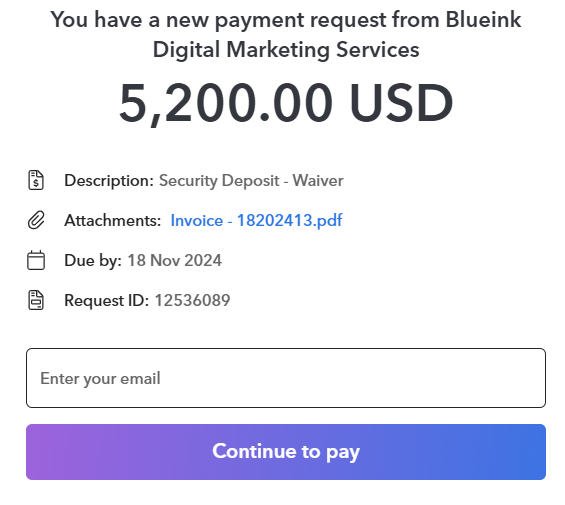
BlueInk Media Productions, aka Blueink Digital Marketing Services, aka BlueInk Media Solutions: This outfit was presented, variously, as the literary law firm that would hold the “security deposit”; the expert that would process the waiver of commission along with the author’s payments; and the provider of other fee-based services, including book trailers and registration seals. Below are the invoices the Zenith author received after the commission was knocked down to 4%, or $9,200:

In an unrelated complaint, a writer reported that they were referred to BlueInk by Calyx to purchase “engaging and detailed book reviews” (supposedly because publishers require them with submissions). Cost: $300 each.
OWG Production Co aka OWG Digital Marketing Services: After experiencing problems making payments to BlueInk for processing of their “security deposit”, the Zenith writer was referred to OWG, which was said to be a subsidiary of BlueInk.

One of the Calyx authors was also referred to OWG for their International Literary Registration Seal ($500).
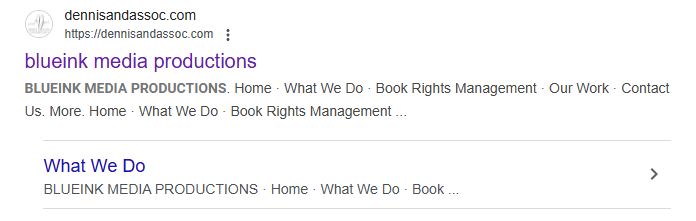
Dennis & Associates: When the Calyx author balked at working with OWG because they suspected it was located in the Philippines, they were referred to yet another business name, Dennis & Associates. But…oops. Someone forgot to change their metadata.
MACCAP LLC: A California LLC first registered in September 2021, this is the holder of the wire transfer account for payments to BlueInk.


Thanks for this blog. I was recently approached from an email address that seemed to be Penguin Random House and cautiously played along until the 4K requirement for blue ink media to prepare a Separation of Rights Order. Now that I’ve read this blog, I recognize the wording and process that was used to approach so many others.
Glad you found my blog! The “separation of rights order” is a newer version of the longstanding book licensing scam: https://writerbeware.blog/2024/04/05/the-scam-of-book-licensing/
I was scammed by Marian Lewis, editor, and Nick who was looking for authors for Amazon. Called Amazon to verify. Never heard of them. Bank stopped payment. I cont’d to get calls from Nick.
Back in the day (like, 50 years ago), new writers had to be wary of what was called vanity publishing (but, many fell for those scams, and by the way not sure the word “scam” had even been invented yet). Now, between the consolidation of so many publishing houses, the growing lists of imprints, self publishing, hybrid publishing, the scam artists are flourishing in ways most of us have never even thought of. This is why your resource, and others, are so important.
The system of agents being the only one who represent the author is crazy, and it leads to many kinds of scam
No.
Using “BlueInk” is really terrible, as https://www.blueinkreview.com/ is very reputable (for editorial reviews, have used them myself).
So new authors might very well have heard of BlueInk and have positive feelings towards it. Though absolutely not connected with these scammers.
Thanks for all you do. AM
These Filipino cons should turn legit and become real literary agents.
They are such hard workers.
But I imagine they are addicted to the hunt for marks and psychically feed on suffering, as well as materialistically on the money.
A vampire by any other name.
Gosh, a writer works awfully hard and then to have to beware of these scammers. As an aside, one of the biggest scams going on for writers right now is AI who has accessed the books of many authors– mine included — from a place that pirates the books of authors and then sells them to the AI technocrats who are trying to teach AI to write like said author. Author’s Guild is trying to put a stop to this and it’s in the courts but the AI technocrats are claiming Fair Use — for the whole book. Amy Atwell has a newsletter that is covering this scam.
Yes, my books are involved, as are most people’s. Authors Guild has a form you can sign here:
https://actionnetwork.org/letters/authors-guild-author-letters-to-ai-companies/