

NOTE: This post has been updated to clarify that the five-year post-publication window for copyright registration is a limit on benefits (beyond five years, registration is no longer presumed to provide prima facie evidence of copyright ownership) but not on the ability to register (per the Copyright Office’s Circular 1, registration can be made at any time during the life of copyright).
A couple of years ago, while searching the US Copyright Office’s public copyright registration database on behalf of an author wanting to know if their copyright had been registered as required by their book contract, I decided on a whim to check my own copyright registrations.
I hadn’t felt any need to do so before. While smaller publishers generally leave it to authors to register their copyrights, for larger houses it’s standard for the publisher to register on authors’ behalf, at the publisher’s expense. Most of my contracts have been with imprints of big publishers. No reason to doubt they’d followed through, right?
But when I looked at my registration record, I realized that one book was missing: my YA historical, Passion Blue, published in 2012 by Skyscape, an imprint of Amazon Publishing. Skyscape hadn’t registered copyright for this book, even though the contract stipulated that they should; and now, several years beyond the five-year post-publication window in which registration provides evidentiary benefits, it was too late to do anything about it.
Confession: when something like this happens to me, it always sends me right to issues of self-worth. Obviously Skyscape didn’t consider me important enough to bother fulfilling its contractual obligation. Rationally, of course, I knew it was probably just an unfortunate oversight. An isolated incident, in other words, the sort of occasional falling-through-the-cracks thing that can happen to anyone.
Except…it doesn’t appear to be occasional at all.
In response to the impending settlement in the Bartz class action lawsuit against the AI company Anthropic over its use of pirated books for AI training, authors have been checking their copyright registrations, since the class is limited to authors whose pirated books had their copyrights registered within five years of publication and before being downloaded by Anthropic (in the USA, as in other countries, you own copyright from the moment you write down the words; but unlike other countries, the USA makes registration a pre-requisite to any kind of copyright-related court action). And increasingly, authors whose publishers were supposed to register for them are discovering how often their publishers…simply didn’t.

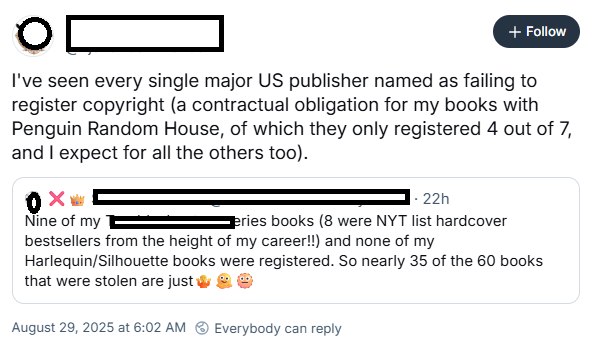
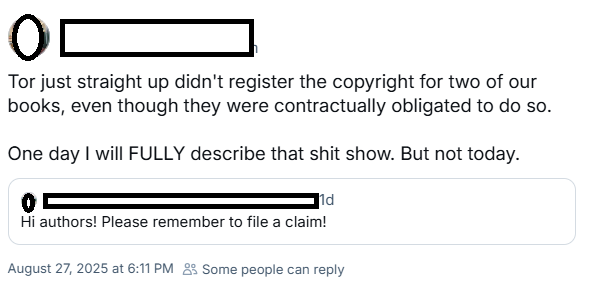

The above is just a sampling of the many posts on Bluesky about this issue. It appears that a problem any of us, checking our registration information, might have found infuriating but assumed was isolated or unusual, is extremely widespread.
In many cases, affected authors may not be eligible to join the class, or may not be able to join on behalf of all their pirated books, even if the books are within the five-year registration window–since per the court’s stipulation, copyright must have been registered before Anthropic downloaded the work. But in my opinion, registration is still worthwhile–for your general protection, of course, but also because there may be other class actions on AI training that you may be eligible to join.
Here’s how to find out if your books may be included in the Bartz class action.
Here’s the US Copyright Office’s registration database, where you can look yourself up and see if your books are registered.
Here’s the US Copyright Office’s online registration portal. Copyright is considered to be officially registered on the date on which all required materials, including the fee, are received by the Copyright Office, even if you haven’t yet received your certificate. According to this circular, registration processing time averages 2.1 months (given that the Copyright Office is leaderless at the moment, it may be longer). Note that the US Copyright Office is the ONLY place where you should register. There are plenty of predatory and scam companies that purport to register for you, but they charge exorbitant fees and may or may not actually submit an application.
Here’s Writer Beware’s resource on copyright, where you can learn more about copyright and when and why to register (including many myths surrounding this subject).
Now that this problem has been exposed, will publishers, realizing the extent of their lapses, be deeply chagrinned and change their ways? Stop laughing! Bottom line: don’t count on your publisher to timely register your copyright, even if your contract requires it. Always check.

I am self published author registered my book in 2023.
I received proposal from traditional publishersr expressing interest for acquisition of my book.
They required that my book need to have upgraded registration in order that commission goes to me, rather than original publishing company.
Is it legitimate?
No, this is a scam. Not only is it highly unlikely that a traditional publisher would reach out to you directly with an offer (publishers expect authors to come to them, not the other way around), there is no registration (or other) requirement to get published. I’m guessing there’s a fee for this supposed registration, which is another scam sign: there should never be a required fee or purchase as part of an offer by a traditional publisher.
Rebecca,
Thank you very much for this important post.
Confession: Every time I see an author’s post on copyrights, I study it for errors. I have vastly more experience with copyrights (well over 350 filed) and copyright disputes — I’ve won over $600k in 24 or 25 cases — than most rooms full of authors. And of those 24 or 25+ cases, I negotiated and wrote the settlement documents myself in the last 10. (Do not even think of doing this yourself without a copyright lawyer; I’m a special case.)
So I know stuff.
And everything about your post seems legally and factually correct to me.
Some details I would add: Registration at the earlier of these two dates is very important for reasons mentioned below: either before the infringement is discovered or within three months after publication. Do not wait beyond three months — ever.
A corollary of the sentence above: IF SOMEONE ELSE DOES YOUR REGISTRATION, CHECK IT AT LEAST A COUPLE WEEKS BEFORE THE THREE MONTHS IS UP, NOT LATER.
Timely registration that meets both of these deadlines entitles the copyright owner to the mysterious but extremely important thing called “statutory damages.” It also entitles the owner to collect legal fees from the infringer.
Statutory damages take the place of having to prove actual damages. This is very important to writers –especially screenwriters because Hollywood accounting is so bent that a movie grossing $100 million on a purloined screenplay might show a loss on its books and be able to argue that the actual damages (lost profits) were therefore zero.
Regardless of what the P&L says, the judge (or a settlement) can get the writer some fat cash with statutory damages.
Also, proving actual damages entails a huge expense in copyright experts and lawyer fees.
Reimbursement for legal fees puts pressure on guilty infringers to settle. Most of my defendants caved in rather than spend to defend themselve in court. This was patially because I had a privately-held company and they couldn’t tell whether I could afford the legal fees (which can easily be larger than the damages).
Next-to-final word: the most expensive copyright lawyer is probably the least expensive lawyer. If your work has been infinged, never go for a cheap lawyer who is not a copyright expert. A big defendant will suck you and your general-practice lawyer into court and start running up the legal fees. That is, if they don’t cause you to just give up and go off and weep.
I’ve done it both ways. Lost a ton of money on my first big infringement case (25 infringements per year for five years, defendant with deep pockets) by using the wrong lawyer, then won a ton with a great one.
I was later able to negotiate settlements of my own because I learned tactics from and used the documents from this great lawyer as models (and because I’m a relentless and hate-filled but focused adversary when stolen from, and I have experience writing federal laws. Yes, in one career, I wrote federal laws.)
Final final word: Unless you already have a contract assigning the copyright to the publisher, always file the copyright yourself and do it in a timely manner. If you’re sending queries, always copyright before you send the content to anyone — even your Mom. It is a simple thing to then assign copyright to a publisher.
Although there’s lot of of popular advice to the contrary, in my opinion there’s no pressing need to register copyright before a work is published. Infringement really only becomes a concern when a work is exposed to a wide audience (i.e., published); and for writers concerned about the submission process, reputable agents and publishers won’t risk their reputations by stealing (which, again, is a crime), and disreputable agents and publishers and scammers aren’t interested in your work at all, only in your money. Go ahead and register your unpublished work if you want; but it really isn’t necessary.
Writers whose work has been infringed should know that there’s an alternative to an expensive copyright lawsuit: the Copyright Claims Board, on which I and other Writer Beware team members have written a number of blog posts. The CCB allows creators to bring cases with a value of $30,000 or less for a small initial fee ($100) and without needing to hire a lawyer (highly paid or otherwise). More information can be found here.
My novel is copywritten for protection!
Can anyone recommend Tauk children’s books publisher? New on here ..sorry couldn’t find where to ask.?!
Ugh, turns out two of my books (same publisher) have not been registered. What a pain.
My publisher didn’t register 4 of my qualifying works Finally did in 2023. I could be out 12k because of their failure. And they kept doing that. Just found 3 more. What a kick in the pants.
I’m so sorry. It’s really shocking how common this is. I don’t think anyone even remotely suspected it was a problem.
Grrr. Looks like the publisher didn’t register my novel like the contract said.
They tell you it’s 2-3 months to get a registration once you submit an e-copy of your book (6 months if you decide to submit two actual copies of your book, and the price is almost doubled: $65 for e-copy, $125 for hard copy).
That’s the time before you receive your registration certificate, a fine-looking document. For a correct registration, your copyright date is the date you file.
Could you perhaps do a ‘Taylor Swift’ with your back catalog titles missing registrations? Just publish a new edition-2025, maybe add a Forward or Afterward, and complete the registrations on those versions…
Would not help with the Anthropic issue but should for the next time….and there will be a next time….
Help how?
So what you are saying is that you sign a contract handing over the rights. You get paid. And then you think that because the publisher failed to protect itself from the theoretical possibility of infringement by someone else, you’re going to try to take the work back from the publisher by filing copyrights for 99.9% the same identical content?
The Tayor Swift case is very different.
She did not own the copyright in the recordings that she sold to the original music company. She owned and still owns the copyright only in the written words of the songs. She then recorded new ongs using the same written words. The music company had the right to sell the original recordings of the songs (and continued to sell them) and she had the right to sell her new recordings.
She would not have had any such right if she had not retained the copyright in the words of the songs.
Also, her giant weight in the business and her huge marketing machine gave her marketing advantages for her new versions. So she could make her new songs out-sell the original recordings. A few years later, she bought the old masters back.
As a new author and working through searches and learn as you go, learned with my first book to never trust these jonny come-lately Self-pubiling publishers. I only used one on my first publish on a book manuscript I had already copyrighted through the U.S Electronic Copyright Office for $65.00. They were an absolute ripoff organization. They did not properly format my books. Did not complete my ISBNs (found that out that almost a year later when I had established an account with Bowker.) Bowker sent me a screen shot of the publishes account holding the ISBN registered numbers with the red incomplete marker on them. They also did not complete my LCCN correctly they left it registered wrong and incomplete. I did mange to get all of that squared away. First thing they tried to sell me in addition to the publishing service was a copyright for $500.00. I wouldn’t let one of these outfits touch my work again. I went through the process of learning, corrected the faulty formatting, updated the manuscripts and doing the best I could to square the first book away myself.
Since that time I have managed to learn enough to continue doing all of my publishing work myself. Hiring my editorial people, formatting my books – correctly in print, eBook and now do all of the foot work for pubilishing my audiobooks, hiring a human narrator, doing final sound file edits myself and publishing them myself. It’s not that hard, but there is some time and dedication involved. Don’t rely on these people, they charge way too much, and do shoddy incomplete work. Once they get your money and your work it’s a crap shoot from there, and they will continue to pump you for as much money as they can convince you to spend. Avoid these legal scammers.
This is actually one of the easiest steps I made in the course of my manuscripts. Register your account and follow the instructions. I have the hard paper copyrhight registrations in my files for everybook I have copyrighted as well as the scanned files locked away on my server, my PC, and held in the files of my publishing email acount.
https://eservice.eco.loc.gov/eService_enu/start.swe?SWECmd=Start&SWEHo=eco.copyright.gov
$65.00 and a little filing work, that’s it the U.S. Copyright Office has your copyriight registered and will snail mail you a copy of your vertificate.
OMG, neither of my books can be found on that database!! I tried searching in several different ways, and came up empty!!
He didn’t register my copyright. When I questioned him, he told me with an ISBN they were no longer necessary. I said, that’s not how it works. He told me he’d get back with me and threw me under the bus.
Thank you for calling attention to this and summarizing it so well. As always.
What an excrement exhibition.
Parents, discourage your children from chasing a writing career. They can’t win. They are up against a perfect organism that will outlive them.
I admire it.
To adults who are still chasing a writing career, you have my sympathy.
— Ash the android in Alien. Paraphrased.
For authors who have self-published but not registered, how long after publication can one register? All my searches so far on this question get me lots of false positives and no answers.
Thank you so much for this post. I’ve just sold reprint rights to an out of print book, and my new publisher and I have been thinking we might not (barring revisions) need to re-register. It turns out my previous publisher did not comply with this contract provision.
My understanding is that the five-year rule applies to any published work. If you self-published without registering your copyright, then five years after publication is the deadline to register. It goes faster if you submit a digital file at the time of registration, but you can only do that with a work that was exclusively electronically published. If it was published in a physical form, print or audio CD, in the US or elsewhere, before you are applying to register the copyright, then you can fill out the application online, but you haver to follow up with a physical copy mailed to the US Copyright Office.
THREE MONTHS. NOT FIVE YEARS!
This is vital: the right time to register is the earlier of three months after publication or before the work is infringed. Failing to meet those deadlines, even while meeting the five-year-rule, puts you in an awful legal position while only MAYBE* preserving your prima facie presumption that it’s yours. The best time to register is immediately after finishing and before you show the work to anyone. Do not listen to any advice contrary to this. See my long post in this thread for the key legal reasons.
*MAYBE: Let’s say you wait four years after publication and someone stole it the day you let it out of your exclusive hands four years earlier. Then the crook immediately filed for a copyright. You will then have to prove (in court, while paying legal fees) that the first copyright filing was not valid. Whose filing should the judge be inclinced to trust when you waited four years?
Registration within three months of publication is optimal, since it ensures that you’ll be able to collect statutory damages and attorneys’ fees in the event of infringement (otherwise, you can only collect actual damages, which are harder to prove). But it’s not correct that registering later fails to preserve prima facie evidence of copyright ownership. Section 410 of the US Copyright Act ensures that it does:
“(c) In any judicial proceedings the certificate of a registration made before or within five years after first publication of the work shall constitute prima facie evidence of the validity of the copyright and of the facts stated in the certificate.”
In the very unlikely event that a thief bothered to make their own fake copyright registration (which by the way is illegal and could incur penalties), the thief and the real copyright owner would have to battle it out in court (with the real copyright owner, presumably, being able to provide evidence of ownership the thief couldn’t, such as drafts, correspondence, research notes, etc.). But that unusual circumstance doesn’t change the fact that registration within five years of publication provides prima facie evidence of ownership.
Additionally, although there’s lot of of popular advice to the contrary, in my opinion there’s no pressing need to register copyright before a work is published. Infringement really only becomes a concern when a work is exposed to a wide audience (i.e., published); and for writers concerned about the submission process, reputable agents and publishers won’t risk their reputations by stealing (which, again, is a crime), and disreputable agents and publishers and scammers aren’t interested in your work at all, only in your money. Go ahead and register your unpublished work if you want; but it really isn’t necessary.
Great post. I hadn’t realized that trad publisher registration was so spotty. Of course, if the publisher didn’t register a book, they won’t get their share of the settlement award either.
It’s definitely too late to register most copyrights to qualify for the settlement and difficult even to determine which can be. Registration has to be “within five years of the work’s publication and which was registered with the United States Copyright Office before being downloaded by Anthropic, or within three months of publication.” SFWA was informed that the books in question were downloaded by Anthropic in 2022 or 2023. To add to the confusion, the list of books in the searchable list at the Atlantic website is not definitive; the official list will be released in early September, as I understand it.