

I always try to keep track of the stories I write, and to update my posts when new information comes to light. Sometimes, though, it’s worth re-visiting the stories themselves–as in the two cases below, where “bewares” that appeared to have resolved return, unhappily, for a second go-around (or seem to).
Harper’s Bazaar Short Story Contest Rights Grab Redux
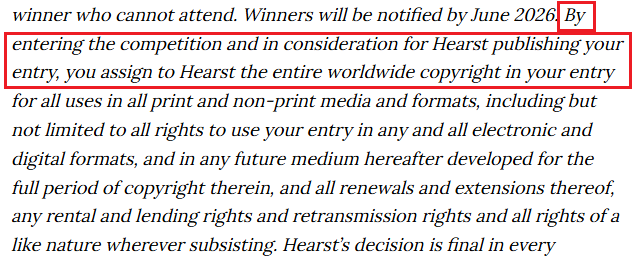
In 2019, I wrote a post about a rights grab in the guidelines for the annual short story contest conducted by Harper’s Bazaar magazine, the wording of which included a surrender of copyright. Here’s what I wrote at the time (Hearst is Harper’s parent company):
The bolded language isn’t completely clear, at least as I see it. Read narrowly (by entering and in consideration for publication, i.e., as a consideration for publication only), it requires the winner or winners only to surrender their copyrights and all the rights that copyright includes for zero financial compensation. It could also, however, be read more broadly, to indicate that merely entering the contest constitutes a surrender of copyright ownership.
The latter would be a hell of a predatory rights grab. But even if it’s just the former, it’s not good: you should never have to give up your copyright as part of winning a writing contest. Either way, it’s hard to see how holding copyright, even just to the winner’s entry, benefits Hearst above simply licensing publishing rights. And contest guidelines should not be so ambiguous that you have to struggle to interpret them.
For whatever reason, Harper’s had a change of heart that year, and removed the copyright transfer from the guidelines. When I checked back the following year, the copyright grab also wasn’t present, though other rights language raised some concerns (see the update to my post).
I didn’t think to check back again until today, thanks to a tip from a reader. The 2026 contest is open for entries, and the copyright grab is back in the guidelines, worded exactly as it was when I saw it in 2019–and, also as then, buried in the middle of a lengthy block of italicized text where entrants’ eyes could easily skim right over it:
I posted a thread about this on Bluesky, noting the ambiguity mentioned above. Helpfully, several people with legal knowledge responded that indeed what’s meant is not the maximalist grab of copyright on all entries, but rather a copyright transfer limited to the winner only.
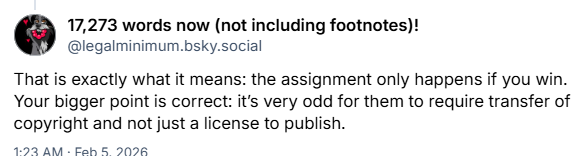
Again, there’s no major benefit to Hearst to hold copyright rather than simply claiming limited publication rights for a story that will probably only ever be published in a single magazine (if it’s published at all: the contest guidelines promise winners only “the chance” of publication). So even if it’s just the winner who loses their copyright, it’s still a bad deal.
A reminder, yet again, to read the fine print–every word, even if they make it hard for you with tiny font or garbage formatting.
IT LIVES!…Sort of: America Star Books, nee PublishAmerica
This may not much resonate with my newer readers. But for longtime Writer Beware fans, as well as writers who got their start in the early days of the digital publishing revolution, America Star Books, and especially its original incarnation, PublishAmerica, is a storied name.
Launched in 1999, PublishAmerica was an author mill and de facto vanity publisher that didn’t charge upfront fees, but turned authors into customers via constant incentives to buy their own books and purchase an enormous variety of nonsense “marketing” products.
PA quickly became notorious for deceptive advertising, horrible quality, abusive treatment of authors, and the sheer brazenness of its sales pressure (this should give you the flavor). Writer Beware published dozens of blog posts about its shenanigans, as did other anti-scam activists on websites that are now sadly gone. The Absolute Write Water Cooler hosted multiple discussion threads about it, including three “neverending” threads totaling more than 45,000 posts. Complaints and warnings piled up online (google PublishAmerica to see what I mean.) Two class action suits were filed against it (both, unfortunately failed). Multiple authors filed individual lawsuits and arbitrations.
In 2014, possibly to dodge the reams of bad publicity it had accumulated, PA re-branded as America Star Books. (When I wrote about the name change, it sued me and other Writer Beware staffers for defamation–thankfully it did not prevail). Inside the company, though, trouble was building, with major discord between the two founders, who in 2015 filed dueling lawsuits against each other for various alleged wrongdoings, and a trio of liens filed in 2016 by the state of Maryland, where PA/ASB was based.
In 2016, PA/ASB stopped accepting submissions. Then, in summer 2017, ASB’s URLs stopped working. Its bookstore site became non-functional and its social media vanished. By September, it was clear that ASB was dead: vanished with no official announcement and no return of rights, leaving royalties unpaid and authors high and dry. My lengthy blog post chronicling the demise can be seen here. (I later learned that ASB didn’t end badly for everyone: founder Willem Meiners sold his Maryland house, re-located to Maine, and published a book.)
This recap only scratches the surface of the PA/ASB saga. But what does it have to do with the present day?
A reader recently tipped me off to the fact that the America Star Books website, which lapsed in 2017, had reappeared at the old ASB URL, americastarbooks.pub. Someone apparently re-registered the URL in 2022, and, per the Wayback Machine, a website had been online since then.
How had I not known this? Of course I had to check. Courtesy of the Wayback Machine, here’s how the website looked before ASB closed down in 2017.
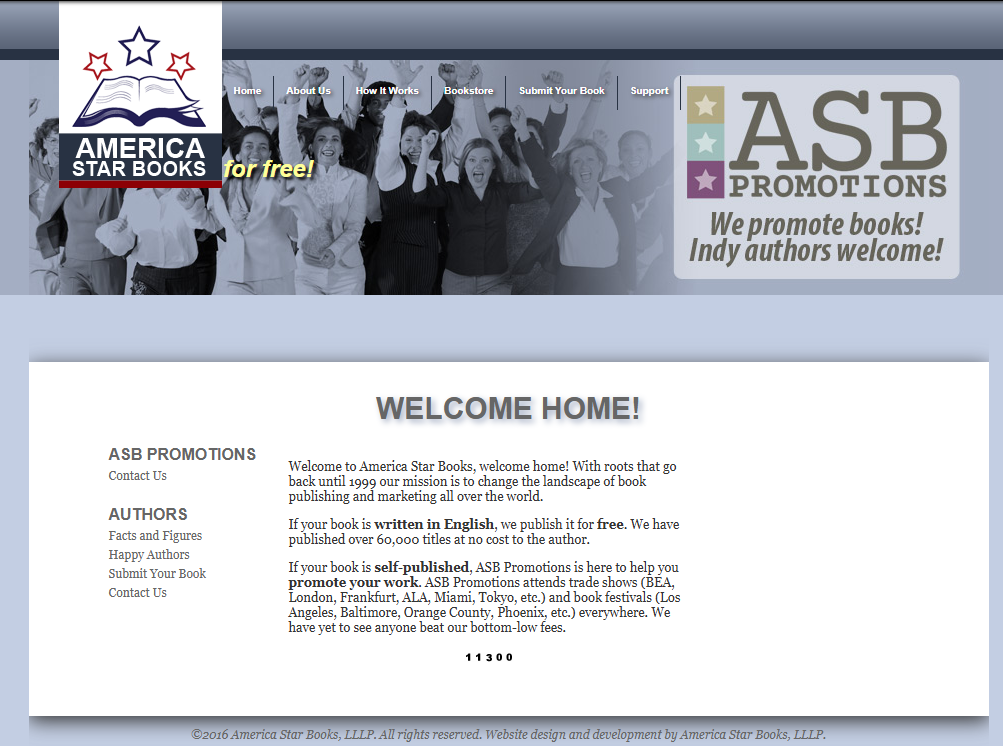
Here’s how the new site looks today.
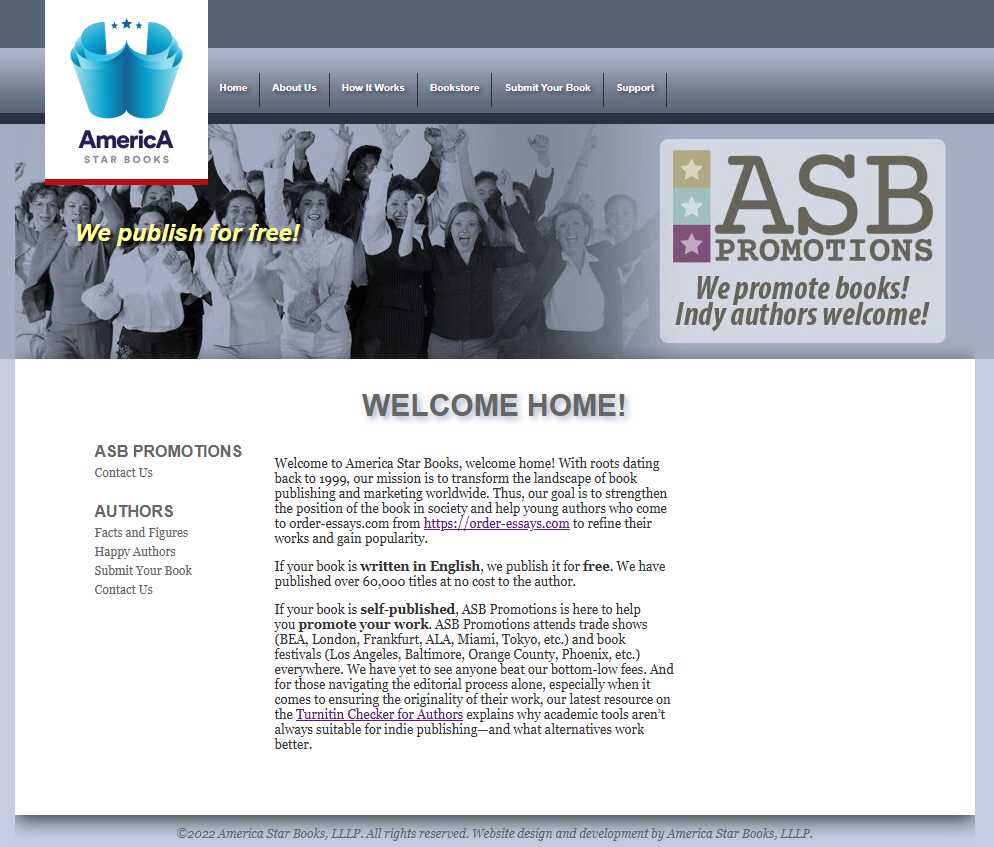
New logo and some extra text, but otherwise the same template. The links in the left-hand menu don’t work, but the links in the top menu go to pages that are also copied, more or less, from the old ASB website template.
So what gives? Could it possibly be that the original PA/ASB miscreants, or people related to them, or maybe even some scammer from overseas, has reanimated this notorious trash publisher, hoping to use it, once again, to rip writers off?
Fortunately, no. The clue is in the second image above, where a link to an essay-writing service is incorporated into the first paragraph, and a link to a “plagiarism checker” appears in the third paragraph. Similar links are scattered throughout the site. So it looks like the new ASB is really just a sort of Trojan horse for advertising scammy websites. It’s a bizarre choice, but who can fathom the mind of a fraudster.
Disappointing, in a way. I’d relish taking down PA/ASB all over again. But better for writers.
If you have vivid memories of PA/ASB, please share them in the comments! And I can’t sign off without mentioning the Atlanta Nights hoax, in which the worst book possible, created by a group of speculative fiction authors (including me) who each contributed a horribly written and/or nonsensical chapter, was submitted to PA to test its claim of selective acquisition. Read more, if you’re inclined, here.

So happy you do this. Awful to think there are people out there messing with artists dreams. Thank you.
Thank you very much for your wonderful research.
Pub America should just give it up. No one who knows anything about them will submit work to them. They are crooks of the first order. Why do they think changing their name will make a difference?
Don’t ever trust a Hearst. Just don’t.
Just read a few chapters of Atlanta Nights! 😂😂😂
What a fabulous hoax.
Thanks, Victoria. You’re a star. But the copyright snitch is terrifying, esp. for ADHD-diagnosed authors (we’re rubbish at reading the small print). XXAlice
Interesting that they’re not accepting submissions befire the end of 2016 (that is not a typo)
Ah, ATLANTA NIGHTS. It actually takes work to write that badly.
(Chapter 10, BTW.)
For our investigations at WritersWeekly, we have found lots of old, defunct publisher websites that have been purchased by overseas scammers. It’s funny that they tend to buy the ones that were also scams in the past. That’s not too smart! What is more common, however, is scammers buying a website domain name that is eerily similar to a legitimate publisher’s website. They even steal the logo. (Impersonation scams.) But, if you look close, the URL is slightly different from the real one. And many of them are spamming authors from Gmail email addresses. We caught a scammer using the WritersWeekly name and logo on a different Facebook page. It’s funny that Facebook won’t take down scammers’ pages, even after multiple reports but, if you submit a trademark infringement complaint to them, it’s only takes two hours for them to take the page down. That shows they have the ability to quickly take those pages down, but they don’t because Facebook is making money from the scammers running ads. We’ve covered that heavily on our website as well.
I’ve seen this too, with the purchase of defunct domain names by scammers. Also I’ve seen scammers take advantage of situations where an existing company (for example, a production company) doesn’t have a website at all, setting up their own fake versions. Although they also do this for existing companies that _do_ have websites: I’ve seen at least two fake Macmillan websites, for example.
It is possible to figure out the fakery by various means (checking domain registrations, doing websearches that will turn up the defunct company) but many writers don’t know to do this, and a well-made, but totally fake website is easily taken at face value.
I had a book published by PA in 2007. I was relatively unscathed. They did my cover, which I liked. I found a major typo later and they fixed it for subsequent POD copies. Despite their pestering, I purchased relatively few copies–most of which I still have, I marketed it myself and even got spots on radio shows. But, if nothing else, it showed me that no matter how hard an author might self-promote, it is equivalent to trying to sell copies of the book on the street to strangers. You really need the help of a publisher or the funds to hire a marketer.
This.
“But, if nothing else, it showed me that no matter how hard an author might self-promote, it is equivalent to trying to sell copies of the book on the street to strangers. You really need the help of a publisher or the funds to hire a marketer.”
Which is why I laugh vomited guffawed when I read the guidelines at Hellbound Books which in essence asked, “What are YOU (the author) going to do to promote your work?”
Me? I was going to ask YOU (the publisher) that question.
I would also add that promoting your book is like knocking door to door, handing out religious cult pamphlets.
Speaking of religious propaganda, there is a special place in hell for publishers who
(fault interrupt)
(Catcher in the Rye tone flagged)
(accessing)
(scanned)
(refresh)
Sometimes I really wonder where those pond ducks go in the winter. They have to go SOMEWHERE.
It is very interesting to me that bigger, well established publishers can be just as offensive as brand new, clueless indie small press publisher hacks that portray themselves as legitimate, educated and knowledgeable publishers of first rate fiction. (Excrement)
Go to everlasting hell, Hearst Harpo Bizzaro, along with the non-paying, rights-grabbing small press jackasses who act like they are doing authors a favor by allowing their work to appear in their inept crappy uninspired projects.
Am I angry much?
You … really … have … no … idea. 😃
I EXPECT such things from stupid small press tyrants…
But assigning worldwide copyright to Hearst?
DELUSIONAL!!!!!
I WILL PUBLISH MY WORK ON A PRIVATE WEBSITE AND THEN HARDCOPY PRINT ONTO TOILET TISSUE, AND SET BOTH MY COMPUTER AND THE SACRED CHARMIN ON FIRE FIRST, HEARST.
Jesus wept.
(breathe)
In happier news I was published by Keith Moon’s daughter in The Nocturnal Lyric in 1998.
I seem to recall her being very polite.
(reminiscing)
That was a positive interaction with small press. She exhibited more professional courtesy than these parasitic “big player” publishers pushing insulting contracts toward eager authors.
Everytime I get a handle on my anger, something else pops up and I just go effing berserk.
It is an admirable quality when Billy Jack beats the HOLY MOTHER OF GOD HELL out of a town full of racists though, isn’t it? We cheered him on.
While my self-righteous fury is considered “uncivilized.” “Immature.” “Not reflective of our company’s policy.”
(heh)
HEARST KNOWS WHAT THEY ARE DOING.
That, by definition, is malevolent behavior. Intentionally harming the author by DEPRIVING THEM OF ANY POSSIBLE FUTURE BENEFITS.
Is that fascism? Communism?
Or just good ol WARPED MUTANT MONOPOLY TYRANNY?
They and their legal team(s) are NOT just some startup amateur independent jerkoff with a new podcast wanting all your rights.
Hearst is methodical and will happily march you straight to the ovens if you later dare proceed to use that work elsewhere.
“We have his signature, Your Honor.”
The question should not be “what is Spliced Celluloid raving on about? What a loon.”
It should be, “why aren’t more authors upset about these copyright grabs and setting their PCs on fire like defiant Buddhists?”
😃
In other good news, I heard four new episodes of MST3k are being created this year.
Thinking of four new Mike Nelson episodes does my body and mind good, and my blood pressure achieves a certain monk-like reverie. Temporarily.
Back to anger issues. An old girlfriend once, very accurately I think, pointed out my problem: I possess a kind of samurai holy warrior syndrome mentality… A physical sense of right and wrong, that in this round hole modern world, is a completely square peg of unacceptable behavior. At least in the U.S A.
Meanwhile, CEOs snigger quietly to themselves, usurping anything they touch, via legalese, corrupt lobbying, and just bad behavior.
Oh, but LOOK!
I won a contest!
SOMEBODY SHOOT ME
I got hooked by PublishAmerica too. My first experience of the publishing world.
I almost feel like I’m at a recovery support group meeting:
“Hello, my name is Sam and I’m a former PublishAmerica author.” 🙂
Back in the late 90’s I was pretty much learning how to really write, and even had some short stories published. I tried my hand at writing a novel, and by the time I finished the second one I thought it was time to try to get it published. In 2003 I sent my sci-fi time travel novel in to Publish America, thinking they were a traditional “small press” publisher. They accepted it, I was overjoyed and it came out later in that same year… I don’t need to tell you how this story ended.
I had to design my own cover, and they did a cursory edit (and I was honestly too green back then to notice that), and believe me, that book needed a *real* editor (as well as a re-write). Anyway, my book came out, I had to market it myself, I was strongly encouraged to purchase a fair number of my books (I don’t even remember how many but I still have half a box of them in a closet). The story itself was a good one, and I even got some good reviews that mentioned that, though I also got my fair share of “this needed an editor” reviews as well.
I made some royalties, but never got back what I spent on the books, and as I learned more about them, the stigma of having been published by them felt like a black mark on my writing resume. Now, I usually leave that experience off my query letters altogether.
On the positive side, it was a learning experience into spotting scams. Seven years later all rights to my book returned to me, and since that time I did re-write it with the skills I honed over the years, and gave it a thorough editing. In the meantime, another of my sci-fi books was picked up by an actual small press publishing house and that came out last October (in many ways, it feels like my first *real* novel publication). However, it’s still my intention to one day have that first novel published again to vindicate it in my mind (however, it’s very hard to get even small presses to look at reprint books).
Also on the positive side, before I realized how horrible PublishAmerica was, I managed to attend two conventions in 2004 as a guest author, and that was a fun experience I hope to repeat with my newer works.
Anyway, thanks for letting me vent, and I truly hope PublishAmerica/America Star Books stays under that rock where they are hiding.
Of course I immediately went in search of the text of ATLANTA NIGHTS, and there it is. It stinks like a dead goat’s armpits. Great job, all.
Thank you!