

This is yet another Writer Beware post about allegations of royalties long left unpaid. But it’s also about the challenges of work-for-hire arrangements, and what can potentially go wrong when intellectual property repeatedly changes hands.
The Complicated Background
The BattleTech and Shadowrun franchises–which included both games and novels–were originally developed and published in the 1980s and 1990s by FASA Corporation, a publisher of role-playing and board games. FASA closed down in 2001, and the two franchises were transferred to a new company called WizKids, founded by former FASA employees.
In 2003, the Topps Company, which manufactures trading cards and other collectibles (and candy, including the iconic Bazooka bubble gum), acquired WizKids and its IP, in a bid to expand its entertainment holdings. Topps closed WizKids down in 2008, citing economic factors; it subsequently sold WizKids and its IP to the National Entertainment Collectibles Association, but retained rights to BattleTech and Shadowrun.
Topps itself has changed hands more than once; it’s now owned by digital sports platform Fanatics Inc., which acquired it in 2022.
The Dispute
In 2016, Topps signed new contracts with two authors and two authors’ heirs for a total of fourteen books in the BattleTech and Shadowrun universes, written between 1996 and 2003 and published originally by FASA or WizKids (you can see all four contracts here, here, here, and here).
As with most novels produced for media franchises, the original publishing contracts were work-for-hire, with the publisher owning the copyrights. The new Topps contracts supersede those original agreements, with no gap between old and new (the old contracts are said to have “remained in full force and effect up until the Effective Date” of the new agreements, and also to have terminated as of that date) and no rights under the old agreements reverting to the authors. The copyright assignment “is deemed to apply retroactively to the date of initial publication of the Works by Publisher’s Predecessors”.
Language in the new contracts alludes to disputes between the authors/heirs and the original publishers, involving royalties and other matters:
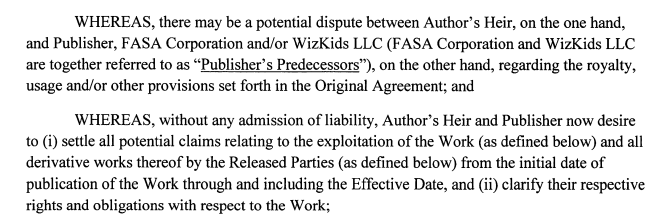
There are also payments to the author or heir of one-time fees (Clause 7.a.) as “full and complete settlement of any Claims” up until the effective date of the new contracts; and a clause releasing Topps and its predecessors from all claims and liabilities, and barring the authors/heirs from suing Topps or its predecessors for any claims under the old contracts, including for “any failure to report or pay royalties under the Original Agreements and/or the unauthorized licensing of rights beyond the scope of the Original Agreements.”
All of which makes it at least somewhat ironic that the same authors and heirs are now suing Topps for non-payment of royalties under the new agreements.
The lawsuit, which can be seen here, alleges breach of contract, claiming that Topps has failed to report or pay royalties for any of the contracted books for 2022, 2023, and 2024, despite “repeated demands” (note the additional allegation in #19 below, which points to delinquency on the part of the original publishers):
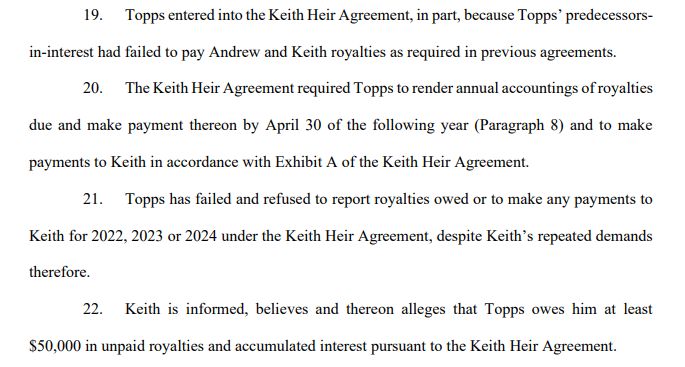
Each of the authors/heirs make similar allegations. Overall, they estimate that they are owed at least $200,000 in unpaid royalties, and are asking the court to award monetary damages of at least that amount plus interest, compensatory damages of at least that amount plus interest, and the authors’/heirs’ attorney fees and expenses.
What’s Next?
The lawsuit was filed last August in the Supreme Court of New York County, and service was acknowledged in October.
Since then, there doesn’t appear to have been any movement in the case, with no response as yet from Topps. (Case documents are public record and can be accessed online; click the Case Information link in the right-hand menu and then paste in the case index number, which can be found in the top right corner of each page of the lawsuit.)
Work-for-hire is an area of publishing where exploitative contracts and poor treatment of writers is all too common. In this case, the repeated transfers of IP and the apparent failures of the original publishers make the situation even more complicated.
I will keep an eye on the case and update this post as information comes in. If you’re a BattleTech or Shadowrun author with complaints similar to those in the lawsuit, please reach out to SFWA or contact Writer Beware.

Hi. I just wanted to publicly thank you/Writer’s Beware for all the work you are doing. I get your emails, they’re very very helpful, well researched, including this one. Shanaz Sukhdeo
Appreciate the kind words–glad you’re finding the posts useful!
Great work Victoria-as usual you shine a light on fraudulent and suspicious activity in the course of defeating evil and raising justice_ blessings abundant to your valiant prowess.
Thank you!
Let’s cut to the chase and become attorneys. Income will be guaranteed and earnings will be much higher than the earnings of 99.9 percent of the population who identify as authors.