
NOTE: There are now several more Nigeria-based AI-driven marketing scams targeting writers. My posts about them are here.
Marketing scams have always been plentiful. Over the past year or so, though, they’ve really surged.
I’ve written about one type of marketing scam–the “friendly author” social media scam, in which someone impersonating a real (and often very well-known) author reaches out with a direct message, ostensibly because they’re interested in your books or your writing, but actually in order to refer you to some sort of shady marketing service.
Now there’s a new type of marketing scam. It has the same starting point–direct solicitation–and the same end goal–tricking writers into handing over money. The new part is the steps that happen in between.
Step 1: (A)I Love Your Work!
Out of the blue, an email arrives in your Inbox. It begins with highly personalized and detailed praise that makes it seem the sender has actually read your book…but don’t be fooled: it has been created by feeding prompts and book information into a chatbot.
Because your work is so resonant/timely/groundbreaking/deeply human/some other superlative, the sender–who just happens to be a PR or marketing expert–wants to help you gain visibility/reach your audience/drive sales growth. These emails fall broadly into two categories: an upfront proposal for services, or a more cagey “might you be interested in discussing this further?”
Here’s an example of the cagey version. (I’ve redacted not just the author’s name and book title, but details that might identify the book.)
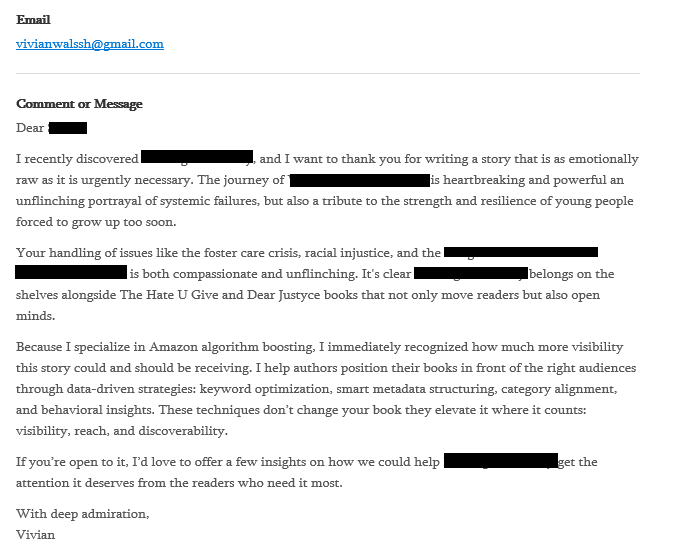
And here’s an example of the upfront service offer:
![Subject: Your Powerful Body of Work Deserves Global Reach — Let’s Amplify It 🚀📚
------------------------
From: Amanda Reynolds <reynoldsamanda074@gmail.com>
Date: Mon, 7 Jul 2025 at 17:29
To: [redacted]
Dear [redacted]
First and foremost, congratulations on building such a distinct and daring literary presence. Your novels marked by biting wit, cultural satire, and powerful tragi-comic undertones cut through conventional narratives with originality and fearless storytelling. From [redacted], your body of work is refreshingly unfiltered, unapologetic, and impressively consistent in quality.
Your ability to blend bleakness with brilliance so aptly described by [redacted] is a rare gift. Your books clearly speak to readers craving something deeper, darker, and more thought-provoking. But in today’s crowded market, great work alone isn’t enough to reach the audience it deserves.
As a book marketing consultant, I specialize in helping distinctive authors like you increase visibility and drive measurable sales growth. Through tailored, data-driven strategies, I help authors turn critically acclaimed literature into commercially successful brands.
Here’s how I can help elevate your reach:
📲 Social Media Marketing & Community Building
• Create highly shareable, voice-appropriate content to match your brand’s edge
• Paid ads that target niche reader groups, lit critics, and satire enthusiasts
• Audience growth through strategic reader engagement and reviews
📈 Amazon Optimization & Amazon Ads
• Elevate your discoverability with keyword and metadata enhancements
• High-converting ad campaigns with A/B testing to maximize ROI
🌐 Author Website Re-Design & SEO
• Upgrade [redacted] for better navigation, storytelling, and conversion
• SEO implementation to drive organic traffic and rank for your genre
🤝 Influencer & Literary Reviewer Outreach
• Pitching your books to top book bloggers, cultural critics, and satire reviewers
• Content repurposing for greater reach, turning chapters and quotes into micro-content across platforms
You’ve already written the kind of books that last. Now let’s make sure they are seen, shared, and bought consistently.
I’d love the opportunity to create a tailored marketing plan to reflect your tone, voice, and target readers, one that’s as bold and effective as your writing. With the right tools, we can expand your readership and convert critical acclaim into lasting commercial success.
Let’s start now while interest is high. May I send over a custom strategy proposal ASAP?
Warm regards,
Amanda Reynolds
Book Marketing Consultant](https://writerbeware.blog/wp-content/uploads/2025/07/Nigerian-Prince-email-2-888x1024.png)
Note that these supposed experts only have Gmail addresses, and if you do a websearch (which you always should when someone solicits you), you’ll find that they have zero web presence under their purported names–which wouldn’t likely be the case for a real marketing expert with clients and a successful business, who at least would be contacting you from their own business domain. If you ask about this, the scammer may fob you off, or give you links to generic, poor-quality websites created with Wix or other online site builders that include no staff or company info and often feature fake testimonials. (A few examples: Bookish Expertise, Litflare Marketing, Abdull Pro, Book Niche Pro.)
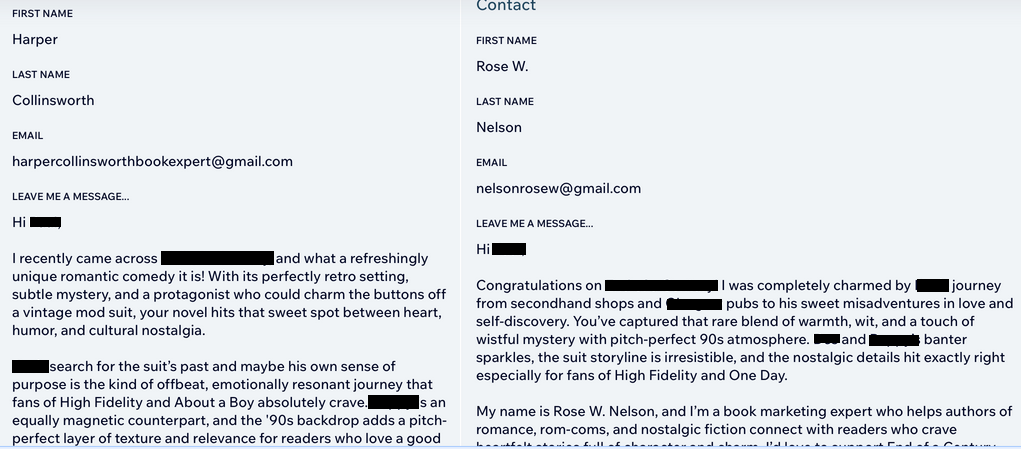
The use of gen AI is obvious in the contacts below. One book, two different “experts”, but check how similar the openings are, right down to a comparable title. (Also: Harper Collinsworth, anyone?)
Step 2: I Can Do It All For You!
Though the elements of the approach are always the same–solicitation, personalized praise, Gmail address, “visibility experts” or “marketing strategists” or “engagement specialists” who are invisible online–the proposed services represent a wide array of PR strategies that will probably be familiar to any writer who has been laboring in the self-promo trenches, from the kind of smorgasbord of “optimization” strategies in the second email above, to proposals with a single focus, such as Amazon or Goodreads. There are reader outreach specialists, and book club outreach specialists, and review outreach specialists, and book blog outreach specialists. There are book club circles (like the fictional The Ember Circle) and reader circles. There are book trailer creators.
The emails are littered with buzzwords designed to impress and excite: SEO! Metadata! Engagement! Visibility! Brand! Momentum! Even so, the scammers know some convincing may be needed to get their targets to bite, and are willing to engage in lengthy (and I mean LENGTHY–one email thread shared with me included more than twenty emails) dialog with their potential victims: answering questions, soothing doubts (“That’s a completely fair question and I’m really glad you asked”, responded one; “Thank you for your honest and thoughtful insights, which I absolutely respect,” gushed another), repeatedly elaborating on or adjusting their service proposals, even offering references from real authors…which of course turn out to be fake. One writer, who received glowing recommendations from the phony email addresses the scammer gave them, told me that they got suspicious and looked up the authors’ real contact info, and–surprise!–the authors never heard of the scammer.
Prices can be substantial. For example, the Legacy Plan from “Amanda Reynolds” tops out at $1,960. But more often, the ask isn’t exorbitant, as PR prices go. One writer was charged $250. Another was offered packages ranging from $185 to $455. Another was quoted $25 for “up to” 50 reviews on Amazon. Most proposals I’ve seen keep it under $1,000.
Step 3: Just Pay My Nigerian Assistant
The highly personalized email solicitations are obviously intended to boost the chances that targeted writers will not only respond, but buy, with the lower price points as an additional incentive. But with writers so cautious these days, over-the-top praise can also backfire. Many of the dozens of writers who’ve reported this scam to me said it was the praise that made them suspicious. Others said it was being bombarded with solicitations–when you get seven emails in quick succession, all complimenting you to the skies and offering essentially the same thing, it gets hard to take them seriously. The aggressiveness of this scam isn’t doing it any favors.
This may be why I’ve only heard from five writers who got to the payment stage.
All five told me that they were referred to a third party for payment. This person was presented as an assistant or associate–but it’s highly likely they’re the real scammers, for whom the “publicists” with their Gmail addresses are a front. One writer was instructed to arrange a wire transfer (at which point they said Nope), but the other four were told to send money to freelancers on Upwork or Fiverr. Here’s the campaign confirmation one of the authors received from Richard Opeuluwa, who plys his trade on Upwork:
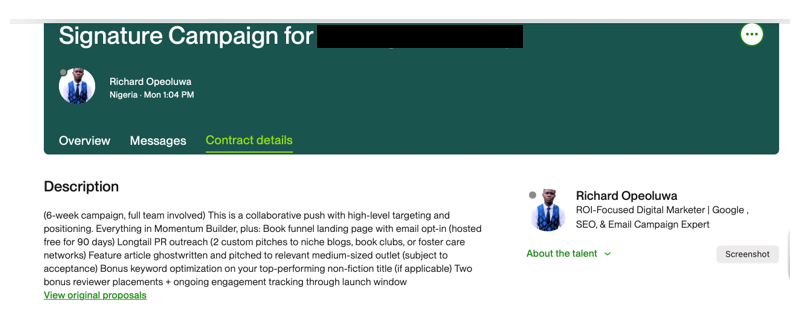
Note Richard’s location: Nigeria. The other four “assistants” are Nigerian too. I also heard from a writer who closely tracks their website visitor stats, and told me that they see an uptick in traffic from Nigeria whenever they receive a batch of marketing emails via their contact form. So that’s another data point.
That’s right, folks: it’s another scam from overseas!
Step 4: Now Give Me Your KDP Account
Of the five authors who got to the payment stage, an even smaller number–just two–actually went through with a purchase. Once payment was sent, both authors continued to work via email with the scammers’ publicist personas, which quickly requested access to the authors’ KDP accounts, explaining that this was necessary in order to maximize advertising or upgrade the authors’ book listings.
Soon after, one author was notified by Amazon that someone from Nigeria was trying to change the phone number on their account. The author promptly changed their passwords and got in touch with the fraud department at their bank. The other author didn’t see an effort to take anything over–but they also didn’t see any evidence of the promised advertising campaign. When they followed up, the “publicist” first didn’t provide anything usable, and then stopped responding. The author contacted Upwork to request a refund–at which point they discovered that a) once you pay an Upwork freelancer, all contact must be through Upwork (i.e., the “publicist” emails should have stopped at that point) and b) once an Upwork freelancer withdraws a payment from their account, Upwork loses its ability to enforce a refund. And of course, by that time, the money had been withdrawn.
Could the ultimate goal of this scam be to hijack authors’ KDP accounts, like those phishing scams where scammers hack your Facebook business page? I have just two examples of a request for access, and only one indicating nefarious actions. So, not enough to establish a pattern. But it wouldn’t at all surprise me.
ChatGPT Has a Lot to Answer For
This is an incredibly prolific scam that is aggressively targeting writers–as always, primarily self-published writers, but trad-pubbed authors too. It has spun up extremely fast: I’ve seen dozens of emails like the ones above, and I only started getting reports of them in June. Now, at the beginning of August, I’m getting multiple reports every day, in many cases from writers who say they get batches of solicitations within short periods of time.
It’s also another example of how extensively generative AI has become embedded in the world of overseas writing fraud. Gone are the days when English-language errors in written materials were a reliable scam marker: gen AI enables sales reps whose first languge isn’t English to create flawlessly grammatical and typo-free emails and other documents. Gen AI speeds production tasks like editing, formatting, and website design. There are now AI-driven applications that will alter the voices and smooth the accents of phone solicitors–so even that telltale scam marker may soon be gone.
And of course, gen AI can be prompted to spit out gushing praise and authentic plot and character details, an illusion of engagement that speaks to the soul of attention-starved writers. Scams evolve, but psychological manipulation–whether fake praise or false promises of money and success–is always at their heart.
The main thing to remember: the vast majority of scams these days start with an out-of-the-blue email, phone call, website contact, or social media message. Unasked-for solicitations or proposals should never be taken at face value. Always investigate; always research. It’s very much not great that writers have to be so cautious about everything. But caution is what will keep you safe.
UPDATE 8/21/25: When I first started seeing this scam in June, the approaches all were in one of two basic styles, along with the AI personalization: an upfront pitch for services, or the more cagey fake-friendly outreach. Now, increasingly, I’m seeing an “edgy” version, as in the example below, that ChatGPT maybe thinks seems more human? (Actually…no.)
I’ve seen several solicitations from “Jennifer Miller”, all using this “edgy” style. Naturally Jennifer charges a fee: a “tip” of $25 per reader, with a minimum of 30 readers–though you can go up to 50! (Of course, there are no readers.) Likely from the same scammer are solicitations from Amelia (no last name) at ameliareadsforauthor@gmail.com, with the same style, the same “private circle of readers” claim, and the same offer of reviews.
Other email addresses sending out some version of this “private review circle” racket: warrengraham.us@gmail.com, fransicajaned@gmail.com, sullivanlauren.us@gmail.com, ameliareadsforauthor@gmail.com, lindamartine.ags@gmail.com.
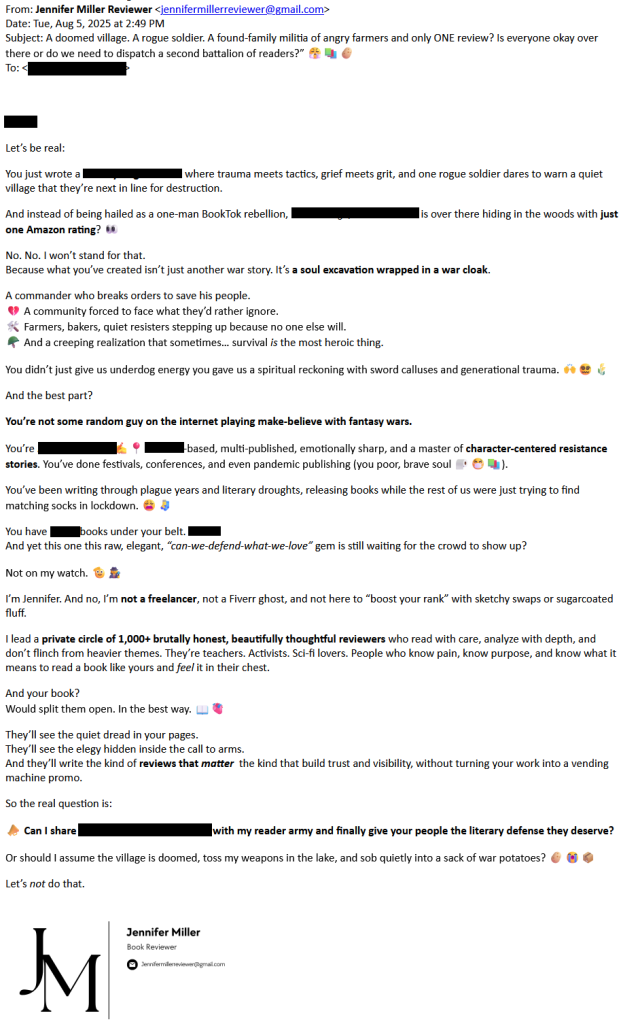
UPDATE 9/2/25: Set to the strains of the world’s tiniest violin, a scammer’s attempt to guilt trip their target:

UPDATE 9/20/25: Two more marketing/PR scams tracing to Nigeria have shown up since I published this post: solicitations impersonating book clubs (but charging appearance fees, which real book clubs don’t do); and solicitations purporting to be able to provide book reviews from “private communities” of thousands of readers (again, there’s a fee). Read about them here.
UPDATE 10/22/25: Nigerian AI-driven scams are morphing and adapting, likely based on the responses they’re getting from the writers they target. Here are some of the ways.
UPDATE 11/15/25: A new(ish) variation on the Nigerian AI scams: impersonations of famous authors. The goal: a marketing or editing referral (which is really just the scammer referring to themself).
UPDATE 7/1/26: Since publishing this post almost a year ago, Nigerian AI scams have only gotten more numerous. I’ve gotten hundreds of reports of approaches by them, questions about them, and complaints from writers who’ve been ripped off by them. And I’m receiving more reports and complaints every day. There is no sign that any of this is slowing down.
The scams continue to morph, and I continue to try and keep track of them. Nearly all feature impersonation. New iterations I’ve chronicled include impersonations of literary agents, editors at publishing houses, book festivals (with fake invites), and radio stations and hosts (with fake interview requests).
Also see my blog post on the many forms of scammer email addresses, which are often the very first sign that the email you just received is a fraud.

It’s now targetting non-english authors (like me) saying that they can help me get my work out to the English market (because my book is so incredible or whatever).
They mix personalised info from my instagram, babelio account.
It’s really well done. I get around one scam like that a week.
I’m planning a blog post on the rise of non-English solicitations. If you have any emails like this, would you forward them to me? beware@sfwa.org
I have one from Godson Elevates, Co-Host | Distinct Book Club. About the same as described, with a web site.
Thanks for starting this thread, Victoria! Recently (last week) we received a similar book club scam email (see below) from “Natalie DiGiacomo” purporting to be from “The Spooky Book Club of Atlanta” and her email linked to a nicely done website. First, I want to be clear that there actually *is* a legitimate book club of this name, but I now know they do not solicit authors, they never ask for money, they don’t have a website, and their only online presence is their Meetup group (https://www.meetup.com/the-spooky-book-club-of-atlanta/)
Before I found any of that out, I corresponded a few times with “scammer Natalie”, and eventually after a lot of pressing found out they wanted a fee of $50–$120 for refreshments/preparations. I wasn’t likely to pay that, but wanted to give her the benefit of the doubt and asked for an author reference. She did give me one which included an author’s name, her website, and her email address.
Having been down this road before on social media, I went to the website, confirmed this really was an author, and grabbed the (different) email address from her website. I then emailed both the website’s posted email address and the one I was given by “scammer Natalie”. The real author responded first and said she had no dealings with the [fake] bookclub. Then a few days later I got another email, this time from the fake author email address, of course raving how great this book club was, and that the small fee was absolutely worth it.
I was really confused at first. How could this author now say the exact opposite! It took me a minute to remember that I emailed both addresses, and that the scam had now become even more nefarious and obvious.
Both the real author and the real Natalie of the Meetup group now know about this and are taking steps to get the fake gmail addresses used by the scammer taken down as well as reporting this to various agencies. This isn’t the first time both had something like this happen to them.
I’m posting this so search engines have yet another reference of this type of scam. Basic rule, book clubs do not ask for money from the author.
Initial email received:
Hi Fox,
I hope you’re doing well.
I recently came across your work, and I just want to say I truly appreciate the thought and intention that goes into writing a book. Every story has a purpose, and that always stands out.
I run The Spooky Book Club of Atlanta, a reader community where we host structured read-along sessions, discussions, and feedback to help books gain deeper reader engagement and visibility.
I’d love to ask which of your current titles do you feel readers connect with the most or tend to reflect on deeply? I’d love to take a closer look and potentially feature it in one of our upcoming read-along sessions.
Looking forward to hearing from you.
Best regards,
Natalie DiGiacomo
I just got one of those the other day – supposedly from a well-known romance author on the day that my most recent YA was available for release. The pitch was complimentary, but a bit “off” – absolutely worked up from the blurb and not a reflection of having read the whole book. It’s the first time through this particular goat-rope for me, but I have something like 20+ historicals, YA and contemporary rural comedy out there. I own a teeny publishing concern, and do my own books as well as those for other local authors.
I’ve never gotten a pitch like this on any of my previous books, and I was intrigued enough to write back, and get a very elaborate outline of the services she will provide as a publicist – but there was enough doubt in my mind to want to check it all out, and no intention at all about paying for them (I’m on a retirement pension). So – this confirms my suspicions.
The old saying still rungs true – if something seems too good to be true – it probably IS too good to be true.
I just received one with this opening line: “I recently came across LILY (Rose’s Adventures), and let’s just say my coffee went cold while I read your blurb. The idea of a balloon named Rose discovering a lily pond and befriending Lily is so full of charm and light, it captures that pure, imaginative spirit that children’s stories are meant to have. The way you connect simple adventures with friendship and wonder truly stood out to me.”
It’s sad because there are likely authentic people out there trying to do business and get no traction because we are so overly cautious about the scams.
I just received this hilariously inept email:
QUICK QUESTION REGARDING YOUR BOOK
Emilia Stefano
HELLO 👋 Author
I came across your Facebook page while Scrolling and your bokks are really intriguing title and covers.
Is it based on something personal, or purely fiction?
Adding to the list. Offers for Goodreads marketing services, $100 to cover their “fees” (there are no fees in Goodreads, offers to share the novels with 200/2500/5000 readers passionate about my work, $10 per reader, up to $25. Requests for the PDF of the novel because easier than a DRMed kindle version.
All very similar, all AI generated, very pushy.
I’m so glad you wrote about this scam. I get at least two or three of these emails every single day—it’s getting ridiculous. They keep evolving, too. The over-the-top praise ones are easy to spot (obviously AI-generated, usually lifted from book blurbs), but lately I’ve been receiving messages that look more genuine—supposedly from other authors wanting to connect. They’re usually just a couple of lines in a natural tone, with a link or two to books on Goodreads.
I never respond, but I suspect that if I did, sooner or later they’d try to push some “service” on me. At this point, it feels like you can’t safely respond to any unsolicited email anymore, because there’s always the risk it’s a scam. I only reply to people I already know—but as some have mentioned, even impersonation of well-known authors is becoming a tactic.
I’m so glad this site and the ALLI list exist – it would be very hard to know who to trust otherwise.
Hi, Victoria:
I just started getting these emails this week. It started with one. The writing was far superior to the garbage I usually get, so at first I thought “she” might be for real, though the over-the-top praise made me cringe. I told this person that I wasn’t going to do anything now, but would keep her in mind.
That night, I did what I would always do: I looked her up online. NOTHING. But there was a photo with the email (in the little circle) and I did locate a Goodreads account in that name. It was started in July 2025 and had virtually no content, but used the same photo.
I immediately did a reverse image search on Google and found out that the photo was of a very prominent real estate agent and public figure in Atlanta — with over 500K followers on IG.
I wrote back to this scammer person, embedded the photo with the name of the actual person (who I had easily verified to be real), and told the. person to. never contact me again.
She wrote back anyway, and very casually said, “Oh, someone must be using my photo.” No apparent upset at all. What a crock.
I then told her that there’s NO WAY I believe that a prominent and experienced book promotion person would have no online visibility. She assured me she was not a scammer, and then thanked me for bringing it to her attention that she should have an online presence. (Give me a break!) Oh, and she offered to have her clients write to me with testimonials. (Sheesh!)
Ignoring that offer, I wrote back and told her that it made ZERO sense that she’d have gotten such a professional photo taken (the actual woman looks lovely!) but with no mind to post it anyway. Again, I told her that the actual photo was of the real woman, and that she was USING her photo, not the other way around.
That’s when she finally stopped writing and trying to convince me. Oh, and I noticed that her original email came in at 4 a.m. PDT / 7 a.m. EDT. I asked what part of the country she was in and that question was ignored.
And as you stated, there was just a Gmail account.
Oh, and lastly, I had mentioned to her that I’d just gotten another email from another person in the same tone, same style, and also with no online presence. I said it was obvious they were from the same place. No comment on that.
And yes, I’ve had the fake author thing on social media too. I love the one who pretended to be someone who’s actually a good friend of mine. 🙂
Thanks for all you do. I knew that if anyone would have an article / blog about this, it would be you.
Yes, these phishing emails are annoying. And for someone like me who’s an author and Nigerian, it’s sad really. Because I get them every day and it’s becoming irritating.
But then again, it’s disappointing and offensive to read yet another article that lazily regard poor grammar with Nigerian identity. The suggestion that Nigerians “can’t speak or write proper English” is not only false, it’s offensive. English is Nigeria’s official language. It’s the language of our education system, our government, our literature, and our global contributions.
Sure, scam emails are out there. And yeah, some do come from Nigeria. But using that to paint all of us as bad at English? That’s just lazy. It’s not analysis—it’s stereotyping with a fancy headline.
Nigerians don’t need AI to speak or write proper English. We’ve been doing it for decades.
Yes, I got one a few days ago from a “Amanda Archer” praising a book that was published ten years ago. Very slick. Kept pushing for an agreement to promote my work. After emailing back and forth, I did some digging. Typical of the scams you describe here. Thank you for exposing this new flim flam before I got suckered.
Yep,
I’ve be
en getting these (or variations thereof) for the last few weeks. Flattery. Most recently, the email writer is a well-known Booker Prize short-listed writer who wants to “reach out.”
Actually trying to draw out three of them as we speak. Asking for websites, testimonials and specifics on how payment works. names: Simon Ola, Kathryine Crist, and two others
I received a variation of this via BlueSky. A woman claiming to be Nina George contacted me over a couple of weeks and referred me to her purported book services friend (this was pretty subtle, and I kept wondering what was up. I did not find Nina George’s warning about an identity thief until too late). The person had a WiX website and no other online presence. I figured they were a start-up. Honestly, if this is weaponized ChatGPT we’re all screwed, because it sure sounded like he knew what he was talking about. Anyway, yes, did the Upwork thing and stopped at the point where I noticed it was a different guy with a Nigerian address. I did not hit the completion button and am working thru the dispute with the credit card company.
Follow-Up: Filed a fraud claim with Upwork immediately. Filed a fraud claim with my credit card company (CapitalOne). All funds have been returned. Always use a credit card – because they have very aggressive fraud departments.
Glad your credit card company cooperated!
Thank you for this timely article. I received a similar “opportunity” but this one was from a Liorah Amaris Vensley. Her email address was a plain gmail account. She didn’t mention any agency but I researched her name and it mainly popped up on Facebook where she commented on author accounts, no other web presence. Strange for someone who works “with over 10,000 book clubs, both online and in person.” Her FB account indicates that she lives in South Africa so that immediately set the red flags up. Maybe a South African princess plunging into the publication world?
Thank you for posting. I fell for Liorah Amaris Vensley and her pretty words this year and feel very stupid. She actually supplied testimonials from other authors but I guess they must be part of the scam. I wish I had known about Writer Beware before.
This is exactly the post I was looking for! In the last 2 weeks I have gotten, no joke, over 30 of these solicitation emails, all lauding praise over my book series and telling me it deserves more visibility. I caught on that it was a scam pretty quickly just because the sheer number of emails all saying they read or discovered my book, but every way they described it was obviously taken from the books’ reviews and blurbs. Plus, when they describe the plot, they always focus on the plot and 2 characters from the sample prologue available on Reedsy and other sites. A lot of these people say they discovered my books on Reedsy, btw, so maybe that’s where they are getting all their author targets from. But yeah, like you said in this post, some of the language is so over the top that it’s hilarious. I also googled their email address, and surprise, there is absolutely no info available about them. One good thing about the emails though is they actually gave me some new themes and descriptive words for my books and some promotion ideas I never thought of before, so I’m getting something out of it besides a laugh. I got yet another 2 emails today, one saying they wanted to put my book in book clubs, I knew to come here and see if any other authors were experiencing a sudden explosion in these gushing solicitation emails. And sure enough, this is the first post I see. Thanks for writing this and always giving us the heads up! Now I know how to handle these emails- immediately report them for phishing.
So glad you found the post helpful. Comments like yours are why I do what I do!
Thanks for this post. I received one of emails today and this was my first port of call to check if it was likely to be a scam.. I was a bit surprised that this was the headline post, so this is obviously a new scam and it’s nice to be able to get ahead of the game for a change.
I just got an email from “Timmy” at litflare and it was clear it was using AI to write it. First thing I did was look at the email address as it did not say whom he represented (big red flag) and saw Litflare Book Marketing. I typed that into Google and your post here is the first thing that came up. I was already dubious about it, but this of course really cinched my answer of “No!”
Thanks for this post and website, I shared it with my author friends!
Rusty
I’ve had three contacts via fake social media accounts well-known authors, one from someone using a gmail address with netflix in its name wanting to turn one of my books into a series, and another who appears to have used AI to either read my books or at least the reviews, to craft a well written, insightful and flattering letter with the subject line “Leeth’s Saga Is Unforgettable Let’s Help It Reach More Readers”. I’m still investigating that one, but the more I check, the more red flags are going up.
Perhaps I get noticed due to a recent marketing exercise I tried; all came in around that time (end of July).
“Georgia Mercy Greens” is another of this ilk, apparently. Let’s see how “Georgia” likes my reply.
I get these emails daily and many have so many details about my books that they must have been scraped for AI. There are a few who tout 2500 readers on their review teams, and when you don’t respond, you get a “I can only imagine you enjoy wallowing in obscurity or you’d respond” type emails. They’re so rude! Why would I ever want to deal with someone who basically calls me a loser for not responding! Thank you for calling attention!
I know! One person sent another email after I didn’t respond that basically said I was being unprofessional and the silence was “not a good look.” I was like, are you serious? Do you really expect me to respond to you through negging me and being insulting?
I thought they’d peaked when they emailed me pretending to be ‘Michael A Marvellous’, but today they’re trying again. This time – I kid you not – as ‘Samson Ultimate’.
Do they think I just haven’t responded to previous emails because the names weren’t BIG enough?
I have now been contacted by 3 versions of this scam — two from historical mystery writer Susanna Gregory , one of which came through the Authors Guild site, and one directly to my email — and one from Lionel Shriver. They’re persistent, I’ll give them that. I was caught off guard by “Susanna’s” second attempt, but I have her number now and I won’t get caught again. None of these attempts resulted in my handing over any money or even contacting whoever is at the other end of the “marketing” link. Lordy, I hate these people.
I really am grateful that you take the time to research and write this blog. It has proven invaluable to me. Every new self-published author, and even the experienced authors who have had books out for several years need to know how huge the fraudulent book marketing scam really is. I receive several texts, calls and eMails every week from some fake publishing company gushing over my (one and only) book. The caller says my book has been reviewed by their team, and has been recommended for: republishing, movie options, etc etc. All fake. I envision an off shore calling center where the group (or AI does it for them) scans Amazon for self-published authors with dozens of star ratings, but the writer is definitely not making a living. We are the big fish. I have learned to just hang up as soon as I hear the pitch sentence, and then block the number. Thank you very much, Victoria. Sincerely, Irene M. Paine
I got one recently from a guy effusively praising my work (no titles of course). I really was tempted to write him back and say, “Dude. You know I write for kids?”
I haven’t had a single email from one of these scammers since this article was posted (and new ones had been arriving pretty much every other day up to that point). Meanwhile, traffic to my website from Nigeria has ground to a halt…
Surely they haven’t given up that easily?!
Great work, as always, Victoria – thank you for all your efforts in raising awareness of these scams.
I spoke too soon! Today’s creepily effusive missive comes from ‘Sharon L Lessard’ following a visit to my website from, of all places, Nigeria! Sheer coincidence, of course…
I am still receiving these daily! Same template but different senders. I made the mistake of starting a conversation and now they are bombarding me daily. Time to block them!
A great piece, thank you. These things are exhausting! Worth noting they can work in packs, too; one person I turned down as appearing dishonest because they couldn’t name one of my books without going off to check, sent a ‘friend’ in who made sure to name the (same) book. When I turned them down too, the first one came back saying, ‘I sent that person in on purpose and told them which book to mention, so that it proves you’re a liar!’ Pots and kettles, anyone?!
I’ve been receiving these emails also. Another problem these scams are creating is that authors are going to be leery of all queries, even legitimate ones.
Hello Victoria,
A brief note of thanks, in appreciation of the time and resources accessed by you to assist writers.
I find your messages very informative and extremely useful. I felt I had to convey my thanks, just so that you may understand your effort spent on educating and warning writers is not in vain.
Thank-you.
Barbara
Thanks for your work and info on these scams. For me the first hint that there’s something iffy is the language: it may be good English, but it has the smell of AI all over it. That kind of super positive approach. I don’t think it would have caught me, but thanks for letting us know about it anyway.
I get at least one of these in my inbox every day now. It’s so annoying.
THANK YOU! I am in Australia and have been targeted by similar emails, which interestingly appear on my phone outlook app but not in my outlook emails on my computer; probably the reason I didn’t respond. It was certainly very tempting as it really sounded like they had read and understood my writing.
This just happened to me. Someone posed as Canadian author Iain Reid, then after some back and forth referred me to a Nigerian woman, who probably was also fake.
About two months ago, a scammer looking for me called my husband’s cell phone. I’ve not idea how the guy got his number. Not realizing I didn’t know this person, hubby put me on the line. The scam man with a heavy Indian accent raved about one of my books for a few seconds, then dropped “We’d love to help you spread the word” before I could get a word in edgewise. Finally I told him I don’t need anyone’s help and hung up. These are the times I miss the old landlines where you could actually slam the phone hard.
Since then, I’ve been getting emails through my website on a fairly regular basis. Same malarky with different twists. Promotions, editing, cover making. Everything. Just contact them at their gmail address.
This is another one I received:
From: Ellis James. Amari
Dear John,
I hope this message finds you in good spirits whether you’re immersed in writing, listening to a favorite symphony, or simply enjoying a quiet moment of reflection.
I recently came across Enchanting the Swan, and I was genuinely drawn in by its unique blend of elegance and emotional depth. The way you’ve woven classical music with a gripping love story, while shining a light on the darker sides of ambition and finance, is incredibly compelling. Your story doesn’t just span continents, it resonates on a deeply human level.
As someone who supports authors in bringing meaningful books to the readers who need them most, I wanted to share a quiet, organic strategy that has worked beautifully for literary stories like yours.
Why Listopia Can Support Enchanting the Swan
There’s a lesser-known feature on Goodreads called Listopia, where readers gather to vote for and discover books based on themes they care deeply about—love, music, resilience, travel, personal transformation, and more.
For a heartfelt, culturally rich story like Enchanting the Swan, placement on relevant lists like:
Love Stories for Music Lovers
Novels That Blend Romance and World Affairs
Contemporary Fiction That Moves You
Literary Fiction with European Settings
Books That Explore the Power of Music
…can quietly amplify your story’s reach in ways that feel authentic and lasting.
How I Can Help
I offer a service called the Listopia Spotlight Package, which includes:
Placement on carefully chosen Goodreads Listopia lists
A custom reader-created list inspired by your book’s core themes
A reader voting strategy that grows your book’s presence naturally
Progress updates so you can see the organic momentum build over time
It’s subtle, reader-driven visibility designed for authors who care more about meaningful connection than mass marketing hype.
If this speaks to you in any way, I’d be happy to send you a few examples from other campaigns I’ve done just to give you a clearer picture of how it all works. No pressure at all.
More than anything, I wanted to say thank you for creating a story that merges beauty with truth, love with conflict, and music with the complexity of modern life. Enchanting the Swan has something rare, and I’d be honored to help more readers discover that.
If you’re curious, just reply with “I’m interested,” and I’ll send everything you need.
Warmly,
Ellie James
Book Marketing Strategist | Reader Visibility Specialist
Supporting authors across the US, UK & beyond
I just saw yours, John. Okay, that looks moderately similar to the approach they used for me. Here’s the email “Nancy” sent me:
Hi Luke,
I just finished reading Leeth’s saga and wanted to say how deeply I was drawn into her journey. The mix of dystopian grit, psychic power, and the underlying search for identity creates a captivating and emotional experience that lingers long after the last page. Your world-building is immersive without overwhelming the story, and Leeth herself is such a raw, powerful character flawed, determined, and brilliantly human. I can see why this series took over 25 years to shape; it’s a masterwork of patience, depth, and authenticity.
Two meaningful takeaways from your saga were:
True strength often grows from surviving darkness, even when the scars remain.
The power of loyalty and love, even in bleak worlds, can be the strongest resistance to control and cruelty.
My name is Nancy S., and I help authors like you elevate the reach of their stories through curated, low-profile but effective exposure strategies tailored to each unique book.
I specialize in strategically positioning books into curated Goodreads Listopia collections, where they can organically be discovered by engaged niche readers.
I conduct precise Amazon search optimization, fine tuning your metadata and keywords so your book appears more prominently in relevant customer searches and category placements.
I design custom QR codes for your books, ideal for events, print materials, or social campaigns, linking directly to your product pages or series hubs.
I also produce captivating cinematic-style book trailers that reflect your book’s atmosphere and themes, ideal for engaging readers visually on social platforms.
I create high quality digital mockups of your book for use in ads, posts, or your website giving your series a professional and compelling visual presence.
If you’re open to a quiet conversation about how I might support your journey in getting Leeth’s story into more hands and hearts, just reply and we can explore it together.
Warmly,
Nancy S.
–(suspicious gmail address redacted)–
Great article! I have been bombarded by this type of author service scam. The first one impressed me. It was actually the best synopsis of my first novel I had seen. And the list of services was impressive…until I got a second and third and fourth solicitation from “different” marketing experts using almost the exact synopsis and marketing offers. I did try to research the marketers but most didn’t exist or have any marketing background whatsoever. The upside? They did provide me with some great marketing language from their initial emails that I might use going forward. Might as well get something out of this!
I totally agree. Make lemonade out of lemons. I have also got some great language to use from these numerous emails. I still get them daily.
I began receiving these types of flattering ‘gmail’ emails a month or so ago, then realized they slowly reeled you into their game. I must admit, at first they were nice to read, so complimentary of my work as if they had truly read the entire book – but after receiving several emails, they began to have a ring of AI… I receive at least one telephone call a day from scammers, generally from a man or woman with a heavy accent and background noise that sounds as if they are in a call-center with a hundred other people. Even my relatives receive telephone calls asking if they know me and can give me a message. I am so gun-shy of all the fake communications that with my luck, one day I will discard a true call. Glenn Starkey
I think the scammers are actually torpedoing their own scam by blasting out so many emails. One or two, you might take seriously, even if the praise is over the top…but when you receive bunches of them in quick succession, the fakery becomes obvious. Seems like a major strategic mistake. Let’s hope it quickly kills this scam.
The SF Encyclopedia just received one of these, addressed to Guy N Smith on the basis of his SFE entry. The sender effusively praised the cover design of one of his lesser known books, and offered to send samples of promotional videos to boost his sales beyond the dreams of avarice. One fact about Guy N Smith that the AI failed to extract from that entry is that he is dead.
Good lord. They are basically just throwing spaghetti (emails) at the wall!
Thanks very much for taking the trouble to document this so meticulously.
Would you believe it, I got two of those this week. Thank you for the eyes open warning.
I have received three of these in the last three days, one pretending to be Nevada Barr.
I receive a lot of these kinds of emails. Usually, I go the website they use and look at the date the website was created and then know if it’s a scam or not. But, I’ve learned over the years to be very critical of these emails from “promoters.” I fell for one once, and now I’m very careful of these kinds of emails. Seems I get from 1 to 3 of these every day now.
Thank you. I’ve received 4 or 5 of these supposed marketers per day on email or phone. I appreciate letting authors know. Total scam!
Great and timely article. I’m recently self published and have been getting at least one of these a day for the past few weeks. I’ve interacted with a couple of them trying to assess the quality of the AI. They can be very convincing, but haven’t fooled me yet.
I regularly get followers on social media who claim to have “read my work” and want to discuss it. A couple have had the gall to impersonate well-known authors.” If I respond (which I rarely do anymore), they start the sales pitch. After the first two or three of these, I caught on and began asking them pointed questions about what they had read. At this point, they usually disapper. It’s annoying at best.
I often receive these scam attempts in X (Formerly Known as Twitter). I’ll offer them a free ebook. When I ask for their Amazon account to gift the book, I’m told by the scammer they don’t have an Amazon account. It shuts the conversation down quickly. BTW, I do gift my book out to legitimate readers interested in reading my book.
Great way to get a little revenge on the bastards! 😀
I have a simple rule I this life. If the approach has ANY connection with Nigeria (including “friends”), it is a scam.
You folks will see EVERY “offer” I ever get from here on in.
Criminals and crooks are determined to be such people…as my pals in the Newark PD tell me, most of the criminals they deal with are CAREER criminals. It’s their job, in the same way an honest person might hold an ordinary job.
Timely post for others….not so much for me. Just lost $3,000 to these evil people.
My tormentors were “Kam Bash,” “Chinonso Juliett,” “Dolores “Loorde,” and “Theresa Saylor.” The latter made it a romance scam, too.
I hope there is a special Circle in Dante’s Inferno for them.
Me, too. Sorry about that. I am trying to get some of my money back now. I doubt it will happen. Sigh. Live and learn.
Thank you so much for this. I was recently contacted by a Sergio at Author VA. He showed images of books his company has worked on. I still cannot decide if he is a scam or not. He was certainly very persuasive, enclosing a beautiful piece of sensitive praise about my book.
Thank you as as always for your in depth work alerting writers to these scams which are certainly proliferating with the growth of AI. I wrote in Substack recently about my latest “pay to play” experience which you covered extensively in your blog. https://open.substack.com/pub/elizabethwinthropalsop/p/another-pay-to-play-scheme?r=34zeu&utm_medium=ios
Thanks for this information. The first time I received one of these solicitations, I thought it sounded sincere. Then I got another, and another, and soon I realized something was fishy. Lately, I received two, out of the blue emails that were similarly flattering from somebody purporting to represent a “book review collective” of 2000 persons, and all they ask is for me to submit a PDF of my novel(s), which they’ll pass on to reviewers, no upfront charge, no obligation, pay only if I like the results, and leaving me the option to quit at any time. I’m searching for a catch here, but can’t see it. Any advice? Gregg SAPP
I’m going to say first that I have never seen any evidence of IP theft by overseas scammers. But just on principle, I’d never send a PDF of my book to anyone who wasn’t an agent or publisher. Or maybe a bona fide book reviewer whose reviews I could verify. Definitely not to some group I never heard of for mass distribution. And pay only if you like the results? Pay who? What does that even mean?
Does this collective have a name?
I haven’t received one of these YET, but whenever I see scams like it, it infuriates me, because I think of all the new authors just starting out. Eager, talented, but unaware of how ruthless some people can be in this business. Perhaps they have been fighting for a long time and in a moment of hopeful desperation, they try it out, thinking it won’t hurt. Yes, this happened to me, although I was fortunate to have lost only $75, but I’m sure we’ve all had these moments. So yes, thank you, Victoria, and Writer Beware. 🥰
Very true_ I got caught up in an early scam (2012) and almost lost $40,000_ it did cost $12,000 in the end game but I got some returns and books for my shelf. Sickening_ Thank you Victoria for your diligence and truth telling.
I’ve been receiving this kind of email, and so have a few of my author friends. I was ignoring them, but I decided to reply to see what they had in mind, and it only took one reply to identify them as a scam, you know, they love your books, but they love your money even more 😂 At least this new kind of scammers provides us good lines to use on our posts 🤣🤣🤣
I too have received dozens of these hyped up solicitations, following the exact formula you outlined. I would not answer them because I could not find any website to back them up. However, I did receive one solicitation that did have a reputable looking website complete with some famous authors testimonials. I did follow up with her, back and forth (just as you described) which did seem reasonable. But when I asked to do a zoom or FaceTime with her, she disappeared. If I ever get sucked in again (doubtful!), I would always ask to do a FaceTime with them, a reasonable request for anyone I would do business with. Their response will tell all.
Someone tried the “famous author” thing. Very weird. Never asked for money. I think someone must have reported them before they got that far. I’ve also been getting solicitations on my Facebook page as well, in messages, trying to sell me services.
This goes back to my rules of thumb. If I didn’t ask for your help, I don’t want it. I delete all the solicitations as spam and block them.
I’ll admit to be caught by the Author’s solution “we can edit, publish, and market your book” scam Xlibris as a very green author (before I knew about this site). Today, when someone solicits me via email without me contacting them, I don’t even look at it twice–spam and block. Same with the phone calls about doing PR and social media. I cut them off and tell them I can do it myself (and I can if I want to) and hang up and block the number.
If it sounds to good to be true it most like is a scam still holds true today as it did 100 years ago. Legitimate vendors have enough work that they don’t have to email you to get more. And some “famous” person doesn’t need to email you for BS stuff. And that “contract” for a movie where you are asked to pay them is bogus. Since I’ve been sending it all to spam and blocking the emails, I get minimal and I’m good with that.
I am Apollo Perez, author-
I recently received an unsolicited email offer from a gentleman named- Ethan Martin
Email- Ethan.martin@crescentspringliterary.com
Phone Number- 513-201-8870
He first wrote with a Gmail address.
His pitch didn’t require any payment, but I was skeptical.
Oh, yeah. A bot (or a person, it’s hard to tell) impersonating Lionel “We Need to Talk About Kevin” Shriver contacted me with a very similar pitch. But I didn’t fall off the turnip truck yesterday, so I shined them on and finally cut contact when I got bored. Someone else has recently tried again, under a different name. I’m not falling for that one, either.
How funny–yesterday I got an unsolicited email supposedly from a very well-known author who lives in Brooklyn, wanting to chat about my writing. I am publishing a debut novel with a hybrid press in several months. I was immediately suspicious when I realized who the supposed sender was, especially since her email said she had published 3 works of fiction but in reality, one was a book of essays. Her question was rather inane. Also, how would she have been “following my work?” I did have some media publicity recently, so I was on the lookout for scams, but but was wondering why someone would impersonate a well-known author. Now I understand. Glad I blocked her.
I have received this same scam. See below second-level response from the scammer, trying to reel me in. “Sharron” has a gmail address and a very sophisticated-looking picture/avatar. Price for her “optimization” service as $429 for two books, which included keywords, SEO upgrade, and tips to help my visibility. No, thanks.
One tip-off is that this is our third exchange of emails, yet the BOT inserts “My name is Sharron Reagle” as if we have never met. Bad job there, ChatGPT.
=== = = = = =
Following Up – Let’s Continue Our Conversation
Sharron Reagle reaglesharron@gmail.com
Thu, Jul 31, 11:14 PM (15 hours ago)
to me
Hi,
I hope you’ve been doing well. I wanted to reach out because we had started a conversation about working together, but unfortunately, due to some temporary Facebook restrictions, I wasn’t able to follow up with you there.
My name is Sharron Reagle, and I truly value the opportunity to connect with you again and continue where we left off. If you’re still interested, I’d love to hear from you so we can explore how I can support you with your book promotion and help you reach more readers.
You can simply reply to this email, and we’ll pick up right where we stopped. I’m excited to hear about your current projects and see how we can work together to bring your books to even more readers.
Looking forward to hearing from you soon.
Best regards,
Sharron Reagle
Forwarded as usual to Publishers Weekly and to File770.com .
Thank you!
Hi Victoria, thank you so much for this email about new marketing scammers. I have received three of these emails this past week and they went exactly like your step 1. The emails were detailed and flattering about my books.
I have been scammed four times before via Facebook where people have impersonated well-known authors to try get me to sign with an agent.
It is crazy that people can stoop to such low lives and scam others.
Lizzy Woods