

For writers chasing a traditional publishing contract, an email from Big 5 publisher Simon & Schuster inviting submission might seem like a dream come true.
Just one problem: major publishers like S&S, which acquire mainly via reputable literary agents and expect manuscripts to come to them rather than the other way around, don’t email random authors out of the blue. Also, impersonation scams are extremely common these days, with fraudsters posing as publishers, literary agents, film production companies, even editors (see my previous post on this subject). Any publishing- or movie rights-related email or phone call that you can’t tie directly to a submission or a contact you yourself made is highly likely to be a scam–and with generative AI infesting every aspect of the writing scam industry, the scams can be quite elaborate and authentic-seeming.
Given the amount of time I spend writing and warning about such things, it’s always funny (well, kind of) when an impersonation scammer tries to target me.
The Bait
A few weeks ago, this landed in my Inbox.
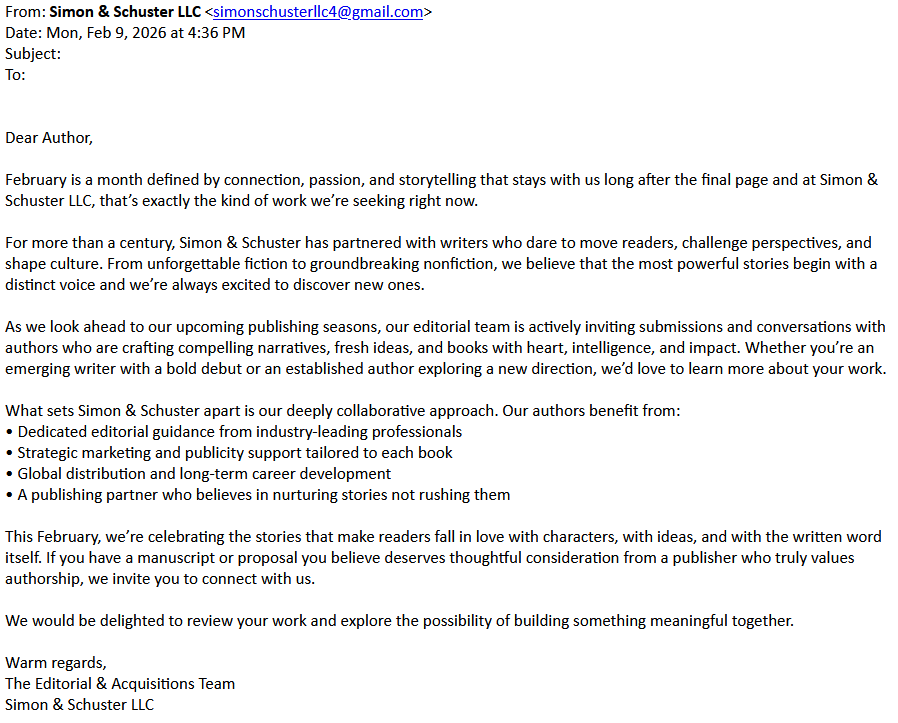
Beyond the two warning signs mentioned above, the email address is a huge red flag. A Big 5 publisher (or, in fact, any other publisher) would be emailing from their own web domain–not a Gmail address. (Gmail addresses are also a feature of a certain type of scam from overseas.) Nor does a publisher like S&S need to tout the benefits it provides as if it were competing for authors (which it very much doesn’t have to do).
I decided to have some fun.
“Tell me more!” I wrote back, in the guise of a first-time author. Within hours, I received an invitation to submit, along with a fairly standard list of information to include. (Another marker of fakeness: the response arrived at 2:22 am my time on February 11, but the timestamp in the header indicated that the scammer sent it at 8:22 am, also on February 11. Since both I and S&S are on the East Coast of the USA, there shouldn’t have been any time difference at all. That discrepancy, with the scammer six hours ahead, was evident throughout our email exchange.)
Here’s what I sent, attaching three chapters of an unmarketable trunk novel donated by a friend of Writer Beware for use in just such circumstances. As you can see, I didn’t try to make it convincing–nor did I delete my signature, which includes not just my personal website, but both of the sites I run for Writer Beware.
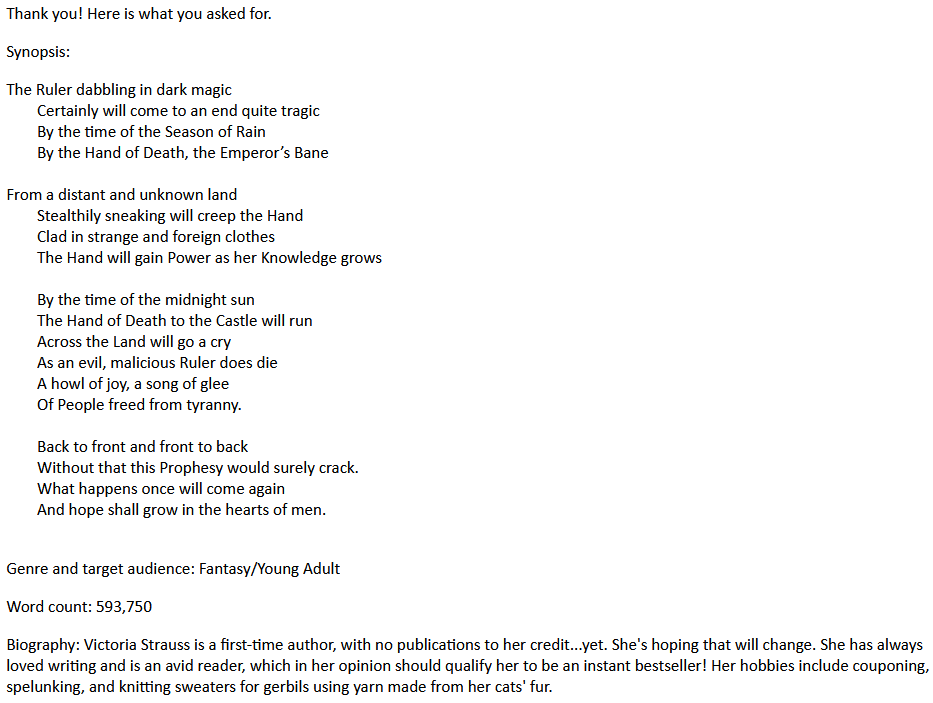
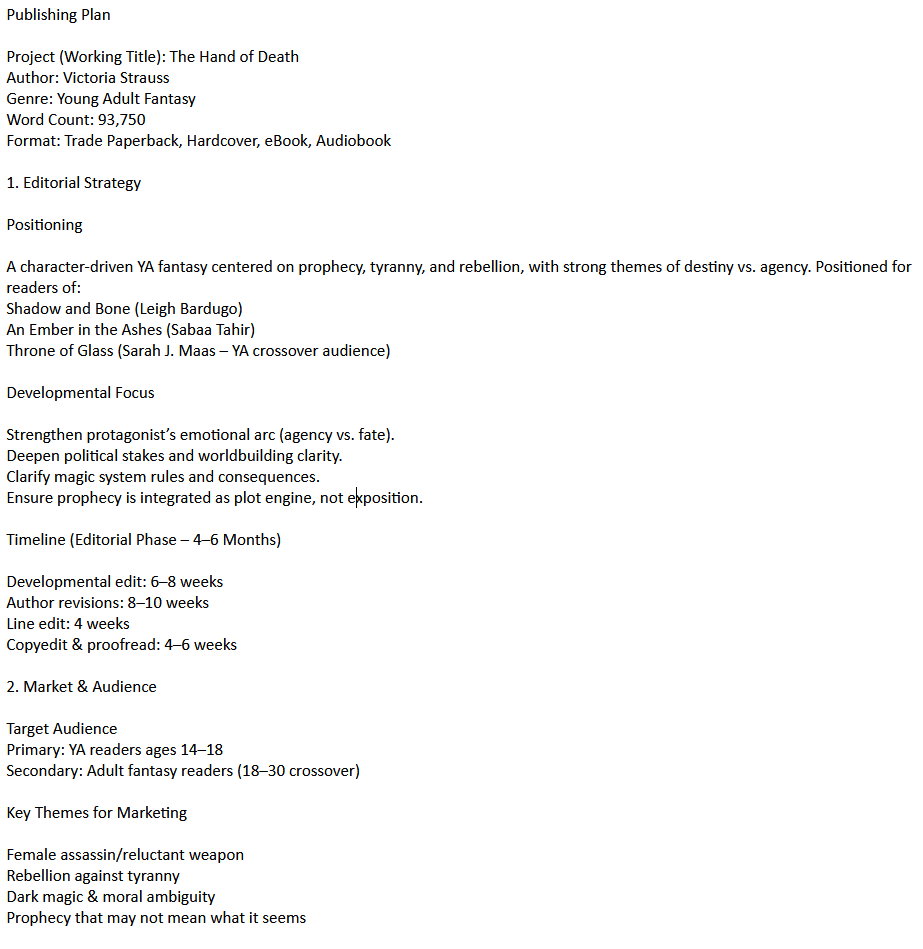
This is the kind of query that publishers (or agents) tend to immediately delete. But S&S loved it! Within hours I received–oh joy!–a publishing offer, plus an extremely elaborate “publishing plan” covering all the many things S&S intended to do for me and my terrible book: editing, production timelines, marketing and sales strategy, author platform development, series and movie potential, and much more. And the cherry on top of this very fake sundae: a $500,000 advance, guaranteed to make any newbie author’s head explode.
The snippet below represents less than a quarter of the email, but it should give you a sense of the level of detail. This kind of ornate confabulation costs the scammer nothing, since it’s all done with prompts and chatbots.
The Switch
Naturally, newbie writer Victoria Strauss was thrilled. “This is so amazing! Sign me up!” I wrote back. At which point the “switch” part of the bait-and-switch kicked in (note the ongoing time difference, with the scammer six hours ahead: this arrived at 6:54 pm my time, on February 11).
![Subject: Re:
Date: Thu, 12 Feb 2026 00:54:55 +o100
From: Simon & Schuster LLC <simonschusterllc4@gmail.com>
To: Victoria Strauss [redacted]
Which payment method works best for you? Would you prefer a wire transfer or PayPal? Also, please let me kknow the amount you're comfortable paying.](https://writerbeware.blog/wp-content/uploads/2026/02/Simon-Schuster-impersonation-payment-1.png)
Wait, what? Novice novelist Victoria Strauss was confused. Why would she have to pay? Wasn’t it true that traditional publishers never required authors to pay for anything? What was going on?
There followed a lengthy back-and-forth, with me asking innocent questions and the scammer trying to convince me that asking me to “invest” $200 to $500 in my literary future was actually a totally normal thing that S&S would do. Throughout these interchanges, they nudged me whenever I took a few hours to respond: how are you doing today? What do you think? Can we move forward with this now? This kind of pressure, along with claims of limited time or limited openings, is a common scammer tactic: they want to hurry you up so you don’t have time for careful thought.
Eventually they abandoned the traditional publishing pretense and admitted that what they were really trying to sell me was self-publishing–apparently expecting me to forget the elaborate trad pub plans and gigantic advance they’d initially promised. (Notice that the scammer is no longer signing off as “The Editorial & Acquisitions Team”, but with a probably fictitious name.)
![Subject: Re:
Date: Fri,, 13 Feb 2026 18:01:30 +0100
From: Simon & Schuster LLC <simonschusterllc4@gmail.com>
To: Victoria Strauss [redacted]
Dear Victoria,
I’m really glad you asked your question it shows that you’re thinking like a professional author.
You’re absolutely right that a traditional publisher such as Simon & Schuster does not charge authors upfront. In that model, they invest in a very small percentage of submissions and assume all financial risk.
However, that path is highly competitive and selective. Fewer than 1% of submitted manuscripts are acquired by major traditional houses. The alternative independent publishing done strategically and professionally allows you to move forward without waiting for gatekeepers, while still producing a book that meets industry standards.
The investment I mentioned is not a “fee to get published.” It is a targeted investment in professional tools that directly impact:
• Market positioning
• Editorial polish
• Metadata optimization (which affects discoverability)
• Professional presentation and credibility
• Distribution readiness
In independent publishing, you are essentially stepping into the role of the publisher. And like any publisher, there are production and positioning costs if the book is to compete seriously in the marketplace.
The key difference is this:
With a traditional publisher, they invest in you but you give up control, timeline, and a significant share of royalties.
With an independent model, you invest in your own project and retain control, ownership, and higher long-term earnings potential.
My goal is not to sell you anything unnecessary. It’s to ensure that if you choose to publish independently, you do so in a way that protects your credibility and maximizes your book’s success. Cutting corners in the early stages often costs more later in missed sales, poor reviews, or limited visibility.
If your goal is strictly traditional representation, I will respect that and can even outline the proper route for querying agents. But if your goal is to see your book professionally published and positioned within a predictable timeline, then investing in the right tools is often the most strategic and empowering choice.
Ultimately, this is about choosing the path that aligns with your goals, risk tolerance, and timeline. I’m here to support whichever direction you decide transparently and professionally.
Warm regards,
Zahara Page](https://writerbeware.blog/wp-content/uploads/2026/02/Simon-Schuster-impersonation-rationale-1.png)
The prices, which it took them another couple of emails to cough up, ranged from a fairly standard self-publishing starter package for $1,500 to an “elite bestseller package” padded with ripoff nonsense like “full author branding strategy” and “ongoing post-launch performance tracking” for $15,000. Yet another switch, since a few emails back they’d told me I’d be paying $500 at most.
The Reveal
I could have gone back and forth with Zahara/fake S&S much longer than I did (one of the hallmarks of AI-driven writing scams is the scammers’ willingness to engage in near-endless email dialog in order to keep the potential victim on the hook), but I have, you know, a life, and anyway it was no longer interesting.
So I asked, as I always do when I lead scammers on, for payment information, specifically requesting wire transfer instructions, since that forces them to hand over banking information. (Note: you should NEVER do this. Unlike credit card payments, wire transfers can’t be reversed…which is why scammers like them.)
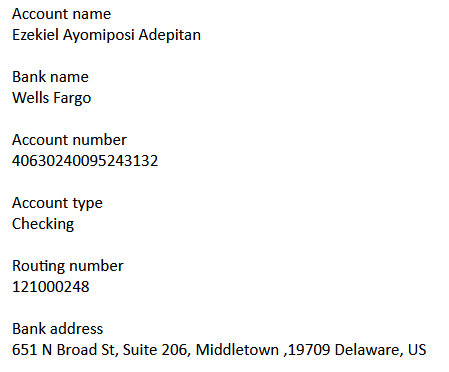
Requiring payment to a third-party, often described as a “financial manager”, is typical of AI-driven scams from Nigeria, which, per the many wire transfer instructions I’ve collected from scammers over the past months, favor accounts with Wells Fargo and to a lesser extent, Kansas City-based Lead Bank.
Additionally, the name on the account is Nigerian; and remember the six-hour time difference? Nigeria is six hours ahead of the US East Coast, where I am. An additional indicator: the +0100 that follows the timestamp in the emails above. It identifies timezones that include West Africa, and can be a useful, though not infallible, way to estimate where a scammer may really be located (since most scammers from overseas have fake US, UK, or Canadian business addresses).
Remember I mentioned the nudging? Fake S&S “followed up” three times in the two days after they sent the payment information (AI scammers often keep pushing for a tedious amount of time, even if you refuse their offers or tell them in no uncertain terms to buzz off). Their final message:
![Subject: Re:
Date: Fri,, 19 Feb 2026 12:03:47 +0100
From: Simon & Schuster LLC <simonschusterllc4@gmail.com>
To: Victoria Strauss [redacted]
Oloribu ni oo ni Victoria](https://writerbeware.blog/wp-content/uploads/2026/02/Simon-Schuster-impersonation-insult.png)
Which Google Translate says means “It’s a disaster”, but the wider internet suggests is a harsh Yoruba insult. So maybe they figured it out?
At any rate, it was time to terminate this small adventure. So I blocked them.
Generative AI is Making Scams Worse
I had fun trolling the S&S impersonator by pretending to be a clueless newbie author. But such scams are no joke. They are aggressive, prevalent, and the use of generative AI can make them extremely polished and convincing–not just impersonation scams like this one, but the highly personalized approaches that are flooding writers’ Inboxes, with lavish details and glowing praise designed to make you believe that the scammer has really read your book.
The goal, always, is to trick writers into handing over money. Though the scammer may not say so initially, that’s the destination they will inevitably arrive at. Any demand for money where upfront payment isn’t standard–which includes not just traditional publishers and literary agents, but Goodreads Litopia lists, self-publishing on KDP and IngramSpark, book club invitations, reading challenges, magazine features, print and radio interviews, and more–is a warning sign.
Hopefully this post has suggested some useful tricks and tools you can use to recognize and investigate the scams that land in your Inbox.

Nicely laid out. I am being inundated with offers of all types and sizes. Some are very basic, and many others are sophisticated enough to be believable. I like the idea of having some fun and jerking them around. I think I’ll do that. Thank you.
Thank you for your posts. Like many other authors, I get emails from Book Clubs and Comic Festivals to highlight or ‘showcase’ my book. They’re all scams. The emails are Gmail, there is no phone number, no mention how they actually came across my book, and they go on and on praising your work lavishly. Although website links look professional, when you get into them, there is not much info about the owners.
I have to admit the AI part of novel description is well-worded… I think I’m going to take these snippets when promoting!
Thanks, Victoria! so amusing…and a good reminder not to be seduced.
Victoria is part of a self-publishing company which has ties in Cebu City. She is simply trying to eliminate their competition. She is nothing less than those pigs in the Philippines. This bitch can go to hell like all of them.
Trotting out the same old lie about me trying to eliminate the “competition”. Can you guys please come up with something new?
The detail that stands out is how the scammer kept engaging even after receiving that query submission. A real publisher would have stopped at the synopsis. The willingness to generate an elaborate publishing plan for a 593,750-word YA fantasy with a protagonist named “The Ruler” is exactly what makes AI-driven scams more dangerous, the cost of appearing legitimate is now effectively zero. The polish no longer signals credibility.
Why did you write this comment using AI?
Congratulations Victoria once again.
So funny and hapless_ You are the queen of glee_
Sadly many fall into the hands of “Oloribu ni oo ni – Victoria”
Whilst they were victimizing you they were leaving others alone and perhaps they will learn from their hideous scams, or not_
I wish every author might know about these kinds of scams and send them back to hell for burning.
Sadly it also reveals the scammer’s desperation to get money into their coffers at anyone’s demise_ especially an aspiring author.
A must read for everyone online.
I love how you dragged them on. LOL
Brava! This post was especially hilarious and useful.
So many of these scams keep coming, and it’s fantastic that you help draw a huge red circle around them for us. 🙂 It was quite entertaining to get to share in your “play” with them 🙂
With a chuckle, I note one additional clue in the very first email (in the originating email address). Simon & Schuster is NOT an LLC.
I got 8 emails in two days, three in one morning. One was elaborate, mentioning secondary characters, obviously picked up from the books’ sales pages. But as with all of them, they had gmail addresses. Thanks for all your work to help authors!
A friend just got an email from someone at the New York Review of Books suggesting she advertise with them. New one on me… name is on the masthead but I told her to double check the email address and time stamp. Great idea. Thanks as always.
Bless you for what you are doing to thwart these scammers, Victoria!
I get several of these a day.Often they mention a particular book, but sometimes it’s just ‘your book.’ And they seem to make an assumption I’ve only written one book.
If something like this comes unsolicited, I assume it’s a scam, block the sender and report it. However, I agree there are probably only a few people as I continued to get more of them.
Thanks for the tip to look at the time. Great idea.
Grimly fascinating stuff! Keep up the good work.
This stuff is all over Threads right now. Accounts with little to no followers clearly using ChatGPT to ask authors if they need beta readers.
Thank you, Victoria. I have received three glowing messages with very detailed plans for marketing my books and immediately I suspected AI but now I can see how to trace the messages’ origins. I’m very grateful to you. Rose Clayworth
Your message is helpful. I have worked with a few of these self publishing companies. 411 Social and worldwide publicists. being my most recent. Are these companies reputable? I worked with PageTurner Press and Media which was not a good deal or good fit. I was used and abused receiving two notices of sales and one royalty check for less than ten dollars over several years! Amazon info appeared to show about 60 book sales a month. With X-Libris, they did what they said but I left them feeling used when they did not listen to my wishes such as using the suggested sale amount I wanted to advertise to sell my book of poems. So, any assistance you offer is appreciated. Thank you.
Thank you.
Thanks for this amusing lesson Victoria. I appreciate your advice.
I just ignore them.
I’ve been targeted with several versions of this. More recently what I call the screenplay heist. They wanted to buy my novel’s screenplay rights for 400, 00 and If I don’t have a screenplay they can refer to people who will write it. For a price.
Thanks for always looking out for us authors and taking the time to supply this information. Scammers like this infuriate me too, because of the damage they can do to authors just starting out. I know, I almost fell for one back when I was first starting out. Long before the internet existed. They’ve been doing this for decades. Sharing this.
I love your posts and this one was especially pithy. When I got (returned) to X because my publisher demanded it, I immediately got scammed out of around $2k. Never again. And this scam was one in which you get something, but not nearly what you paid for. This was for my third book over, say, 40 years. If I didn’t really enjoy writing, I’d stop :)anyway, thanks for your inspirational posts!
Great stuff, Victoria. A warning to us all. I was particularly taken by the relentless nature of the exchanges. With A1 it must take very little effort for the scammers to draft convincing replies. I have been inundated with marketing scams recently. I, like you, have a bit of fun by replying enthusiastically but always asking for a face to face meeting before committing. The wriggling excuses I get for their inability to meet personally can be quite amusing … One even told me he lived in Inuit territory after I pressed him for a venue!
I’ve been engaging with AI scammers quite a bit myself lately, trying especially to get payment info to see if I can identify patterns. My theory (for which I have absolutely no evidence, just a hunch) is that the enormous volume of emails is the work of relatively few individuals who control hundreds of accounts and usernames and use AI not just for the initial flattering solicitations, but to automate much of the response.
I truly appreciate these posts, as I’m getting flooded with these cons and all my social media efforts (why do I bother) only become conduits for scams. Are there real readers out there anymore?
Again, many thanks for going to all this trouble for independent authors who are inundated by this sort of nonsense. I know I speak for so many when I say, with tremendous gratitude. Celia
“Throughout these interchanges, they nudged me whenever I took a few hours to respond: how are you doing today? What do you think? Can we move forward with this now?
“This kind of pressure, along with claims of limited time or limited openings, is a common scammer tactic: they want to hurry you up so you don’t have time for careful thought.”
This is the same technique I use to ask a woman on a date! Have to speed them up!
Doh!
Thank you once again, Victoria, for your very detailed post on these scammers. Just yesterday, I received another letter for another book. I’ve received letters from Donna Tartt, letters to have my work presented at book clubs, and letters for PR and marketing.
The world is teeming with fraudsters.
The worst part for me is that Donna Tartt is one of my favorite authors. Imagine! She not only read my book, but took the time to write such beautiful words about it.
Except, of course, she didn’t.
Be careful out there!
THe so-called Donna Tartt who wrote you also wrote me. And also such a beautiful letter full of praise for my book (Orpahsn Evade The Authorities). I LOVE Donna Tartt’s writing and would be thrilled if it were true. But really, why would she write me? Sigh. This is the third time a famous author supposedly wrote me. These scammers are cruel.