

HURN PUBLICATIONS
I first heard of Hurn Publications (that’s a link to an archived version; the Hurn website is no longer online) not because of author complaints, but because of a contact from the company’s founder, Meaghan Hurn.

Shortly after I published this post about contract cancellations and other troubles at vanity publisher Waldorf Publishing, Meaghan emailed me to say that she had a list of publishers who were willing to “help” the cancelled authors by printing new editions of their books. Regardless of the publisher, referring authors isn’t something I’d ever do; Writer Beware is scrupulous about avoiding conflict of interest, and we never offer publisher (or agent) recommendations or referrals. We also promise confidentiality, and don’t pass on names to third parties.
Meghan also asked me to take a look at Hurn and “see where we might be able to improve from your unique viewpoint.” I give advice to writers for free, but to publishers, not so much. Nevertheless, I took a look. And I saw some warning signs. Meaghan Hurn had no apparent professional publishing or writing experience prior to founding the publisher. The company was less than a year old (there’s a really high failure rate among new small publishers; it’s best to wait until they’ve been publishing books for at least a year, and preferably longer, before approaching them); it described itself as a “collaborative” publisher (often a euphemism for pay-to-play; Hurn emphatically denied that authors had to pay for anything, but some publishers make that claim and still have a book purchase requirement); and it claimed trademark status for non-trademarked properties (I checked).
Last but not least, Hurn’s contract suffered from multiple personality disorder: it required authors to surrender copyright, yet promised to register copyright in the authors’ names; it claimed rights in perpetuity, yet released them after five years; and it pledged to pay royalties quarterly, but also just once a year.
So I honestly wasn’t too surprised when, in late October, I began hearing from Hurn authors. They told me that on October 24, after several weeks of silence, Meaghan Hurn abruptly took down the Hurn website and closed her social media accounts.
The same day, they received this letter, informing them that Hurn was closing immediately due to Meaghan’s illness. The letter does dissolve all contracts and revert all rights (a step that many small presses that go suddenly dark neglect to take) and agrees not to enforce “the portion of the contract that requires you to pay to use [your edited manuscript]” (this provision, which Writer Beware considers predatory, did not appear in the early version of Hurn’s contract that I saw). But it also seeks to monetize the company’s dissolution by offering to let authors buy their cover art for $350.
Especially with publishers that are one-person operations (or one person plus some freelance editors), illness or family troubles or other personal misfortunes can completely derail the business. But Hurn’s sudden closure didn’t come totally out of the blue. Authors told me that there were trouble signs well before October 24th: books with uncorrected errors, late royalty payments and statements, unfulfilled marketing promises, and poor communication.
As of this writing, Hurn books are still for sale on Amazon, in both print and Kindle editions. It can take some time for retailers to remove listings, and publishers do have the right to continue to sell any print editions they have on hand at the time of closure or contract termination. They should pay royalties on all of those post-closure sales, however. Hopefully Hurn will do so.
Hurn authors, please let me know.
UPDATE 2/10/22: A local news station in Harlington TX has picked up the Hurn story. Authors are still waiting to be paid (Meaghan Hurn is claiming that checks went out Feb. 2, but to date no one has received one), and Hurn books are still on sale at various retailers (including in ebook editions).
DREAMING BIG PUBLICATIONS

I’ve been getting complaints about Dreaming Big Publications (not to be confused with the similarly named, and now defunct, Dream Big Publishing) off and on since 2018. These include scheduling delays, unpaid royalties, no sales information, failure to respond to emails, and in one case, publishing an audiobook that the publisher did not have the rights to.
Now, apparently things have gotten worse, to the point that authors are asking to to terminate their contracts. In late August, Dreaming Big posted this in the members-only section of its website:

Compared to some termination fees I’ve seen, these aren’t large–still, it’s not a great sign to have enough authors wanting to get out of their contracts that you feel obliged to monetize the process.
Like Hurn, Dreaming Big is basically a one-person operation that has been derailed on occasion by the owner’s health issues. But that may not be the only source of Dreaming Big’s problems with paying and accounting royalties. Here’s the royalties clause of its contract:

That’s it. No schedule of payments. No requirement that the publisher provide a royalty statement. Small presses often ignore the terms of their own contracts, so having a royalty schedule and an accounting requirement doesn’t mean you’ll get them. But not having them definitely increases the chances that you won’t.
Something to watch for.
UPDATE 2/2/25: Thanks to a question from a Dreaming Big author, I followed up on this blog post and took a look at where the company is now.
The answer: nowhere. Its web domain is for sale, its Facebook page hasn’t been updated since March 2022, and its last listed pub date was December 2021. But…most of its books are still live and on sale on Amazon. Looks like Kristi abandoned the company without telling authors, terminating contracts, or removing books from sale.
This is a nightmare situation for authors, because without an official announcement of closure, or an email or letter of termination, it’s very hard to prove that your publisher went out of business and therefore should not still be selling your book. You can try to get Amazon to remove your listing using its infringement form, and other retailers to do the same by sending DMCA notices; but thanks to the lack of proof of official closure, such efforts may not be successful.
The Dreaming Big contracts I’ve seen have an eight year term, with the term starting to run on publication; once the eight years are up, all rights revert. So if nothing else, you will get your rights back eventually (and at that point, if your book is still on sale, you’ll have concrete proof of infringement). Here’s the relevant language:

AZURE SPIDER PUBLICATIONS

Another one-person operation–Azure Spider Publications–is the subject of a spate of recent author complaints. These include no royalties, no royalty statments, non-response to emails and messages, and refusal (via non-response) to terminate contracts and remove books from sale despite clear evidence of breach (the said non-payment and non-provision of royalty statements, both of which are required in the contract).
I tweeted a couple of alerts about the situation, which appear to have motivated the publisher to reach out to me.
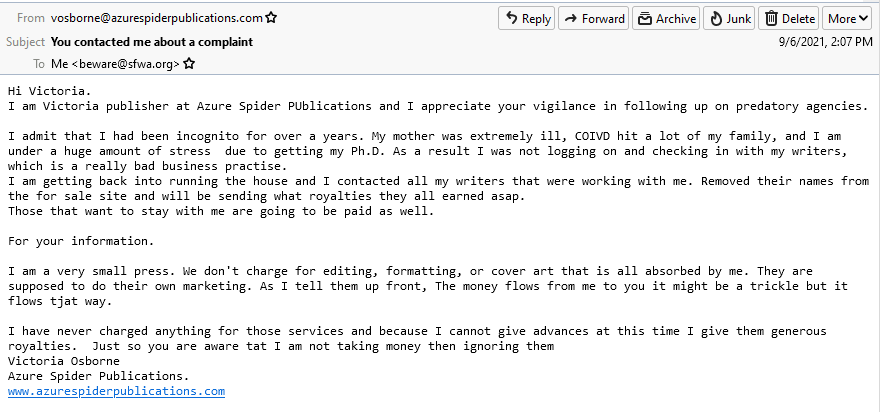
I’m always at least a little skeptical about health excuses, since I’ve encountered so many situations in which they turn out to be false. Covid especially provides a convenient rationale: I’ve seen it used frequently in the past year and a half–sometimes honestly but often otherwise–to justify non-performance. But these tales of misfortune may also be genuine, so they deserve at least the benefit of the doubt.
In this case, though, doubt has run out. The promises made in the email have not been fullfilled–at least for the authors who contacted me, who have still not received royalties, rights reversions, or even a response from Ms. Osborne.
******
Finally, an observation. As I’ve noted in each case, these publishers are all basically one-person operations, with perhaps some freelancers or part-timers to fill in the gaps. The owner of Dreaming Big, for instance, has admitted that publishing is a sideline: “Publishing is fun and more than a hobby, I suppose, but it’s not what pays my bills”.
If you’re going to put your manuscript into the hands of a publisher–not to mention, sign a contract that binds you to the publisher for years if not the life of your copyright–you really want publishing to be the publisher’s primary business–not something done “for fun” or as a hobby or in their spare time evenings and weekends. With the best will in the world, one-person and part-time ventures, which are often without financial reserves and don’t have the cushion of regular staff, are super-vulnerable to unexpected outside events–illness, family emergency, personal misfortune, and the like. As seen above, these can lead to mistakes and delays, or even push the company into closure, leaving authors in limbo.
Again, part-time publishers may be entirely well-intentioned, and may have the savvy or drive to keep things running smoothly. But for authors, signing with a publisher that isn’t a full-time operation is a risk factor. When you’re evaluating whether to accept a contract offer, it’s something you need to consider.

I was a Dreaming Big client for around three years. I had no idea those books still showing up on Amazon are still being held by the owner.
As per myself, when they released my book, they released an unedited mess. I was embarrassed to market it. I asked for edits and got nowhere fast. The Audiobook was worse (How do you screw up an audiobook? I suspect you hired a friend or your teenager to do the job and they mispronounce words). Despite that, it sold better than the other books she was had at the time. I had some understanding of marketing, wonderful friends who were more savvy than I was, and I live in a loyal small town. They rock.
I trusted her to send royalties (nope. No schedule. My bad)–which was foolish. I got one royalty check the first year. I asked when to expect the next one, and she never replied. I knew it sold more than a few copies the second year because I was getting fan letters from locals and and requests for signed copies (very flattering, very kind).
I went in search of legal advice and an publishing attorney (friend of a friend) walked me through what to do to get my book back. I sent a certified letter that was returned. I finally sent her an email asking for her to give me my rights back, indicating I would take legal steps next, but really didn’t want to.
She finally replied and said that I’d get my rights back in return for not pursuing the royalties she owed me. I said yes.
More than once during that last year I had other authors reach out to me to ask about her and whether I was satisfied with her services. Though I chose my words carefully, I let them know that they’d be better off as indie authors. All but one listened.
It was harder to get the audiobook rights back, but I went to AUX and told them that I was getting the runaround from the publisher. The rep at AUX deleted the files and almost gleefully gave me the power to publish my own audio book.
I got it back, hired two editors, cleaned it up, and it sold better with me than it did with DBP after I did the clean up. Not a huge success, but people read it.
Hurn’s business model is identical to that of Booktrope. I can’t believe that’s a coincidence. I don’t know why she thought it would work better this time.
As of 7 Dec, there has been no update with Hurn. In fact, authors including myself have been blocked my Meaghan from contacting her. I can say that I am now looking into the legal avenues I can take.
Thanks for the notification about Azure Spider. I am one of the aggrieved authors, as you know. To date I have heard nothing from Ms. Osbourne despite repeated attempts. A few days ago I joined the Authors Guild, and I am hoping that they will apply a little pressure.
The information that's public on Writer Beware–on this blog or on our website–represents just a fraction of the complaints we've received. If you email me with the name of a company, I'll check my database to see if I've heard anything, and share that information with you, in confidence. beware@sfwa.org
The blog is a valuable service to all authors. I will check the "list" prior to submitting anything for publication.
Thank you for valuable information and advice.