

I’m blogging over at Writer Unboxed again today, with an overview of a type of scam that currently represents 50% or more of the questions and complaints I receive.
The current self-publishing industry has its roots in the mid-1990s, when three startups–Xlibris, Trafford, and AuthorHouse–began selling digital publishing services to individual authors.
(Bear with me: I’m getting to the subject of this post!)
Along with similar provider iUniverse, these companies later incorporated under the umbrella of Author Solutions, Inc. (AS). A pioneer in the assisted self-publishing space, AS also pioneered the hard-sell sales tactics, deceptive advertising, and expensive junk marketing techniques that dominate this publishing segment. (Junk marketing: marketing services that are cheap to provide, sold at a large markup, and are of dubious value for book promotion.)
Sometime in the mid-2000s, AS began outsourcing most of its sales and production to the Philippines, where there is a large, educated, English-speaking work force that’s also less costly than equivalent workers in the USA. Inevitably, some of the more entrepreneurial-minded of these staffers, seeing how lucrative it was to convince writers to spend large amounts of money to publish and market their books, decided to set up their own self-publishing enterprises to poach authors away from AS and other companies.
When I first started discovering these AS knockoffs (here’s my first blog post about them), they were mostly just selling Author Solutions-style publishing and marketing packages–although exponentially more overpriced and deceptively advertised than the original, with terrible customer service and the books and other products far more likely to be of poor quality (and that’s when they didn’t just take the money and run).
In recent years, though, their numbers have exploded—there are hundreds of AS knockoffs in operation now, and more cropping up all the time—creating fierce competition for customers in an increasingly crowded field. This has driven them to adopt ever more brazen practices to support their quest for writers’ cash: forging documents and contracts from Big 5 publishers, selling completely fictional products such as “book insurance”, engaging in elaborate front operations involving multiple fake businesses, and impersonating reputable literary agents, publishers, and movie companies.
Impersonation scams especially have become common over the past couple of years, and they can be quite convincing. In this post, you’ll find examples of the three types of impersonation scam you’re most likely to encounter, along with a look at the telltale signs that can identify them.
LITERARY AGENT/AGENCY IMPERSONATION
You’re most likely to be targeted by an impersonation scam if you’re a self-published or small press author—but any writer may be approached. The scam usually arrives out of the blue, via an email solicitation like this one (the @directacquisitionsteam email address is tied to this scam):

Steve Troha is a real agent with a real agency–Folio Literary Management—so if you Google him, you will get authentic results. The website URL in his signature card is the real Folio website. However, there are multiple red flags in this email.
- A real literary agent (or publisher, or film company) is highly unlikely to contact you out of the blue with an offer ready to go—even a provisional one. Agents don’t “test the waters” for writers they don’t represent.
- It’s a mass email (you can tell because the “from” and “to” addresses are the same). A rare, genuine contact from a literary agent would come to you personally. You’d be addressed by name, and your book title would be mentioned—neither of which this email does.
- A real agent with Folio Literary would be reaching out from the Folio email address (@foliolit.com)—not from an alternative address (@groupof acquisitions.com) that has no discernible connection to Folio.
- The promised “upfront payment” (a real agent would say “advance”) amounts are preposterously inflated. Advances for first-time authors are more likely to fall in the $5,000 range than the $150,000 range. Scammers often try to turn writers’ heads with big money promises…which they can then argue will more than offset whatever large fee the writer is asked to pay.
Another sign of scam: an alert on the front page of Folio’s website. They’re aware their agents are being impersonated, and like a number of other targeted agencies, have posted a warning. (The absence of a warning shouldn’t be taken to mean there’s no malfeasance going on: the agency may not be aware it’s being impersonated.)
Here’s another one.

Again, Jennifer Carlson really is a literary agent with DCL Literary Agency, which a websearch will confirm. The email is personalized to the author, with their email address and book title (both of which I’ve redacted). The link to the DCL Literary website is genuine.
As with the fake Folio email, though, solicitation is a warning sign: busy literary agents don’t generally cold-call writers. In addition…
- The tone of the email is off. Would an established agent with an extensive track record really spend three paragraphs pitching her credentials as if she were completing a job application? Seems unlikely. Agents expect you to pitch them—not the other way around.
- There’s also the vagueness about how she happened on the author’s work (who exactly furnished the “high praise”? A rare, real contact from an agent would say) and a telltale lapse in the fourth paragraph: agents don’t describe publishers as “clients” (an agent’s clients are authors, not publishers). For that matter, a real agent wouldn’t use the term Traditional Publisher, since it’s a given that that’s the kind of publisher an agent works with.
- The email address, @dcl-agency.com, looks authentic–but it’s fake. Per its website, the real DCL Literary’s email address is @dclagency.com (no hyphen). Scammers often use email addresses that look like real ones, but include small differences; it’s always wise to double check.
- Also worth checking: when the email domain was registered. In this case, it was registered on July 14, just 5 days before the email was sent–which doesn’t really fit with an agency that has been in business since 2005.
Like Folio, DCL has a scam warning on its front page.
Other warning signs to watch for (this applies to the examples below as well): a gmail address (a genuine contact will use the agency’s email domain), English-language and grammar lapses (since most impersonation scams come from overseas—though thanks to ChatGPT, this is less likely to be a marker these days), a list of things supposedly required by publishers other than a manuscript and synopsis, such as professional reviews, professional editing, a query letter, or a book trailer (publishers are interested in none of these things, and agents don’t demand them), and any mention of fees or purchases (other than commission).
As with all scams, the ultimate aim is money. The writers who received the emails above were informed by the fake agents that their books had to be edited to meet publishers’ standards, and referred to a “trusted” editing firm…aka the scammer behind the curtain. The fee: $3,500 and up.
A different, but related scam: the entirely fictional literary agency.
PUBLISHER IMPERSONATION
Major publishing houses are even less likely than established literary agents to contact authors out of the blue. So if you receive an email like this one, be very suspicious.
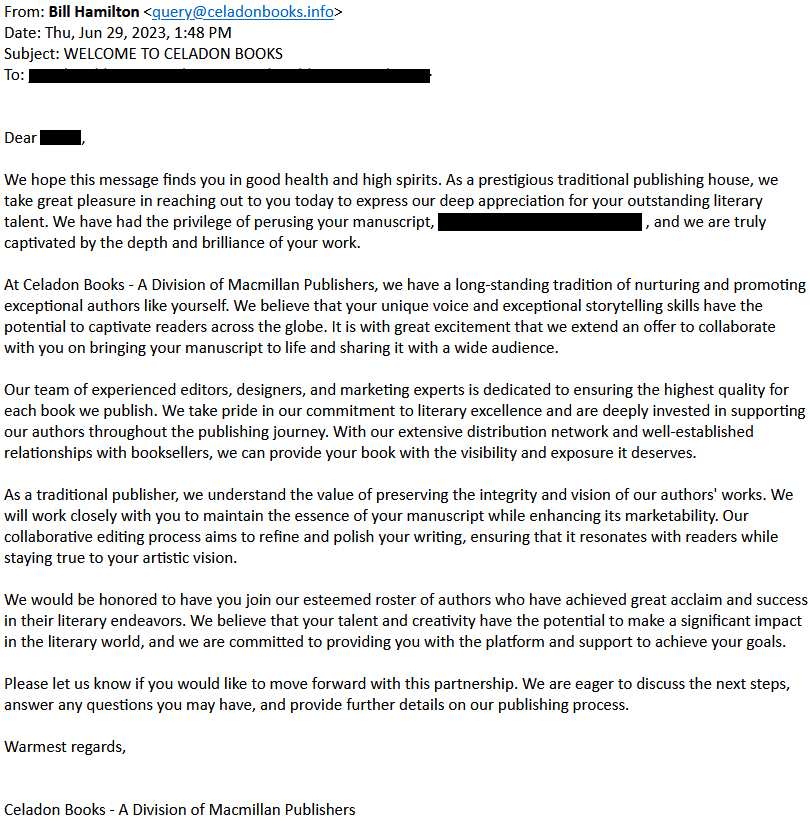
Here again, there are elements of verisimilitude, just in case the recipient does some websearching. Celadon Books genuinely is an imprint of Macmillan. Bill Hamilton really does work there, as Executive Editor (this can be confirmed on the Celadon website). And the email is personalized, with the author’s name and book title.
However, even beyond the red flag of solicitation, plenty of caveats apply.
- The email reads like Celadon is competing for a job opening—not very plausible, given that authors compete for publishers, not the other way around. Plus, like so many Big 5 imprints, Celadon acquires exclusively through literary agents (as it states here); it has no need to approach authors directly.
- As in the fake Jennifer Carlson email, the term “traditional publisher” is a marker: big publishers won’t identify themselves that way, since they assume you already know.
- There’s also the telltale vagueness about how Celadon acquired the “privilege of perusing” the author’s manuscript. Any legitimate contact would be specific about where they saw or heard about your work.
- This solicitation too boasts a fake email address. The real Celadon address is @celadonbooks.com—again, confirmable at its website. That email domain was registered just this past April…not very plausible for an imprint founded in 2017.
Like so many of the literary agents who are being impersonated, Celadon is aware that its name is being misused, and has placed a warning on its website. Other Big 5 publishers have as well. Here’s HarperCollins. Here’s Hachette. Here’s Simon & Schuster.
FILM COMPANY AND FILM PRODUCER IMPERSONATION
What author doesn’t long to have their book made into a movie?
Scammers are well aware of the power of the Hollywood dream. They’ve been taking advantage of it for years with expensive book-to-screen packages and exorbitantly-priced screenplay-writing services…and now, by impersonating producers and production companies.

Once again, solicitation is the first warning sign. How likely is it that the head of a major production company like Amazon Studios is going to be reaching out to you personally? Not very. Also…
- Would a studio head really use a gmail address, rather than his company’s official email address (in this case, @amazonstudios.com)?
- If your work is so “remarkable”, wouldn’t “Mike” mention your title? And how he discovered it? Other than the author’s name in the salutation (which I’ve redacted), this email is totally generic.
- Most of the email is about the “cinematic trailer”, in which a real production company would have zero interest. Film rights aren’t optioned or sold based on 3-minute trailers provided by the author. Instead, this is what the scammer wants to sell you; they’re betting you don’t have a trailer just lying around, and will welcome a recommendation to the “reputable trailer vendor/house”, aka the scammer for whom this email is a front.
Costs for trailers vary depending on the company, but can run as high as $5,000. They are frequently of poor quality, with robo-voices and poorly-chosen stock images.
Here’s another one.

Todd Williams isn’t as well-known as Mike Hopkins and Amazon Studios, but he’s a real producer with a number of films and TV shows to his credit.
However, this email reeks of scam: the absurd email address (gmail again, and what actual film director makes “filmdirector” part of their user name?), the over-the-top yet completely generic praise that doesn’t even mention the name of the writer’s book, the absence of disclosure on where/how Fake Todd encountered the writer’s work.
What writer wouldn’t want to be approached by Netflix?.
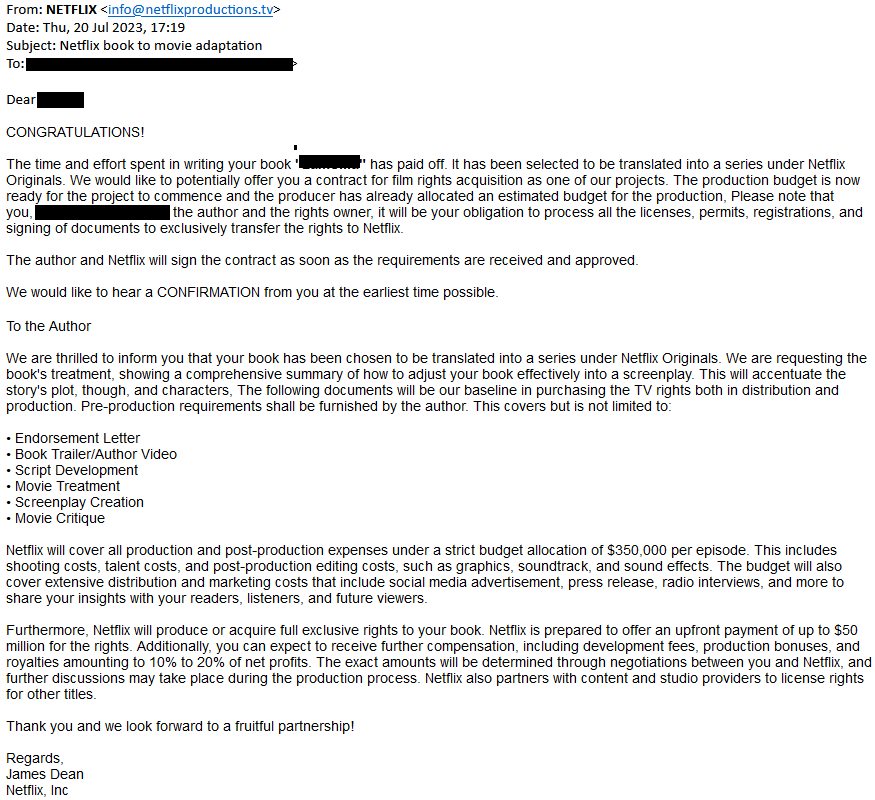
Caution signs (other than James Dean reaching out from beyond the dead):
- As in the examples above, there’s no word on how Netflix spotted the book or who “selected it” for acquisition. You can’t see it because of the redactions I’ve made, but the writer’s name and book title are in a different font, suggesting that they’ve been dropped into an email template.
- Instead of over-the-top flattery, there’s an over-the-top money promise: $50 million! Even most movie stars don’t earn that much. Big-money promises to turn writers’ heads are a time-honored scam technique.
- The email address, @netflixproductions.tv, is non-credible, given that Netflix’s main email domain is @netflix.com; plus, the email domain was less than a year old when the writer received this solicitation.
- Also note the list of “pre-production requirements”. Absolutely nothing on this list would be demanded by the real Netflix as part of an acquisition offer. If you’re ever lucky enough to sell film or TV rights (most likely via a reputable agent), the production company will pay you for them (there should never be a cost to you) and will then hire its own people to develop the script and create the screenplay.
The aim here was to sell the writer screenplay writing services, at a cost of $5,000 (quoted price: $10,000, with 50% supposedly “contributed” by the scammer). That’s actually fairly low for a screenplay scam; I’ve heard from authors who’ve paid as much as $20,000.
A different, but related scam: the entirely fictional film company.
HOW TO PROTECT YOURSELF
The examples above represent a tiny sliver of the hundreds of impersonation scams I’ve seen. There’s a lot of variation in technique and tactics, and while some are transparently bogus, others can be pretty professional-seeming and convincing.
Be skeptical. The first thing, always, is to remember that reputable literary agents, publishers, and film producers do not typically cold-call writers. For scammers, on the other hand, solicitation is the main way they acquire clients. Fulsome flattery should also make you suspicious, as should promises of big money. You can never say never in the writing business—but any publishing- or film rights-related solicitation should be treated with extreme caution.
Use the tips in this article. Investigate the sender’s email address. Check the agent’s or publisher’s website for impersonation warnings or information that doesn’t match the solicitation. Do you have to provide anything other than your manuscript (if so, do you have to pay for it)? Do a websearch—someone may have posted a question or complaint.
Plug the agent, publisher, or producer name into the search box of the Writer Beware blog. I’ve written several posts about impersonation scams, and update them regularly with new names.
Email Writer Beware. If I’ve heard something, I’ll tell you.

OMG I FELT LIKE I WROTE THE ABOUE STORY. I TOO WAS A VICTUM OF XLIBRIS SAME STORY PAID THOUSAMNDS OF DOLLARS TO HAVE MY BOOK FOR THE WORLD TO SEE. BUT I WAS FIRST APPROACH BY DORRANCE POBLISHI NG AND TURNED THEM DOWN BECAUSE MY BOOKS WERE PERSONAL AND I WAS AND FOR GOT ALL ABOUT MY BOOKS UNTIL AWHILE AGO I SAW MY BOOKS OUT THERE BEING SOLDNOT WRITING THEM TO SELL BUT FOR ME IT WAS A HEALING PROCESS OF HAVING SUCH A NOT LOVE CHILD AND GROWING UP OF FAMILY .WELL ANYWAYS FOR THE LONGEST TIME I DID NOTHING WITH MY BOOKS .MY CONTRACT WITH XLIBRIS WAS FOR THREE YEARS ROLALITIES ONLY AND ALSO FOR XLIBRIS NAME ON MY BOOKS. I HAD THE PEOPLE THAT WERE WORKING ON MY BOOKS TOLD ME NOT TO LET XLIBRIS HAVE ANYTHING MORE TO DO WITH MY BOOKS BECAUSE I WON”T GET ANYMONEY FOR MY BOOK AND THAT THEIR WERE SEVERAL LAW SUITES GOING ON AND THAT THEY WERE QUITING . WELL I HAVE CONTACTED XLIBRIS SEVERAL TIMES TO TELL THEM I WOULD NOT BE RE SIGNING MY BOOKS BUT TERMINATING MY BOOKS AND THEIR NAME TO BE REMOVED FROM MY BOOKS .I SENT AN EMAIL STATING JUST THAT AS I WAS TOLD BY THEIR LEGAL DEPARTMENT BUT THEY NEVER STOPPED .I TOOK ILL WITH CANCER TWICE
Hi Victoria.
Rose here!
Your article – The Rise of Impersonation Scams – is very enlightening. My first 4 novels were published by XLIBRIS, costing a lot of money with unsatisfactory results. eg. distortion of my books stories, incompetent proof reading & later more costs for marketing, book fests, Hollywood produceer pitching ect. I no longer use their services. But I receive a multitude of offers from XLIBRIS for more publishing, marketing and the likes. Even membership in Author Solutions. Then of course – lots of IMPERSONATION SCAMS – Publishing Houses & Literary Agents, Film Producers, wanting money upfront, requesting screen plays & other HOLLYWOOD preferred material. Well, you know their action. So far, I’ve avoided beeing caught out, through thorough research.
I might add, that your article gave me a deeper insight into those Scammers, especially XLIBRIS. I am now even more cautious, deleting & BLOCK those SPAM e-mails DIRECTLY.
Thanks again for all your great information.
Best regards, Rose