
NOTE: Some scams have re-packaged “book licensing” as “Separation of Book Rights Order” or “Legal Registration for IP Protection” or “Independent Publishing Registration” or something similar. Don’t be fooled.
LICENSING: THE REALITY
A few weeks ago, I wrote about the common scam of “book returns insurance”, in which scammers take something real (book returnability, a normal element of book publishing and selling) and spin it into a nonexistent “service” (a kind of “insurance” product, which you supposedly have to buy if you want your books to be returnable) for which they can charge big bucks.
Today’s blog post focuses on the similarly deceptive scam of “book licensing”. Like “returns insurance”, this fictional item is based on something real (the licensing of rights that’s necessary for publication) that scammers have distorted into an imaginary requirement they can monetize (a book license you supposedly must obtain in order for your book to be published or re-published).
To be clear, there is no such thing as a “book license”–at least, not in the sense that scammers use the term, meaning an item like a driver’s license or a fishing license that you have to take steps to acquire and must have in order to do the thing associated with the license. As the copyright owner of your work (which you are, by law, from the moment you write down the words), you have the power to grant licenses for publication, but you do not have to obtain any kind of license or permission in order to do so. By re-framing licensing as something authors have to get, rather than something they are empowered to give, scammers turn the reality of licensing on its head.
(What about copyright registration? you may be thinking. Isn’t that a kind of license you have to obtain? Not in the same sense. Registration is an optional extra step that confers certain legal privileges, but has no bearing on your ability to grant publishing rights to third parties, which you can do whether you’ve registered copyright or not. Most countries have no official registration process, anyway; the US is an outlier in making registration a pre-requisite for legal action. For more information on copyright, registration, and other important matters, see my blog post, Rights vs Copyright: Untangling the Confusion, and the Copyright page of the Writer Beware website.)
BOOK LICENSING: THE SCAM
Many scammers present the supposed necessity of a “book license” as part of a package of services. Here’s an excerpt of a solicitation from Quantum Discovery, one tentacle of a much larger scam complex; it’s part of a pitch for a re-publication package priced at $899. The writer has been told that traditional publishers won’t consider self-published books, and in order for Quantum to “endorse” the writer to publishers, their book needs to be re-licensed under their own name as an “independently published author” (the writer is expected not to notice the illogic of this premise):
![TO DO'S FOR THE BOOK
- Process own book license, taking off [redacted] as publisher,
- Re-register book license under your name, [redacted],
- Cover design be enhanced (optional),
- Add an author photo and "About the Author" info for credibility purposes,
- Adjust the prices to make it more affordable to target buyers,
- Remove the logo of [redacted] in the preliminary page and on the back cover.
All other corrections of the book's exterior and interior come at no additional cost in relicensing/republishing the book under your name as publisher.
Once these are implemented, it will be easier for me to pitch your books to my networks as they are presentable and of standard making it attractive to Traditional pub-houses.
All book improvements are subject to your approval before implementation.
The re-licensing process takes 2 to 3 weeks to complete.](https://writerbeware.blog/wp-content/uploads/2024/04/Book-licensing-Quantum.png)
Book licensing is also often pitched as a stand-alone service–as in this example from The Literary Firm (which like Quantum Discovery is part of a large scam complex; I’ve seen dozens of examples of the solicitation below, sent out under a variety of different names). The claim: a Big 5 publisher is interested in the writer’s book, and is prepared to pay an option price [sic] of $525,000 plus royalties if the writer qualifies. The license is pitched as just one of several items the writer must submit, with three paragraphs of BS on why it’s supposedly necessary (note the driver’s license analogy):
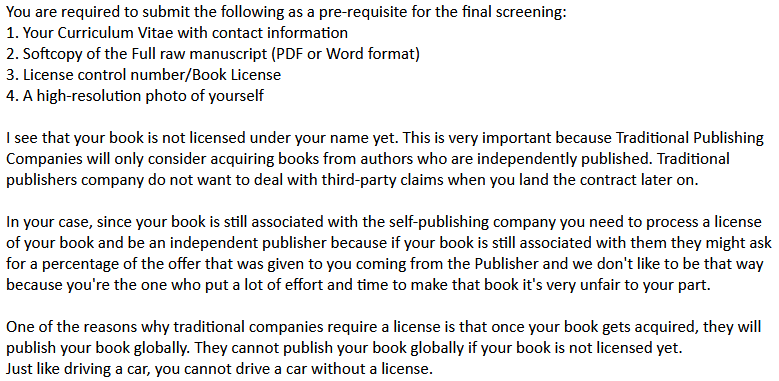
Just as in the first example, what’s really being sold here is re-publication of the writer’s self-published book (that’s what’s meant by “licensed under your name”), with the same bogus claim about traditional publishers and some additional scare tactics invoking money grabs by self-pub companies. Similar obfuscation can be seen in the overview of the “licensing process” provided by The Literary Firm’s Colton Ramsey (see this blog post for mentions of The Literary Firm and Colton himself, who exists only inside the algorithms of Midjourney or another AI image generator).
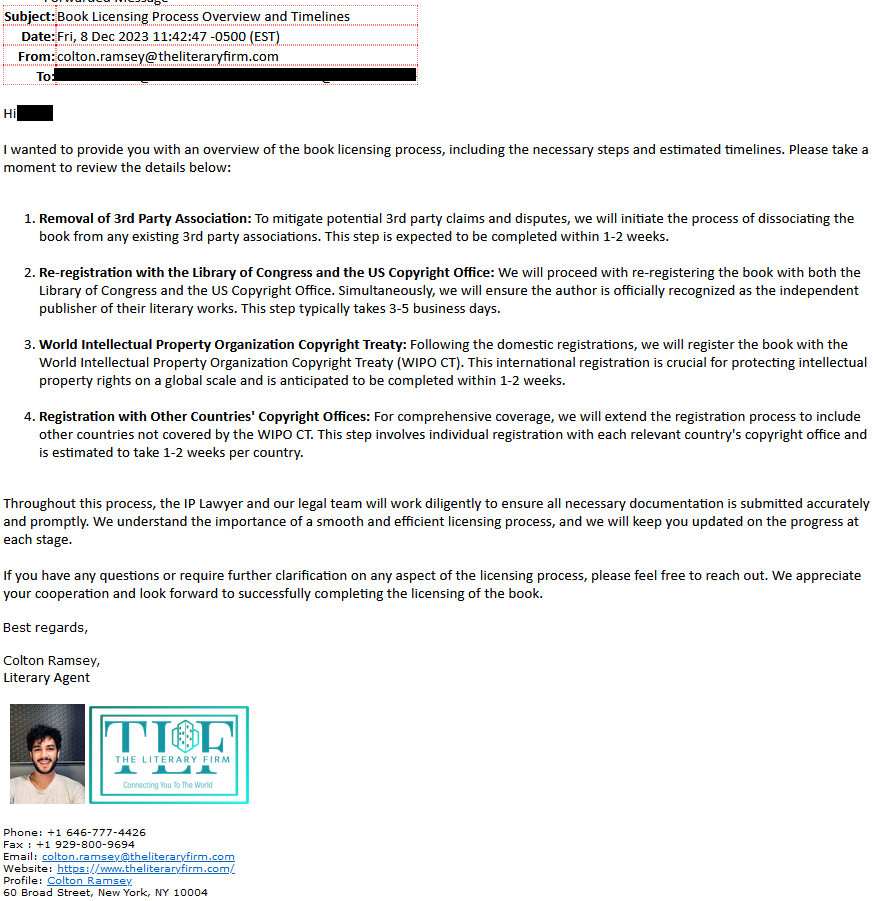
Among other falsehoods, WIPO does not offer a registration process; and though WIPO administers a variety of intellectual property treaties, not one of them is called the WIPO CT. Notice also the generous window for delay offered by Step 4: important because it allows the scammer time to bombard the author with other opportunities to spend money before the author discovers that the whole thing is smoke and mirrors.
Here comes the price tag. It’s a deal! Three of the four steps are free!

Also charging $1,500 for book licensing: Gerald Timberlake, purported “major traditional publisher” acquisition specialist. The carrot: the prospect of a ridiculously inflated advance. If the writer balks at handing over four figures for the query and license, no matter–Gerald can turn around and try to sell book reviews or the Cinematic Book Trailer instead.

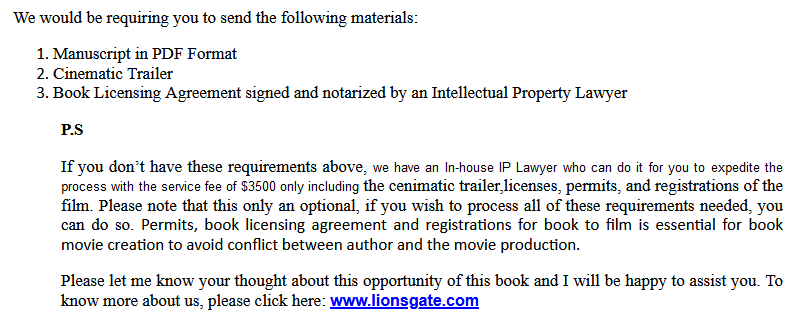
Some versions of the scam add an extra layer of fake importance by incorporating an “Intellectual Property Lawyer” into the mix–which also, of course, creates the opportunity to charge a larger fee. The scammer is betting the author doesn’t have easy access to an attorney (who would surely inform the author they were being rooked), and will be grateful for one to be provided. This solicitation impersonates a Lionsgate executive, who claims to be interested in turning the writer’s book into a film:
Still other scammers go beyond a mere license into something even more distant from reality: an “international seal” purportedly necessary for re-publication. This goes by various names; here’s one example, excerpted from a solicitation impersonating a reputable literary agent (the scammer that sends these out is an impersonation specialist):

An alternative formulation, from the same source:
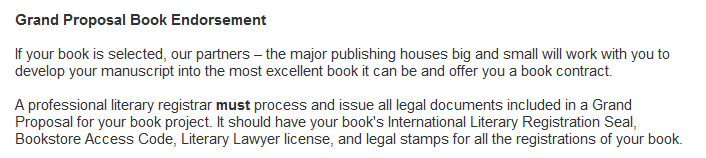
And still another, from a bogus publishing contract created by scammer Stonehenge Literary & Media:

So what exactly is this very important international seal? Even the scammers don’t really know. Here’s the gobbledygook collation of falsehoods explanation one scammer sales rep offered to a persistent author:

The author was understandably still confused, so the sales rep tried again:
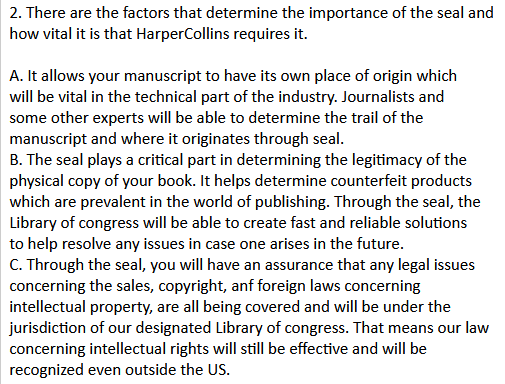
Sure cleared that up.
Seal fees that have been reported to me average around $1,800, though undoubtedly there are scammers who charge more. For the money, authors get this:

Needless to say, it’s completely fake, from the made-up “seal” image to the non-existent International Copyright Office to the never-heard-of-it International Copyrights Code to the fake registration number that borrows the format of US Copyright Office registration numbers even though this is supposedly an international document. The format of the entire thing, in fact, has been adapted from US copyright certificates, including the preamble and the Register signature–which, bizarrely, appears to be a clumsy partial attempt to imitate, or maybe just evoke, the signature of Shira Perlmutter, the current US Register of Copyrights. (For comparison, click here.)
PROTECTING YOURSELF
Thanks to how common book licensing scams have become, I often get emails like these from confused authors:


(The second email is from the author who received the fake S&S contract mentioned above; it demonstrates the circularity of impersonation scams, with the scammer, posing as S&S, referring the author to itself.)
A few tips for self-protection.
Educate yourself. Whether you’re self-publishing or seeking traditional publication, knowledge is your greatest ally and your best defense. I’m not minimizing how complicated, confusing, and opaque the publishing industry is; but so many authors dive into the publishing process without taking the time to do even the most minimal learning, and as the emails I receive every day attest, trying to learn on the fly is a recipe for getting scammed. The Writer Beware website (as distinct from this blog) is a good place to start.
Just as important, in this era of solicitation scams: beware out-of-the-blue emails and phone calls! Solicitation is the main way scammers like the ones mentioned above acquire clients, and any publishing- or movie rights-related email or phone call that isn’t directly traceable to a query or contact you yourself made should be treated with extreme caution. Book licensing scams are exclusively the province of companies on my Overseas Scams List; check it to see if the company that contacted you is included.
Book licensing scams are often a component of impersonation scams. My impersonation list identifies people and companies that are frequently impersonated; if the person or company that just emailed or called you is on it, be wary.
If you’re still in doubt, email me; I’ll tell you if I have anything helpful in my files.
And remember: you have the power to license your rights, and you don’t need to get–let alone pay for–a “license” or “seal” in order to do so.

I love this article. Thank you so much. The Quippu Quill sent me an e-mail regarding relicensing my book exactly as you described. You have been a big help to me, and you are doing a great job of educating us authors. Thank you again.
Love this article, my husband was about to be scammed by Anitta Hubb. Have you ever heard of her? Please let me know all you can. She has gone over and beyond wanting him to get a book license.
Dear Victoria, thank you for all your support and help to the writing community. You are providing an invaluable service amongst the growing sophistication and proliferation of these scammers.
Hello Victoria. Licensing (aka relicensing, publishing, re-publishing) is the main entry point (first step) for scams.
These scammers (mostly from the Philippines) will call authors out of the blue, and present themselves as literary agents. They will them discuss with that in order for them to represent your book (to big publishing houses, movie producers, bookstores, booksellers, etc.), the book must be re/published first. This is where the scammers “gauge/measure” the author’s potential to put out more money (and to be deceived more).
Once an author’s financial capability has been established, here comes the second part of the deception. These scammers/fake literary agents will then say that they have endorsed the books (to booksellers, movie producers, or whoever would have the interest in acquiring the book), and promising them of huge sums of money once the book is successful.
The scammers greed sometimes takeover right away. There are instances that the book re/publishing isn’t done yet, but the “manuscript” has already been endorsed for acquisition, and we can expect an email or call from someone who is interested in the book acquisition, along with the “requirements” before the book will be acquired.
The funny part is that those who will acquire the book is also within the same office or same company with the fake literary agents. They have a game plan for a certain author. They will formulate the plan, and someone from the same scam group will pretend to be either a film producer, a bookseller, or a representative from a bogus company. They will then entice the author, and promise large sums of money, but the requirements for acquisition must be fulfilled first. And guess what, the “requirements” will be fulfilled by the literary agent’s company.
It is indeed a coordinated scam, wgere everyone would play a crucial part to deceive the author. These scam companies from the Philippines have a wide arsenal of weapons to deceive the author. They can pretend to be a movie producer, a book seller excutive, someone from a fake foundation. They can be whoever they should be, they have the resources to do so. I hope authors would realize what is obvious. If an offer is too good to be true, it is a scam. I hope authors would be able to read between the lines, and trust their instincts. If something isn’t right, then it is really not right.
Can you tell me how many books L.R.Price Publishing ( LRPublishing their new name) has published in 2023 please? Any books published in 2024? Also have any books been published in 2024. This firm is still advertising for new authors. It seems there are many scams out there and ‘Book Licensing’ may be another minefield for us authors.
Victoria, it is David Muecke,
the author of Angel Boy.. You are doing a great job by way of educating us Authors, the scammer targets.
Now the market that seemed hopeful due to the artificial interest. Tha interest made everything sound hopeful. The interest made an authors future seem fruitful.
Yet in reality, what is a talented author supposed to do? Every writer is an artist. Each writer has dreams. So, how can a author who is crushed. How can an artist grow? How can a writer make good of a worthless situation?
Maybe it is time to start a Author challenge program. You know, like American Idol or the Voice. Some of us writers may be open to this type of a contest.
Well, keep up the great work, the leadership information blog. This absolutely helps, thank you.
David Muecke