

NOTE: In response to this post, Dashtoon has modified its contract. See the update at the bottom.
Dashtoon is a startup (founded in late 2022) digital comics creation platform that promises to revolutionize the comics industry by allowing anyone to create their own webcomics using generative AI, and to distribute and monetize their creations via the Dashtoon app. Licensed in Delaware USA and doing business as Dashverse Corp, it’s yet another shiny entry into our new AI-crazed reality, and has garnered venture capital investment and positive media coverage.
Via its Authors Program, Dashtoon also licenses books and stories and turns them into comics, covering all production costs and paying authors a royalty. It also appears to be looking to license already-published comics for distribution on its platform. Here’s an example of the emails it has been sending out (this is a form email; I’ve seen several of them):
![Dear [redacted],
Hope 2024 is going great for you.
You must be busy with multiple requests so I will keep it brief:
We are impressed with [redacted] and believe that its rich narrative has the potential to be brilliantly adapted into the dynamic world of comics.
At Dashtoon, we are a team of talented artists and writers with a proven track record of bringing literary works to life through the visual medium.
We’d love to explore the possibility of licensing [redacted] to create webtoons.
May we get on a quick introduction call next week? Sharing a deck that contains more details about Dashtoon. Looking forward to a positive response.
Best Regards,
[redacted] (she/her)
Licensing Team
Dashtoon](https://writerbeware.blog/wp-content/uploads/2024/05/Dashtoon-solicitation-1024x369.png)
I’ve also had the opportunity to see a number of Dashtoon contracts, both exclusive (for book adaptations) and non-exclusive (for distribution of already-published work).
Analysis of both follows. Bear with me; it’s gonna get wonky.
EXCLUSIVE CONTRACT
An example can be seen here. All the examples I’ve seen are identical.
THE LICENSE
The license period is 10 years (see the Definitions section), and is “irrevocable” (i.e., un-cancelable by the author–see Clause B.1.(1)). While a 10-year term is certainly preferable to a life-of-copyright grant, I consider it unduly lengthy for a digital publication–especially when authors don’t have the ability to terminate (something that is reiterated in Clause D.a.: “During the Term, Licensor [the writer] shall not be entitled to terminate this Agreement.”) The only provision for termination is the writer’s breach of their warranties (Clause D.b.) or a force majeure event (Clause D.c.), and that power rests solely with Dashtoon. There’s no provision for termination due to breach by Dashtoon.
Also, per Clause B.1.(3), Dashtoon’s “decision to not exercise any of its rights under the License…shall not cause such rights to revert to Licensor.” This leaves Dashtoon free to adapt your book right away, four years from now, or never–with the un-cancelable 10-year license term in place regardless.
Preferable: a three, five, or seven-year contract, with a requirement to publish within a stated period of time (for example, within a year of the effective date) or else return rights.
RIGHTS
The grant of rights (Clause B.1.) is sweeping, and includes much more than the creation of comics. Here’s the contract’s definition of “Illustrated Adaptations”, a term that’s used throughout the contract to describe the entire scope of rights granted to Dashtoon:

So in addition to adapting books into multiple graphic forms in multiple languages, Dashtoon can create derivative works–a broad term that encompasses a wide range of uses, as indicated by Clause B.1.(2)d., which gives Dashtoon the right to “[e]dit, modify, summarize, dramatize, or enhance any aspect of the Licensed Titles, including the storyline, characters, chapterization etc., in any manner”. (To the author who wondered if this gives Dashtoon the right to use characters in spinoff series…yes, it would appear that it does.)
The use of generative AI is written into the contract (Clause B.1.(2)b.). (According to Dashtoon’s promotional brochure, just 2% of the work is done by AI,, but I don’t know how you would verify this.)

The writer retains copyright in the book licensed for adaptation. However, the copyright for the characters Dashtoon creates rests with Dashtoon, and that copyright endures even after the contract has expired. From Clause B.3. (note the double prohibition on author challenges):

Ditto for any other elements created by Dashtoon–including, presumably, not just visual elements, but the translations and derivative works included in the grant of rights (this is the second paragraph of Clause B.3.):

Pretty much any adaptation of a written work to a different medium will entail similar copyright provisions. But some authors worried that Dashtoon could continue to use and profit from works created during the contract even after the contract expired, with no further compensation to the author. A later clause (Clause D.d.) does appear to require a new agreement (and fee) for such use:

Do writers get input into the adaptation process? Some, per Clause B.5., which covers production–but only in regard to the comic (there’s no mention of input into derivative works), and only to a limited degree. Authors can provide feedback on no more than three lead characters, with just two requested changes allowed. They also get to see the first three episodes–with, again, just two requested changes allowed. Thereafter, it looks like the author can only provide feedback once episodes are published; Dashtoon will correct errors and mistakes, but only commits to “make reasonable efforts” to accommodate creative changes.
PAYMENT
Dashtoon monetizes its content via the Dashtoon app. Readers can access the first ten episodes of a comic free, plus a daily free episode. To unlock further “premium” episodes, they must purchase Dashcash ($4.99 per 100 “coins”–premium episodes I sampled cost 5 coins each). Creators are expected to release an episode a day. Many of the comics have hundreds of episodes.
Authors earn a 15% royalty (none of the contracts I saw included an advance). See page 11, Annexure B.
Dashtoon’s website describes this rate as “competitive”, but in reality…meh. Yes, Dashtoon is shouldering all the expense of production, etc., which they can reasonably claim justifies a smaller royalty percentage–but that 15% is not a generous share to begin with, and is made even less generous by the fact that it’s paid on net profit (not net revenues as claimed, since various expenses are deducted from revenue before the royalty is calculated). From the contract’s Definitions section:
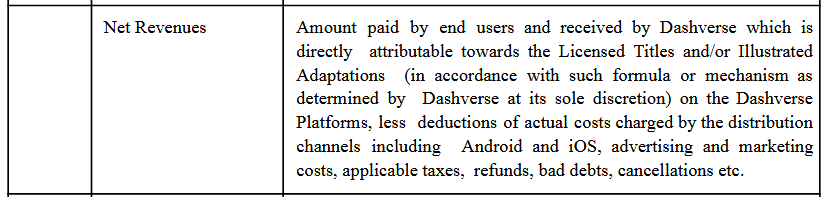
Additionally, how Dashtoon determines what’s “directly attributable” is completely opaque: it’s left to Dashtoon’s “sole discretion”. One might assume that “directly attributable” means the actual value of the coins readers pay to unlock episodes–but it’s never wise to assume.
Oh, and royalties are disbursed just once a year–and authors must submit an invoice in order to be paid. See Page 11, Annexure B.
OTHER MATTERS
Your ability to comment on your Dashtoon experience is restricted. (Clause C.k.; “it” refers to the author):

The mechanisms for dispute resolution are unclear. Per Clause B.10.b., the contract is governed by the laws of the state of Delaware, where Dashtoon’s parent company, Dashverse, is incorporated. Makes sense. But the actual process for bringing and adjudicating disputes? Per Clause B.10.a., it’s pretty vague:

At least authors aren’t locked into an arbitration process. But what is the process? Who will determine “mutually and amicably”? What if “mutually and amicably” can’t be achieved within 15 business days? It would be good to know these things.
NON-EXCLUSIVE CONTRACT
An example can be downloaded here. As a contract for re-publication/distribution of an existing work, it’s shorter and simpler than the exclusive contract.
– There’s no stated grant term–which can be a major red flag in a contract–but in this case it’s balanced by the fact that the author can terminate the agreement at any time with prior notice of 60 days (Clause D.a.).
– The Grant of Rights includes only the right to publish and distribute the licensed work on the Dashtoon platform. There’s no claim on any other rights.
– The pay actually is competitive: 50% of net revenues (which, remember, means net profit, since the definition is the same as for the exclusive contract)–although it’s still just once a year and the author must invoice.
– As with the exclusive contract, the author’s ability to comment is restricted: they are barred from making “any defamatory or libelous or discriminatory remarks against Dashverse”.
– An oddity that would give me pause, not just because it’s weird but because it complicates things if there’s ever a dispute: As mentioned, Dashtoon’s parent corporation, Dashverse, is incorporated in Delaware, USA. Yet the Dispute Resolution section (Clause 7, much more detailed than the equivalent clause of the exclusive contract) not only requires arbitration if disputes can’t be amically resolved within 15 business days, but requires it under the rules of the Singapore International Arbitration Centre. And the contract itself is said to be “governed by the laws of India.”
What the implications of this are I don’t know. Is it maybe just an oversight? But it’s certainly strange.
FINAL THOUGHTS
All in all, these are far from the worst contracts I’ve seen (that honor goes to the horrible contracts of the serialized fiction app space). Writers have told me that Dashtoon is open to negotiation, which is a positive sign.
But not every author knows to negotiate (or what to negotiate). A contract needs to be judged by its boilerplate language (at least, in my opinion)–and (again in my opinion) Dashtoon’s boilerplate does present some issues of concern, including the long grant term and relatively poor remuneration of the exclusive contract, and the odd Delaware/Singapore/India discrepancy in the non-exclusive contract. Not necessarily screaming “bewares”–but certainly matters that must be fully understood and carefully weighed.
Beyond that…Dashtoon is a startup. Lots of promise, lots of hype…but still a work in progress, without enough of a track record to definitely establish proof of concept. In that context, while there doesn’t seem to be much risk in agreeing to a non-exclusive contract that encumbers few rights, pays reasonably well, and can be canceled at will, signing a contract that irrevocably and exclusively binds you for ten years is a leap of faith that needs to be considered very thoughtfully.
UPDATE 6/3/24: Dashtoon has reached out to let me know that it has revised portions of its exclusive contract in response to this post. Here’s an excerpt from its email:
Sharing a summary of our key modifications-
The License Period: Our aim is to create a webcomic for every license we take, however, if for some reason we are unable to do so, we’ve modified Clause B.1.(3) to reflect the following – the Parties herein agree and accept that in the event Dashverse does not initiate any action to exercise its rights within 3 years from the Effective Date, the rights granted herein shall automatically revert to the Licensor.
Rights: Our intention is to create digital webcomics only. Hence, we are re-clarifying our definition of Illustrated Adaptations – Any work in the nature of vertical digital comics, digital comic strips, digital graphic novels, digital motion comics, interactive comics etc., and similar works their adaptations, combinations and translations thereof.
As you can see, we’ve removed the mention of derivative works which was causing some confusion and apprehension earlier.
Input into Adaptation Process: We are currently working with multiple authors across US and Europe and authors can be as involved as they want to be in the creative process. There are 2 rounds of discussions as opposed to a maximum of 2 changes as you previously inferred. We have updated the language in the contract to reflect this.
The revised contract can be seen here. A change not noted in the email: a paragraph has been added (Clause B.5.h.) to bind Dashtoon to a timely publication schedule:

Also, the second paragraph of Clause 3 (see above) has been deleted.
These are encouraging changes–especially the elimination of the derivative works language–and Dashtoon is to be commended for its willingness to make them.
Interestingly, though, the royalty percentage has been removed from Annexure B (in the earlier contract, it was 15% of “net income”), so it’s no longer clear what Dashtoon pays. And the definition of “net income” hasn’t changed (i.e., it’s really net profit), nor has the timing of royalty payment and accounting: per Annexure B, it’s still just once a year.
Also unchanged: the dispute resolution procedure (Clause B.10). Dashtoon didn’t address the odd discrepancy between the exclusive contract (which does not require arbitration and is governed by the laws of Delaware USA) and the non-exclusive contract (which does require arbitration and is governed by the laws of India).

Here you go again, trying to bring down another legit startup company but obviously not that well-known. You even charge authors yourself for following your website and blogs. Bottomline: Everyone is trying to make a living. You’re old, try to do something right for once in your life you old hag.
When scammers insult me, I know I _am_ doing something right.
Someone sounds remarkably butthurt, should someone call the waaahbulance? Sounds like a terminal case lol. Not Victoria’s fault Dashtoon sucks and can’t run a straight business. They’re not legit, they’re barely creative, just greedy. Victoria doesn’t even charge anything, you’re just mad and can’t come up with anything legit to say so “YoU ChaRge PEoPle!!!11!!!!” Lol I get you’re super used to lying but give it a break one in a while.
This isn’t making a living, this is just standard scamming. Get a real skill and make a real living. Relying on AI is pathetic, you get what you deserve when it comes to that. And take your own advice: do something right for once in your life, you old coot. Like disappearing.
They have a branch in Singapore to benefit from Singapore’s wonky copyright laws that strongly favor publishers over creators. I will lay bets on it.
That’s an important message of a callous sneakiness that shouldn’t be part of the publishing world
They’re also taking advantage of Delaware’s laws to pretend they’re based in the US when really they’re not. Basically, too poor for the Cayman Islands but still want to engage in shady tactics