

Well, not actually a thousand. But a lot.
It’s been a little while since I’ve written about ghostwriting scams (previous posts include the markers that identify ghostwriting scams and the scams’ misappropriation of the Amazon name and trademarks)…but given how prevalent they are, and their increasing aggressiveness in advertising, especially on Facebook and other social media, it seemed like a good time to re-visit them, via an especially egregious example I recently discovered.
But first…a little background.
Ghostwriting scams pose as publishing service providers. Like the similar similar-seeming publishing/marketing scams from the Philippines, they are based overseas, primarily in Pakistan and India, and offer menus of publishing and marketing services designed to attract writers looking to self-publish or to market their books.
Also like the Philippine scams, they frequently take writers’ money and run, or deliver substandard quality, or treat whatever package or service the writer initially buys as a gateway to the writer’s bank account, relentlessly pressuring them to hand over more cash. Writers may also be targeted for more serious fraud, such as book order scams and fake offers from production companies like Netflix–all requiring huge upfront fees. It’s also very common, once the books are published, for the scammer simply to vanish, cutting off communication and never providing sales reports or paying royalties.
However, ghostwriting scams differ from Philippine publishing/marketing scams in important ways. The emphasis on ghostwriting and book writing services, which you’ll find on every ghostwriting scam website, isn’t really a focus for the Philippine scams. Additionally, while the Philippine scams mostly target authors who’ve already self-published (claiming they can do better or transition them to trad-pub or movie deals), the traps ghostwriting scams set are primarily for writers looking to publish new manuscripts for the first time.
To rope in victims, ghostwriting scams rely mainly on social media advertising and sponsored links on Google, whereas the Philippine scams typically deploy targeted direct solicitation, with emails and phone calls to individual authors (if you’ve ever self-published a book, you probably know what I mean). And while ghostwriting scams strive for confusion, with company names mimicking those of real publishers or “borrowing” Amazon trademarks, the impersonation scams and fake literary agency scams that are so prevalent these days are exclusively the province of Philippine scammers.
Given that both the targets (authors) and the purpose (to rip them off) of these frauds are the same, such distinctions may seem like splitting hairs. If you’ve been rooked by one of these outfits, what difference does it make where they come from or what their advertising strategies are? However, the characteristics of each type of scam can help you understand where the dangers lie, and, if you’re targeted, to recognize what you’re dealing with. Both of which are important to your ability to protect and defend yourself.
Angela Hoy’s Writers Weekly has been paying attention the problem of ghostwriting scams also, investigating companies and compiling a list of names to avoid (be aware that this only scratches the surface; there are literally hundreds of these companies).
All of the above can be handily illustrated by the example of USA Pen Press, which I discovered just the other day thanks to an alert about several Bluesky accounts (such as this one) that appear to be normal users but are all using #USAPenPress hashtags, posting USA Pen Press advertisements, and messaging writers with invitations to “submit”.

It didn’t take long on USA Pen Press’s website for me to identify it as a ghostwriting scam. Many of the typical markers are there: the prominent advertising of ghostwriting services, of course, but also an array of trad-pubbed book covers to falsely imply USA Pen Press had something to do with them, a header image (see above) with even more false references to famous writers, “testimonials” that all sound alike and in one case reference a different company, awkward English (“How Do the USA Pen Press Work on the Book Covers?” “What the process of Ghostwriting includes?”), and false claims (they say 10+ years in business but as of this writing, their web domain is just 119 days old).
I see these kinds of websites all the time, and added the USA Pen Press alert to my Ghostwriting file without thinking much more about it.
That same day, purely by coincidence, I received another scam alert, this time about a ghostwriting scam that had appropriated the (mis-spelled) name of a famous publishing house,: Mcmillan Book Publishers. I paid “Mcmillan” a visit, and…uh, where have I seen that before?
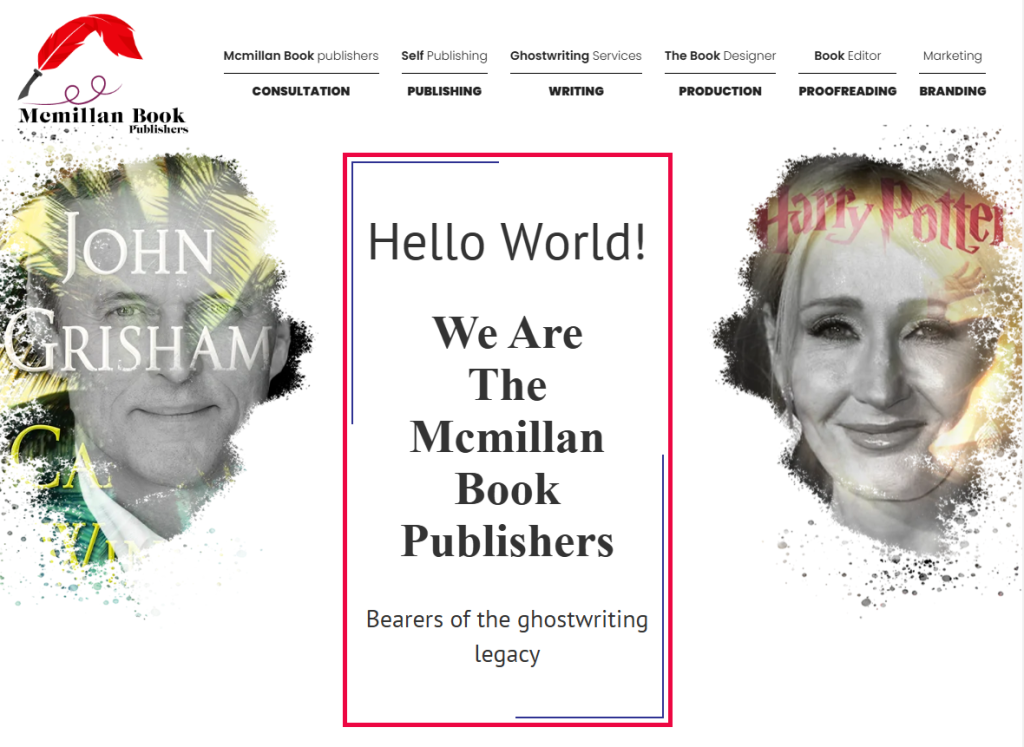
“Mcmillan” proudly bears the “ghostwriting” legacy rather than the “book publishing” legacy, but its website and USA Pen Press’s are otherwise exactly the same.
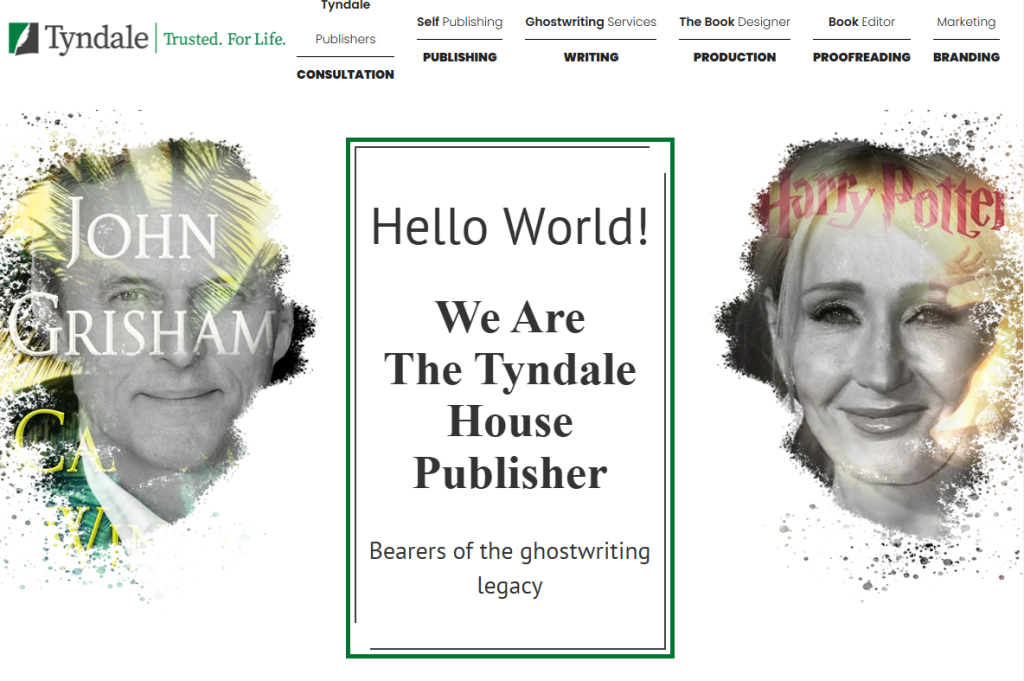
It’s another marker of ghostwriting scams to try and maximize their reach by operating under multiple names. You can often find these by picking a memorable sentence and doing a phrase search. I searched on several phrases, including “Bearers of the ghostwriting legacy” and “Bearers of the book publishing legacy”, and what I found exceeded even my expectations: a network of not 5, not 10, not even 20, but 28 websites linked by the homepage opener above, identical formatting, word-for-word identical content, or all three (there’s a full list at the bottom of this post).
Several appropriate real publishers’ names. Here, for example, is Tyndale House Publisher:
Or HarperCollins Book Publishing:

There’s one for Wiley and a second one for Macmillan (spelled right this time). There’s even–and this made me laugh–one for Dorrance, a vanity publisher. Also, as is very common with ghostwriting scams, several of the sites misappropriate the Amazon name and/or trademarks, including Amazon Kindle Books Publication, Amazon Book Crafting, and Kinetically Defined Pages Publishers (KDP–get it?)
The USA Pen Press scam complex may be the biggest I’ve ever documented, but it’s by no means unique. Here are a few more tips on protecting yourself.
– Be skeptical of social media advertising, especially if the company direct messages you. It may be legit but there’s an outsize chance it’s not.
– If you’re looking for a publishing service, don’t click on sponsored links; they aren’t all scams but many are. Instead, check with the Alliance of Independent Authors, which offers benefits to members and also an annotated list of self-publishing service providers.
– Be aware of scam markers. My Overseas Scams list (link in the top menu) and How to Spot a Ghostwriting Scam post can help.
– Always remember that when you pay for publishing services, you aren’t an author dealing with a publisher, but a customer dealing with a vendor, who has a vested interest in telling you whatever will get you to buy.
– Research, research, research. A websearch on the company’s name may turn up online complaints. Check Angela Hoy’s list. Email Writer Beware: beware@sfwa.org.
– Don’t trust Trustpilot or similar online review sites. Those glowing four- and five-star reviews can easily be bought on Fiverr or other jobs sites (this “reviewer” charges just $5).
Here’s a full list of the websites in the USA Pen Press scam complex. Ghostwriting scam websites have the longevity of mushrooms, and are constantly swapping out names and de-activating links–if you find this post even just a couple of weeks from now, many of these sites will no longer exist. But as of this writing, all of them were active.
USA Pen Press
Premier Book Publishing
Amazon Kindle Books Publication
Macmillan eBooks Publisher
HarperCollins Book Publishing
Wiley Book Publishing
Tyndale House Publisher
Venture Book Publishers
Dorrance Publishing House
Ghost Publishing Agency
McMillan Book Publishers
Kinetically Defined Pages Publishers
Self-Publish Inc.
Book Publisher USA
Chelsea Publishers
Home Easy Writing Services
Alpha Book Publisher
Home Prime Writers Academy
Ghost Book Authors
Digital Book Lab
Prime Publishings
Hexa Publishing
Vanity Book Publishers
Ghost Writing Professionals
X-Atlantic Book Writers
Twayne Publishers
Book Publishers
Amazon Book Crafting
Underwood Miller Publishing

A good way to find a quality ghostwriter is through the association of ghostwriters also online at the authors guild marketplace
Thank you so much. I’ve seen some of these names pop up as Facebook ads. I assumed they’re vanities. Had no idea they’re scams beyond just the vanity pub scam. Isn’t it high time for the US Attorney General’s office to get involved? Thanks for all your hard work.
Thank you for your hard work. Wow! Crooks could start a legit company with as hard as they work on this. Kitty
I am wondering now about Hay House and their related self-publishing arm Balboa Press.
Hay House is a traditional publisher; Balboa Press is their branded assisted self-publishing service provider. Balboa is run for Hay House by Author Solutions, which provides all of Balboa’s services (Author Solutions has a very poor reputation for service and quality, and is notorious for hard-sell sales tactics); really the only functional connection between Hay House and Balboa is the Hay House name. I’ve also gotten complaints about Balboa, as detailed here: https://writerbeware.blog/2013/08/30/more-warnings-spectacular-productions-balboa-press-author-solutions/
Thank you so much for doing this important work. The whole world seems to have a huge dark economy of fraudsters. You are appreciated.
A million thank you, for this invaluable information. It is so frustrating, at times. I will share this with my fellow inde authors.
Thanks so much for this – it’s always valuable to see the lengths these shysters will go to; there are so many people who are certain this or that publisher is legit, because they appear to have an established web presence.
Thank you for all the work you do, Victoria. You help to keep us all safe in the ever more dangerous world of publishing.
Thank you, Victoria.
Now I am really worried. I signed a contract to have my first book published by Austin Macauley Publishers based in the UK, so how can I know from Australia where I live, if there are really a legitimate publishing company? Luckily I don’t see them on your list, and all my communication with them by email gave me the impression that there were the real deal, but I haven’t had any phone contact with them, so it is possible that I have signed up to a scam. What should I do?
They appear to be a vanity publisher, judging from the marketing (their website addresses authors as the audience, not readers)
Bruce, I’m very sorry to tell you that Writer Beware considers Austin Macauley–along with two other closely-related UK publishers–to be vanity publishers, not “hybrids” as they claim. I’ve written about AM and its sister companies here: https://writerbeware.blog/2019/07/12/seven-prolific-vanity-publishers-austin-macauley-publishers-pegasus-elliot-mackenzie-olympia-publishers-morgan-james-publishing-page-publishing-christian-faith-publishing-newman-springs-publish/
Contrary to what many vanity publishers claim, whatever fee they demand covers not just the entire cost of producing a book, but the publisher’s overhead and profit as well. Publishers that rely on authors’ fees as a major profit source have diminished incentive to get books into the hands of readers, or to cut into profits by providing high-quality editing, design, marketing, or distribution.
I’m sorry to give you what I know is upsetting information. Feel free to email me, if you have questions: beware@sfwa.org
A family member signed a contract with Austin Macauley, paid them a significant amount of money to publish their children’s book, and then waited. And waited. And waited. After a year of waiting, with no progress, a partial refund was grudgingly made by Austin Macauley, although that was like trying to squeeze blood from a stone. Good luck with trying to have a sensible or productive phone conversation with them. My family member had to communicate entirely by email, and I believe that the person at the Austin Macauley end was actually replying from Pakistan. 😐
Ron, would you please cut and paste your comment into my post about Austin Macauley, so that writers searching on AM are more likely to see it? It’s here: https://writerbeware.blog/2019/07/12/seven-prolific-vanity-publishers-austin-macauley-publishers-pegasus-elliot-mackenzie-olympia-publishers-morgan-james-publishing-page-publishing-christian-faith-publishing-newman-springs-publish/. Thanks!
I’m sure these will pop up on Facebook as well. Definitely agree with the Pakistan angle since a lot of the newer FB publishing pages have tons of fake likes/fake followers/fake reviews and admins from Pakistan.
Thank you for protecting us Indie Authors, Victoria. Victoria Smith
Thank you so much for all you do for us all. It is greatly appreciated.
This is getting complicated . . . maybe I’ll just stop writing.
Thank you for that. I would also add to your list names of phony publishers. FFS Global of New York, Writing prime of los Angeles, Nate Jordan – claiming to have connections with Netflix. Hemingway Publishers who claim to be screen script writers
Coincidentally, it looks like this is the one-thousandth post on this blog.
I didn’t even notice that! Man, that’s a lot of words.
I hope the publishers are paying better attention than they did when I was warning about on-line infringements. They all have an affirmative duty to police their trademarks, and these sites are doing great harm to their brands.
All of the Big 5 now have Fraud pages with warnings and some of the names/email addresses of the scammers–but for the most part not front and center on their websites, so you have to kind of dig to find them.
Thank you for sharing this information! Every author needs to be aware!
Great expose once again. Thank you!!