
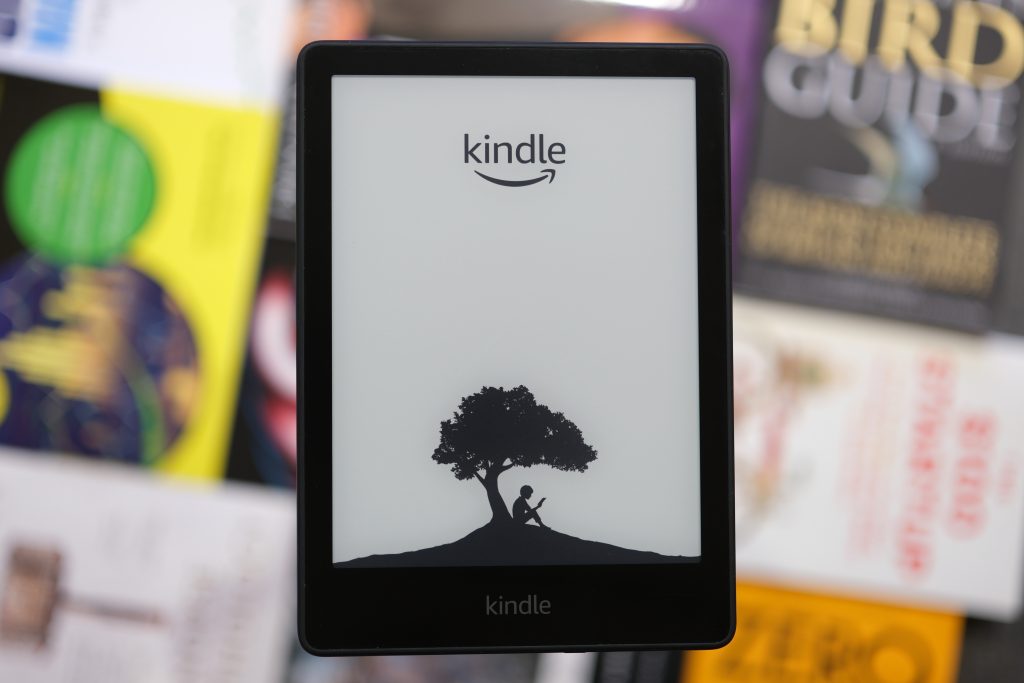
In a recent press release, Amazon noted that some new features were coming to Kindle.
We’re adding new AI-powered reading features that preserve the magic of reading on Kindle. Story So Far lets you catch up on the book you’re reading—but only up to where you’ve read without any spoilers. For our endlessly curious readers, Ask this Book will let you highlight any passage of text while reading a book and get spoiler-free answers to questions about things like a character’s motive or the significance of a scene.
The lead article in today’s Publishers Lunch (PL) is all about Ask This Book, which went live in the Kindle iOS app earlier this week (it’ll be rolled out on all devices and Android OS in 2026). Amazon’s breezy announcement of the feature’s debut describes it as “your expert reading assistant, instantly answering questions about plot details, character relationships, and thematic elements without disrupting your reading flow.” You can highlight a phrase or sentence, type a question into a search box, and AI will generate an answer “right on the page.” There’s a little video to demonstrate the process.
That might sound inoffensive enough. But as PL points out, Ask This Book is, in effect, “an in-book chatbot. You ask any question about the book, and a generative AI process provides you answers.” Which would seem…hmmm…to raise some rights concerns.
Questioned about this, Amazon was not prepared to elaborate, but did note that Ask This Book is not optional for rightsholders:
Our query about what rights the company was relying upon to execute the new feature was not answered, nor did they elaborate on the technical details of the service and any protections involved (whether to prevent against hallucinations, or to protect the text from AI training).
Asked whether rightsholders could elect to withdraw from the program, [Amazon spokesperson Ale] Iraheta wrote, “To ensure a consistent reading experience, the feature is always on, and there is no option for authors or publishers to opt titles out.”
Most of the literary agents and publishing executives PL reached out to for comment were not aware that Ask This Book was live–and some were not aware of it at all. PL quotes one publisher who echoes the rights concerns, noting the need for “both a legal and technical review to understand the process and protections Amazon is deploying, as well as the rights they are relying on to do this in the first place.”
It’s not the first time Amazon has rolled out a new feature without adequate notice or consideration of the rights involved.
For those with long memories it will recall the early days of Kindle, when in early 2009 the company rolled out a text to speech feature that would read aloud ebooks, trampling on audio rights for the sake of being able to do so. At the time, Amazon spokesman Drew Herdener insisted “these are not audiobooks. Text to speech is simply software that runs on devices and reads content.” Simply software.
Pushback from rightsholders was considerable and immediate, and Amazon quickly conceded to make the feature optional, “modifying our systems so that rightsholders can decide on a title-by-title basis whether they want text-to-speech enabled or disabled for any particular title.” They denied any infringement, claiming the “experimental text-to-speech feature is legal: no copy is made, no derivative work is created, and no performance is being given.” Yet they acknowledged, “Nevertheless, we strongly believe many rightsholders will be more comfortable with the text-to-speech feature if they are in the driver’s seat.”
Will there be similar pushback on Ask This Book? As PL points out, “many people would deem the outputs of generative AI analyzing a particular copyright work as the very embodiment of a derivative work (or simply a direct infringement).”
Agents and publishers broadly regard anything to do with generative AI as a separate right reserved solely to the author, and publishing contracts are increasingly addressing this issue. The primary focus has been on preventing unpermissioned AI training, but with the technology embedding itself at warp speed in all aspects of the book business, the rights implications are expanding just as fast…especially where, as here, they sneak in under the radar.
UPDATE 12/23/25: The Authors Guild is weighing in on Ask This Book, which it believes “turns books into searchable, interactive products akin to enhanced ebooks or annotated editions—a new format for which rights should be specifically negotiated.”
We reached out to Amazon with our concerns and they reported to that “The feature only uses content from the book as a prompt which is not retained or used to train the underlying AI model.” An Amazon spokesperson explained that Amazon considers the feature to be “a natural language expansion of the search functionality that already exists in Kindle apps and for which no license is required.”
The AG doesn’t agree with this reasoning.
In creating a chat feature that allows readers to ask questions about a book—including analysis and summaries—Amazon is possibly creating a derivate use, not a mere search function. Amazon has confirmed that it is using a “standalone” instance of an AI model to answer user queries and that its responses are based solely on the text of the book purchased by the user. This may suggest that Ask this Book uses RAG (retrieval augmented generation) technology, though we don’t have confirmation of this. RAG uses, for which there is a growing market, are typically licensed.
Bottom line: the AG believes that AI-driven enhancements to books must be licensed and compensated, and that Amazon’s unliateral, unlicensed, no-opt-out incorporation of Ask This Book into the Kindle “sets a dangerous precedent for the future of licensing for AI features.”
UPDATE 12/30/25: In a followup to its initial writeup on Ask This Book, Publishers Lunch reports that the Authors Guild has been sharing concerns with Amazon about infringement of authors’ rights.
Ask this Book, they say, “turns books into searchable, interactive products akin to enhanced ebooks or annotated editions—a new format for which rights should be specifically negotiated.” Amazon’s counter is that the new feature is “a natural language expansion of the search functionality that already exists in Kindle apps and for which no license is required.”
Neverthless, Amazon appears to have made some changes.
When we first reported on Ask This Book, it would analyze the full text of the book and answer questions about the book in full. Now, the AG writes, “After complaints that the chatbot was providing spoilers, the application appears to be limited to text already read, and responses now seem to refer to the selected text. When first released, the feature answered questions about the book as a whole and provided analysis, but is more limited now, often answering that it does not have the information sought.”

This feels like a quiet but significant line crossing. Framing Ask This Book as a “natural language expansion of search” glosses over the fact that interpretation, analysis, and spoiler-free explanation are not neutral retrieval actions. They are value-adding transformations of the text.
The lack of notice and the no-opt-out stance are what really stand out here. Even if the model is not training on the content, turning books into interactive, AI-mediated experiences clearly changes the nature of the work and the reader’s relationship to it. That is something authors and publishers should at least have a say in.
The 2009 text-to-speech parallel is a good reminder that Amazon has been here before, and that pushback mattered. This feels like another case where convenience and platform control are moving faster than rights clarity, and where “just software” arguments don’t quite hold up under scrutiny.
As I see it, real readers won’t use it. It distracts from the reading experience. Readers with squishy brains will. Let them. They continue to ruin their reading experience in many ways and let some areas of their brain go lazy (dormant). The old saying, “If you don’t use it, you’ll lose it,” is fact.
As for money, it won’t make a difference to my books. I’ll still generate income.
As for stealing ideas and such, we are living in a fluid world. Things come and go; one day we own something and the next we don’t. Once we release a work into the universe, we have lost control over how it is used. We can fight to regain control, but it is futile and a waste of creative energy. The only way you truly maintain control is to keep your story locked in a drawer where no one will read it. I won’t live that way. I can’t live that way.
As for AI, it’s here only until the grid goes down. I don’t feel threatened by it because the grid is overdue to go down, some predicting within the next five years.
As for eBooks, they have been a great income and have reached readers worldwide, but unless you have print copies (which AI can’t touch), the eBook is a temporary product. It can vanish in a second and will when the grid goes down.
If writers want to opt out of this new Amazon feature (which undoubtably will spread to other electronic book sellers), they can just have print books. Of course, there will be a price to pay in lost sales.
As for me, I will enjoy this blip in time, writing and sharing my stories with readers. I will not spend time worrying about which book sellers will ‘steal’ my ideas. The world is changing fast, and we can either fear every step or just release that negative energy into to the universe and enjoy the ride. I choose to enjoy the ride. Write on.
The main concern for me is the lack of an opt-in or opt-out feature for authors. For well-known and classic books I assume the AI will regurgitate what is already on the internet in terms of theme. etc., thus giving my high school students a new way to cheat, lol. But any living author who still owns her own copyright should be able to opt-in, or not. I personally would prefer opt-in, because an opt-out option will miss a lot of authors who will be unaware of the feature. If the author has to opt-in, that is an intentional act that proactively says, “Yes. I want this feature on my books” In my opinion, this should especially apply to KDP for indie authors. It should be a negotiating point for trad pub authors.
I have a 5th generation Kindle so I cannot test Ask This Book feature. Does anyone here have this feature on their current Kindle? We are told, it’s live already. If so, please test it out and post your findings.
Entrapping “Ask This Book” in a copy of Joyce’s Finnegans Wake will be our first act of fighting back against the siliconic LLM bastards.
Sounds like a perfect Captain Kirk move, like when he distracted an evil entity in the computer by directing it to calculate pi to its farthest number, lol!
Good analogy. Although, as you correctly pointed out, it could simply cough up reworded data from A Skeleton Key to Finnegans Wake, The Encyclopedia Britannica, the internet, et al.
But clearly, it deserves a ~pi in the face~ !
I note with interest that my grammar-correcting keyboard is attempting to force an apostrophe into “Finnegans.”
Oh, the irony in which we “currently” swim.
I find it offensive that this AI will determine what the author intended. How the $#@& going to tell the reader what I was thinking?
I think it’s time for authors, indie authors especially, to have a mass exodus from Amazon. I am beginning to look at alternatives. Someone suggested kofi to me and a new site called YEARN is opening.
I sell my e-books via my website.
How do you do that?
I think you’re right. I think it’s time for Indie authors to look at other options…and only sell paperbacks at Amazon. That might send a message.
It’s stealing. Pure and simple.
I have another thought about Amazon’s AI “ask this book”-feature.
It means
– scanning every book into a database
– analyzing every book for plot, characters, descriptions etc.
– storing reader questions and answers
It’s a training ground for authors.
In other words, they are using our books and the readers’ interest to train their OWN WRITING BOT.
Why are they doing this?
To cut out the creators. Just like Spotify, Amazon wants to produce AI books that sell.
Spot on Hannah. It is a cover way to get an author’s creativity into AI for their own purposes.
I have no problem with this. Automatic text to audio (which does not require AI at all) even less. As goes this new feature the only rights issue is in the AI training phase. I have opened all my books (3 nonfiction, 5 novels) to AI. As long as it is not used to *republish* the book itself, I don’t care.
I have a short essay on the subject on my blog at this link: https://ruminations.blog/2024/11/12/a-i-can-have-my-stuff/
This seems to me to be another way to accelerate the increasing dumbness and inability to think. Readers are supposed to work these things out for themselves, not be spooned, AI or not!
I don’t know why thus us being done. Oh, wait! If we can’t think for ourselves we’ll be easy to manipulate.
If I were not published by a small publisher, I’d definitely pull my books from Amazon, but I don’t have the authority to do that.
Gee, I totally trust a massive company owned by oligarchs to correctly summarize the subtext of books criticizing massive companies and oligarchs. Because thinking is dangerous, as we all know, so it’s better if we just outsource it altogether.
It takes away your critical thinking skills and assumes you need someone else to highlight for you. Interesting. I have a kindle 5th generation. I don’t believe it has this feature.
“Reading assistant.” Good bloody gods, that is insulting as frack! It is inconceivable that most readers will want this “feature.” It seems reasonable to conclude that most readers using Kindle keep the WiFi off anyhow, which one can hope disables this AInsult disabled.
I am fortunate to have a Kindle reader that is too old to have its operating system updated.
Aside from the impossibility of AI knowing exactly what my thoughts are about my characters’ motives or a scene’s significance, it’s the knowledge that AI can hallucinate. Once a hallucination is created, it can take on a life of its own. These hallucinations can easily spread across social platforms. Even worse, these hallucinations can be used in AI training. The author’s story intentions are at the mercy of what the AI model determines they are. This can be dangerous.
‘Aside from the impossibility of AI knowing exactly what my thoughts are….”
Alas, I fear that one day soon, AI’s will. {wry grin}
I don’t ~need~ a g*ddamned “reading assistant” any more than I need their vapid “cheerleader” BSware telling me “you’re on a reading streak now!”
It’s like being forced to attend Disneyworld at the tip of a Glock.
Disgusting trashware coded by mental midgets.
FFS, let’s go ahead and quit reading and writing altogether while these emotionally-crippled tech dolts Midas-touch the human equation into oblivion.
Meanwhile, untalented bastards and whores cheer it on!
Progress!
Delusional jackasses.
This is why I find the vanishing IT and coding jobs due to AI so exquisite.
They did it to themselves.
Enjoy your obsolescence.
You never deserved the job anyway… Could no more write a quadruple nested IF/THEN module than you could play chess.
Godless cut and paste script parrot pirates.
(See what I did there? Parrot? Pirates? As in pretend hackers? YOU’RE WELCOME FOR THE HIGHER AUTHORITY’S LEVITY.)
Amazon is a cancer.
It will be your undoing.
Deliveresld to your pathetic door.
Next up… Amazon handling all the dead bodies.
Just
You
Wait.
(use your imagination)
Btw, any marketing embryo could tell you the word “Kindle” is an AWFUL name for a product.
What was up with that?
Undercurrent Thanatos?
I get so ANGRY at the CONSTANT MONKEY ABERRATION of being UNABLE to stop “fixing” what isn’t broken.
Humans will SUCK until they become extinct.
Welcome to the REAL Disneyland rides.
I t(h)rust you are “this high”?
Maybe I will put my kindle under an old fashioned ~Luddite~ BOSS CNC endmill and video record a few micron shaving passes until the device gives up the ghost, and then put the video on various social feeds.
Random: Imagine society one hundred and fifty years from this moment.
There there. I know. Have a tissue. Take all you need.
I purchased ten boxes of Kleenex on Amazon.
My normal Zen Buddhist calm has definitely been compromised by Amazon’s latest shenanigans.
Some “experts” have already concluded that about 17% of the Information Technology and related fields have already been fired due to A.I. replacing them.
I asked an online A.I. to write an application for iOS in React Native based on my criteria, and the damn thing did.
Genesis is SkyNet! {not really, but frack!}
I was able to return to Zen Buddhist equilibrium, but it took a six-pack of Dr. Pepper, a box of Sociables crackers, and two cans of Easy Cheese in a can.
Nearly every day, authors are faced with additional challenges while navigating an industry, that was, let’s face it, already filled with enough pushbacks, pitfalls, and problems.
I’m going to gain a hundred pounds if I keep consuming “destressor junk food.”
Oh, terrific. A chatbot has been invented to do the hard work of reading my books. It will summarize the plots, provide helpful answers about what motifs I’ve used in the plots and what they symbolize, what makes my characters tick, what themes the books have, what message I am trying to convey – heaven forbid my readers engage with my writing or do the hard work or reading or thinking, because now there is a bot to do all that for them!
“Bringing back the magic of Kindle”
Yes, if by “magic” you mean “brain rot.”
And let’s not forget the potential for plagiarism and intellectual property theft.
Since Amazon has practically cornered the market on e-books, good luck opting out of this abomination unless you want your work to be print-only, which for an indie author means impossible to market. (Also, Kobo, Barnes and Noble Nook, etc will probably follow suit, anyway).
THANKS, AMAZON! I HATE IT!
BEWARE of AI AND AMAZON TOGETHER THEY WILL RUIN YOU AS AN AUTHOR
AMAZOM TRIED TO SELL MY BOOK AS A FULL BOOK WHEN ITWAS A MOCKUP BY MY FIRST PUBLISHER XILBRIS
Print is king once more.
I’ve had a review on my book where the reviewer completely got part of the character’s actions incorrect and can’t even flag it for being incorrect. What the heck will happen when AI starts doing the same thing??
I do not believe this is acceptable. When it comes to peoples rights and the rights to what they create, especially now in the realm of AI, companies should be checking if it is okay to implement anything AI related.
I personally will stay away from Amazon and publishing my books there. I would encourage all authors to move away from them. There are many other channels where books can be sold. People fear that if they’re not on Amazon their books won’t be successful. Not true at all.
If enough people move away Amazon will have to start showing respect before implementing actions that affect or could affect people’s rights.
We have all heard about too big to fail but some organisations aee becoming too big to care and that is dangerous. The only power many of us have is to vote with our actions and choice and that is more powerful than we believe…
my 3d book in The Continuing Saga of Rikki Tikki Tavi was released a few months ago and i really am ticked off that people aka AI is taking advantage of possession to think they can do what they want and not pay the consequences. personally, i wouldn’t want a book’s plot “revealed” to me until i READ it. i don’t quite understand what this AI stuff is about but i know i don’t want somebody or something taking the credit for what i did and i don’t get anything to show for MY work. i appreciate all this update but i’m 74. i remember phone booths, manual typewriters and prayers in school and wish it would all come back!
Amazon no longer lets rights holders opt out of text to speech. I tried with one of my last books.
I hate this. I doubt if we’ll lose money because of it, but I hate this crap being shoved down our throats without an opt-out option. And frankly, they always fuck it up.
The inability to opt out is especially galling. Even though, if that right existed, it would be given to publishers rather than individual authors.
Thank you, Victoria, for posting the disturbing info about Ask This Book. The under the table method fits Amazon.
Bailey Herrington
Come on, guys. You want to stop water from flowing downhill? AI is here to stay, and you know very well that it’s useful to our culture. If you’re afraid of losing money because AI can summarize your book, you don’t understand how life works. Revisit that issue quick(ly). Then, use your creativity to make money with the help AI can really offer you if you take the time to look at it. Right now, you’re the “old guys” in the room. Learn or be swallowed. Up. You know, some people didn’t like electricity. You can join them even now. Call your local Mennonite or Amish community.
The issue here isn’t luddites bemoaning the adoption of generative AI, but rather the conflict between rampant AI development and copyright law. We writers don’t necessarily want to shut it all down–but we do want our rights to be respected, which means that a company must license (and hopefully pay for) the use of our intellectual property if it wants to create derivative works from it.
Yes. I totally agree with you.
….And as responsible authors – within the Publishing Industry – we have a right to:
1. Ask a simple question: “IS Amazon a monopoly within the Publishing Industry?”
2. Do the United States Monopoly Laws apply to Amazon?
So I take it you’re opposed to the creation of, say, the FPC in the 1920s? Not to mention the myriad other federal- and state-level laws and regulations since the advent of electricity…
Other people can argue on the merits of this, but I can’t get over your metaphor. “You want stop water from flowing downhill?” As though that’s some kind of impossibility.
People have been stopping water from flowing downhill since recorded history. It’ called a dam. Stopping water from flowing downhill is so easy that there’s even a kind of rodent that can do it.
Great reply!
Cool. Since chatbots are notoriously incapable of “understanding” context but excel at providing answer-shaped responses, the future for authors is getting screamed at on social media when they disagree with the all-knowing bot about what they wrote in their own books.
I wasn’t done being angry about KDP making it mandatory to allow PDF downloads if you want your ebooks DRM-free, but there’s always more room for anger toward Amazon!
Goodness, I feel so behind in all these tech stuff. I will try to understand how this feature works when it comes out. It seems like soon the bots will read for us and regurgitate our own words.
Oh, wait, they already have. Sigh.
Are they saying their AI will determine what a character’s motive is or a scene’s significance. Answers to reader queries might not be apparent in the prior text, especially motive, which might be revealed later in the book. If this is the case my books are coming off Kindle. Patricia Vestal.
I agree with you that when this comes out, one must pull one’s e-books off of Amazon and go elsewhere. I would, however, leave my paperbacks on the market. Maybe paperback might come back full swing.