Latest Posts

Bad Contract Alert: Webnovel

Post header: Webnovel logo

A bit over two years ago, I wrote about two companies, A&D Entertainment and EMP Entertainment, that appeared to have been deputized by serialized fiction app Webnovel (one of the biggest players in the serialized fiction space) to recruit authors to non-exclusive contracts. The contracts from both companies were (and continue to be) absolutely terrible.

EMP Entertainment no longer appears to be active (it has no website and I've heard nothing about it since 2020), but A&D is still going strong, and over the past two years I've been contacted by a lot of (mostly very young and inexperienced) writers who are confused about its complicated English-language contract, or have changed their minds after signing up and want to know how to get free (as with the contracts of so many serialized fiction apps, there's no option for the author to terminate).

A&D recruits via a bait and switch. Writers are solicited by an editor or Author Liaison who claims to have discovered the writer's work on Amazon or elsewhere, and invites them to publish on the Webnovel platform (the bait).

Copyright Claims Board: Mid-January Update

The Copyright Claims Board, the new tribunal for small copyright claims in the Copyright Office, started accepting claims last June 16. As of January 11, there have been 281 claims filed (plus seven so far in 2023.)  Of those filed, there have been 145 orders from the Board dismissing the claim, 84 amended claims, and 16 opt-outs.

Significantly, there have only been eleven Scheduling Orders – cases declared active by the Board - most within the last month. This is the first step in a case after the claimant has successfully jumped through all the hoops necessary to follow the Board’s procedures (including paying the full $100 fee.) The order schedules a timetable for the next steps, starting with the respondent’s response to the claim.

Things move slowly at the Copyright Clearance Board, but that’s actually the way it was designed. Both claimants and respondents have plenty of time to act, and, at least theoretically, everyone should have enough time to take the actions that are required of them in the process.

The Best of Writer Beware: 2022 in Review

Header image: the number 2022 in neon on a black backround

As 2023 gets underway, it's time again for Writer Beware's annual look back at all the schemes, scams, pitfalls, and publishing industry craziness we covered in 2022.

A New Home for the Writer Beware Blog: After many years, Blogger (our previous home) finally got too small for us, and we transitioned to Wordpress. How that came about--and the benefits thereof.

Some important publishing industry initiatives kicked off in 2022.

Happy Holidays

Header image: candles burning in the snow

I can't believe it's the end of another year--where did the time go?

From Michael, Rich, and me, best wishes for a healthy, safe, and joyful holiday season, however you choose to celebrate it. Heartfelt thanks, also, to the many readers, writers, and industry professionals who share their stories with us and help to spread the word about Writer Beware. We couldn't do it without you.

We'll see you in January!

The “Mexican Film Director” Scam

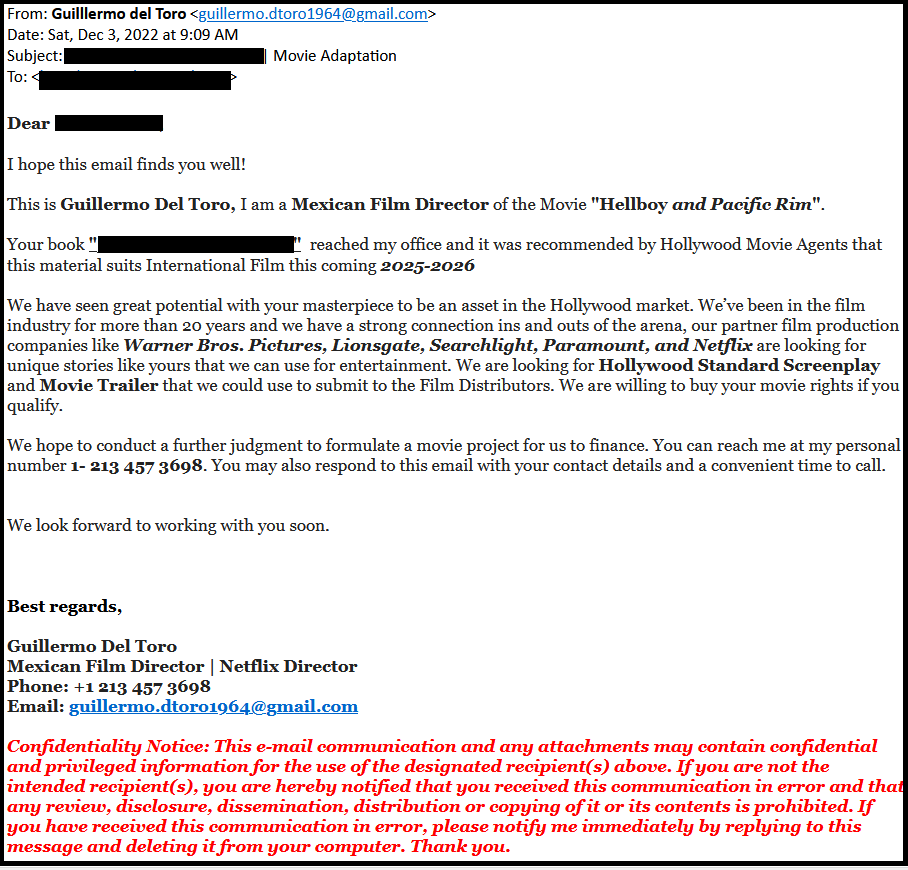
Solicitation email supposedly from Guillermo del Toro offering to buy movie rights

If a rash of solicitations over the past few months are to be believed, there's a major rush down in Mexico to acquire film rights to books.

These virtually identical emails are, of course, laughably bogus--from the peculiar capitalizations, to the anonymous "Hollywood Movie Agents", to the implausibility of these supposed directors bollixing up their own movie titles, to the unlikelihood of famous film folks personally soliciting authors via funny-looking Gmail accounts--but they have been briskly doing the rounds since this past summer, and I've collected quite a trove of them thanks to the many authors who've sent them to me.

Obviously a scam, in other words. But what's the endgame?

Why You Might Not Want to Use Wire Transfer or Payment Apps to Pay For Publishing Services

Header image: Zigzags of yellow Caution tape on a white background (credit: heromen30 / Shutterstock.com)

One of the few remedies available for writers who've been ripped off by scammers is to file a payment dispute.

This is possible if you've used a credit card or PayPal, and are within the window of time in which a dispute is permitted. In the USA, credit card companies are required by law to give consumers up 60 days from the time they receive their bill to dispute a charge, though many companies allow for a longer 120-day period (the Consumer Financial Protection Bureau maintains a database of US credit card company agreements where you can look up your company and see what their policy is). They also cap consumer liability at $50. Protections for UK credit card users are similar.

For PayPal, the dispute window is within 180 days of purchase.