

Babelcube
Babelcube is a platform that matches publishers and self-publishing authors with freelance translators to produce foreign-language versions of their books. Authors and publishers can post descriptions of their books for translators to bid on; the author can then select the offer they prefer. Translators can peruse book descriptions and bid on books they’re interested in. Payment for both author and translator is a revenue share of sales income, with Babelcube taking an administrative fee of 20%.
I’ve long been a bit skeptical of Babelcube. Book translation is much more than simply rendering words in a different language; both skill and artistry are needed to capture the author’s voice and style. Running the text through Google Translate or another translation program won’t do that, even with some by-hand tweaking. Also, authors are able to cancel projects if they don’t like the quality of the translation–but how do you vet quality in a language you don’t speak?
I don’t doubt there are honest translators at Babelcube, and satisfied authors too. But the potentially very low pay (revenue-share arrangements are always highly speculative) would seem to attract a lot of non-professionals, with all the quality issues that implies–not to mention the potential for scammers looking to make money with a large volume of quick, shoddy translations. (One example, shared with me by a translator: an English-language book whose title included the word “rake”–as in philanderer–and was translated into Italian using the word for the garden tool.)
More recently, I’ve been hearing from both authors and translators who report several issues: royalties not paid on time (some authors told me they’ve been waiting for months), royalty reports and tax documents not received, rights not reverted as requested, and no response from Babelcube to questions about these problems.
It’s not a huge volume of complaints, especially compared with what a large platform Babelcube is; but it does suggest that caution is in order. See also this article from a translator on the risks of working with Babelcube.
Barnes & Noble Book Order Scams
There are two of these going around.
The first is a continuation of this scam, which is impersonating several different bookstores. Authors receive a solicitation informing them that B&N wants to stock 3,000 copies of their book. B&N will “shoulder for” printing and production costs; all the author has to do is pay $1,000 for “shipping and handling for the distribution”.

The scammer claims this arrangement is “the most common term bookstores around the world are following”, which of course is completely false. Bookstore orders are transactions between bookstores and publishers; there is never a cost to the author. Nor do bookstores fund the production of the books they stock, or pay royalties. Both are the publisher’s job.
The second B&N order scam is courtesy of the generically-named Book Publishing Company, whose website ticks most of the boxes of a ghostwriting scam. Authors who engage the services of the Book Publishing Company quickly receive an email announcing AMAZING NEWS: Barnes & Noble has sent a “letter of acceptance”! Here’s the (extremely fake) letter:

Once again, not how book ordering works: authors aren’t involved in these transactions, nor do bookstores set royalty rates. Nor do bookstores (reputable ones, at any rate; there are other kinds) charge “shelf space rent”.
Note that no fees are mentioned. Instead, the author is directed to contact Book Publishing Company, aka the scammer, to “consent” to the order. When they do, they’re informed that this incredible opportunity will cost them $4,500–a substantial chunk of change, sure, but a mere trifle compared to the $25,500 they’ll make on 1,500 sales!
I haven’t heard (yet) from any authors who’ve fallen for either of these scams–just from writers who encountered them and were suspicious enough to check with me. But I would guess that authors who pay never hear from the scammers again.
Audiobook Order Scam (Featuring a Fake Non-Profit)
This one comes courtesy of 20/Twenty Literary Group, a fake literary agency with a roster of imaginary agents that does all the things that real agencies don’t, and none of the things they do. It’s operated out of the Philippines by Bridgebooks, which runs a number of other scam operations in the USA and other English-speaking countries (a full list is here).
Its latest gambit: an audiobook order scam.
The author is contacted by one of 20/Twenty’s imaginary agents with an offer to re-publish the author’s book–for a fee, naturally. Shortly afterward…surprise! The author gets a call from a Jennifer Lim, who claims to represent a society for the blind. Jennifer wants to order 5,000 audiobooks to be distributed to the society’s members! Naturally, 20/Twenty can oblige. The cost is steep–but oh, those royalties!
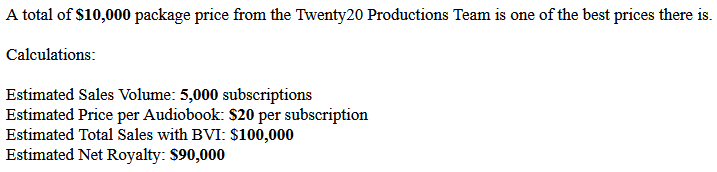
Yes, it’s a total ripoff. But that’s just the start.
See the reference to BVI? That’s the initials of the society for the blind on whose behalf Jennifer Lim placed the order: the Foundation for the Blind and Visually Impaired.
Would a real non-profit organization contact an unknown author out of the blue to order thousands of audiobooks that the author didn’t even have? Seems a bit improbable. BVI’s website looks legit enough–at least, to a casual inspection, but you know I never give anything potentially scam-related a casual inspection. Closer scrutiny reveals some oddities: getting the foundation’s name wrong in a couple of places, a November 2022 domain registration that doesn’t match BVI’s claim to have been founded a decade ago, and a Baltimore address that’s the same as that of a different organization for visually impaired people, the National Federation of the Blind.
What’s the likelihood of two major non-profits serving the same constituency cohabiting in the same space? I would say small.
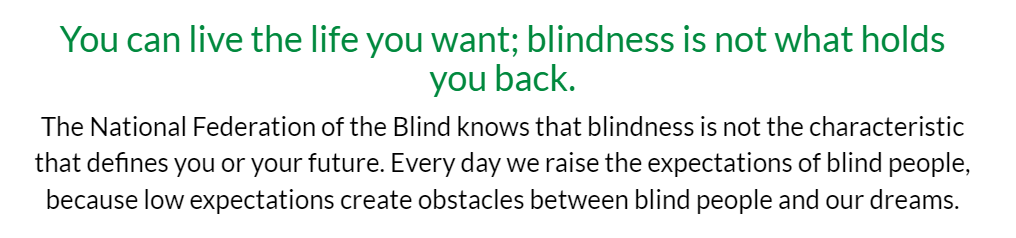
So I did some content comparisons. Sure enough, almost the entirety of the BVI website has been plagiarized from NFB’s. There’s been a lot of re-wording, but it’s recognizably the same content. From NFB and BVI home pages:

Their eerily matching Advocacy pages:
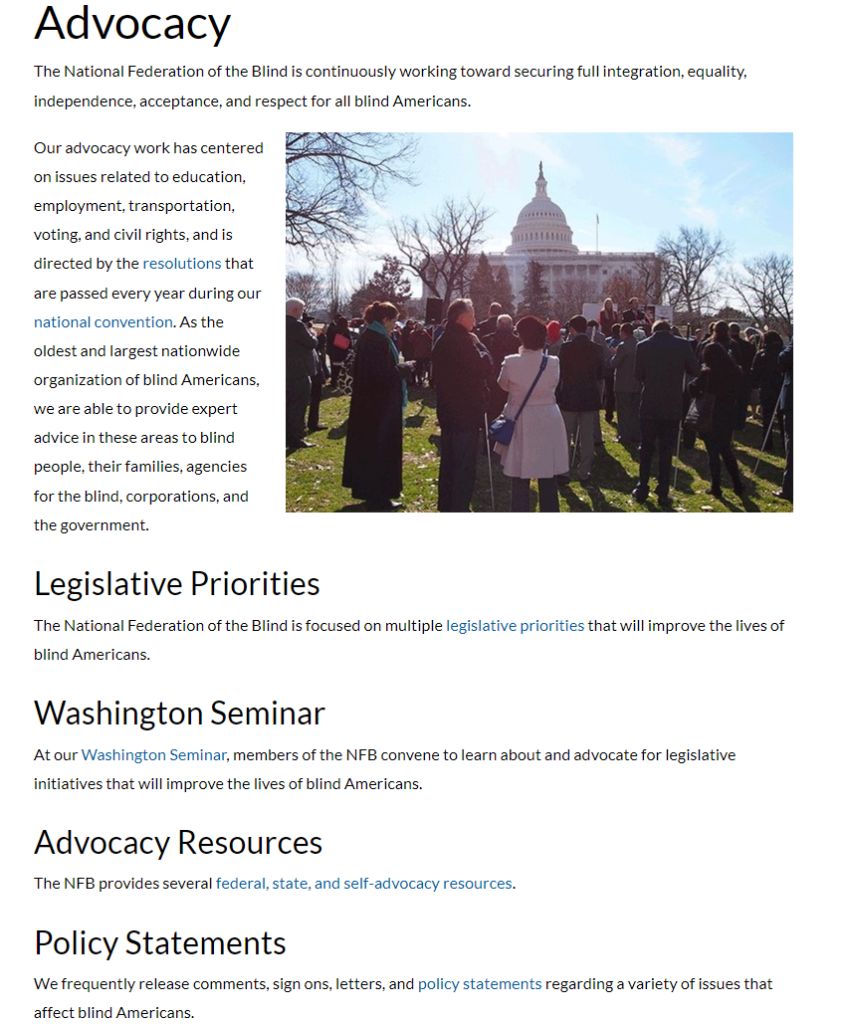
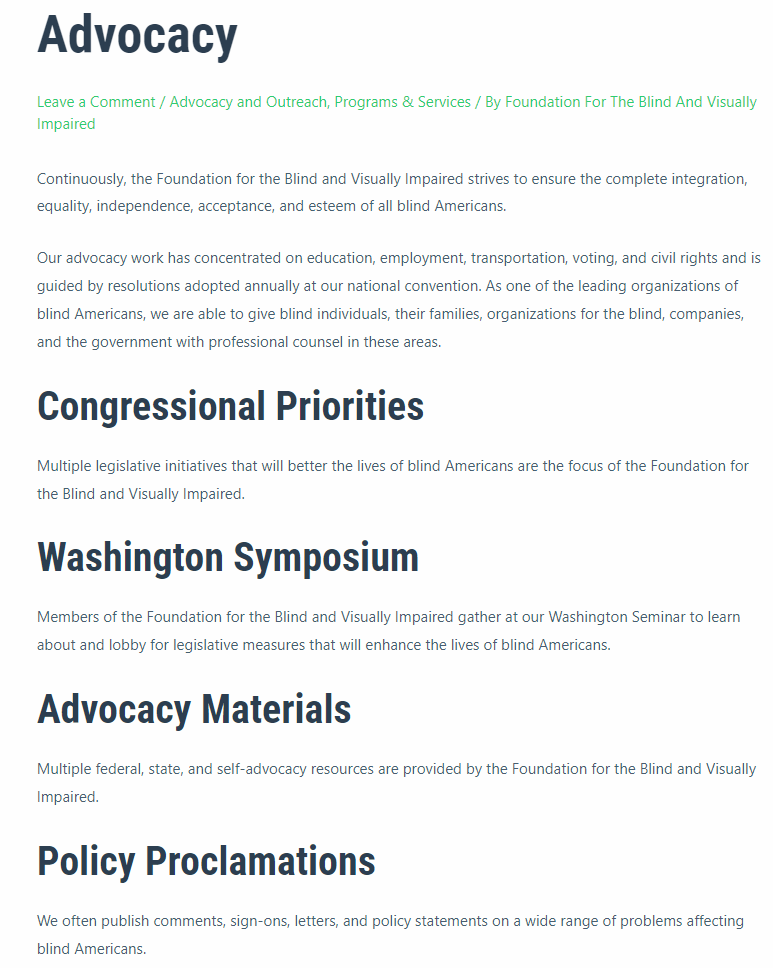
I could go on…and on…but you get the picture. The “Foundation for the Blind and Visually Impaired” is a fake–nothing more, apparently, than an adjunct to an audiobook order scam.
It kind of astonishes me that the 20/Twenty people went to this much trouble–it’s not the first time scammers have created fake organizations that mimic real ones to fool their victims, but BVI is definitely the most elaborate (and certainly the most cynical).
I contacted the NFB to let them know about this theft of their content and mission. As usually happens when I try to alert people or groups that they’re being impersonated or otherwise targeted, I got no response.
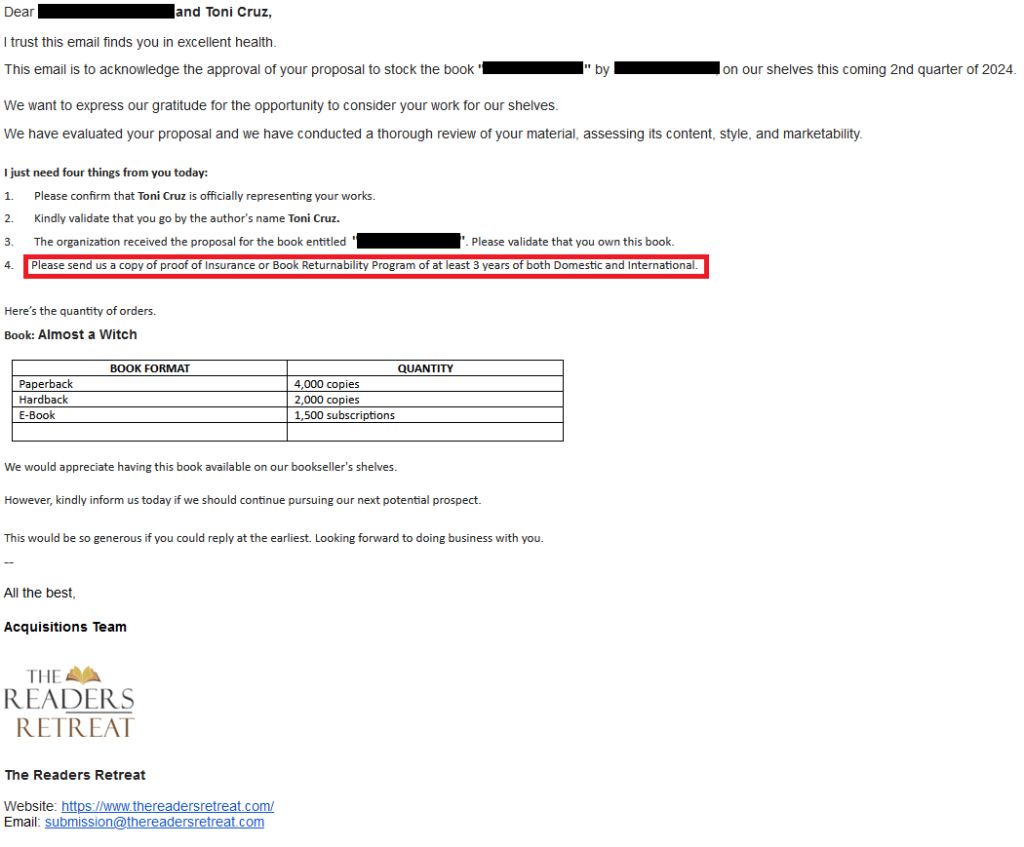
UPDATE 1/28/24: As an alternative book order scam, 20/Twenty has created The Reader’s Retreat, which places fake bulk orders for physical books. Just one catch: the author has to have (meaning buy) “book insurance” (there’s no such thing) for as much as $9,000. Here’s the Reader’s Retreat “proposal” (note that they slipped up on item 2, where they should have entered the author’s name and instead entered the name of the 20/Twenty “agent”):

I got scammed by Archway Publishing out of $2700.00 they wanted two more payments of that price. My first payment went through and I am trying to recoup it now. Beware of that stuff. Also I am Leary of Barnes and Noble Experts. I don’t know if they are legit but they want $1000 to publish.
Barnes and Noble Experts is a scam, like the ones described here: https://writerbeware.blog/2022/01/24/how-to-spot-a-ghostwriting-scam/. Scams of this type often “borrow” the names of well-known publishers, or booksellers like B&N.
Re Babelcube translation… I have no problem with my translator. She was awesome and is in agreement to remove my translation from sale since it’s done very little in sales. (Which seems odd to be honest) Babelcube, however, is utterly hopeless to deal with. It took them ages to publish the title, and despite promises to take the copy off sale this year, they still haven’t done so after 5 months of emailing. Blamed their distributor’s automated process in April and promised to look into it. But I’ve not heard from them since, and the book is still published in multiple places. My warning to other authors: stay far away from Babelcube.
I received yesterday a formal, well formatted and well written email from “Jordan Kendrick B&N Marketing” at “jkendrick.barnesandnoble@gmail.com” — offering to put my new book, Myers Flat News, on Barnes & Noble’s brick and mortar shelves for the modest investment of $500 for 1500 copies –just as you had warned in your excellent blog. The days of being able to catch a scam by looking for misspellings and other errors, as well as no official email address except Gmail — are long gone. Thank you for your Blog and your work. Carol Ruth Silver
I can testify that this is true concerning Babelcube who defrauds authors and translators of their earnings. They even have deactivated their contact us button on their website. They keep renewing my books to sell it even after I have used different means to request termination of contract with all my books. You cant even delete your books. I went on their website and contacted all the sponsors and whoever I could find that was featured on their website with some response. I even went on linkedin to call them out for their fraud and have even reported them to linkedin for fraud. The owner Carlos Granados profile is also still there. I contact them on support@babelcube.com and Jona Gonda responded but when I asked for details and cancelation of contract even deleting my content she stopped responding. So yes I would warn people if you love peace and want to avoid scammers down the line do not upload your precious work on their platform. Barnes and Noble still sells my books without my consent. Its a shame.
I received the email from Jordan Kendrick at “B&N.” Having worked in the corporate world for over forty years before I chose to take up writing novels, I learned a simple trick for spotting fake emails. Look at the email address. If it doesn’t end with the companies name, something along the lines of @barnesandnoble.com, it’s not likely to be a real address. A perfect example is this one, Jordan Kendrick B&N Marketing . It ended in @gmail.com. That’s a free email and although this person tried to hide his fake ID on the front end of the @ sign, I wasn’t fooled ‘much.’ As I shook my head, leery that it was fake, I decided to check it out, just in case because the email came to me, not my pen name’s email. I mean I would like to see my books put on the shelves of bookstores after all. Sure enough, you had this post indicating it was fake. There are a couple of other locations also telling the world this guy is a scammer. Oh well, nice for about two seconds to think that B&N might actually want my books put into their brick and mortar locations.
Despite my suspicions, I was roped in by “Fiorella DeLima” as a book placement specialist and “Jordan Kendrick” as a “marketing director” at Barnes & Noble. I did give them some money before I realized it was all too good to be true, but they present themselves with a Barnes & Noble logo and a slickly designed package that had me hooked. Of course, they don’t provide a phone number, and the email is gmail, not a corporate one – that had me wondering from the outset, but my ego got in the way of better judgment.
If you paid by credit card, I’d encourage you to dispute the charges, even if you’re beyond the window for doing so–banks and credit card companies are often willing to work with fraud victims.
Babelcube is an absolute pain in the neck. Just to fill some time I decided to translate two more books for an author. The first one I did for her still is not on Amazon, and also it took them over a year to get it published! The second one I did last year has not been published at all so far. And the third one, well, I did not even get a response from the author!
I have written to Babelcube several times and never got an answer.
I don’t think I will ever translate there again.
Missing from your list is Tektime, which is also horrible for various reasons. They automatically are deducting Italian taxes from your royalties. If your country does not have an agreement with Italy to avoid paying tax twice, you will get your royalties minus 30%. The author I was translating for is in the US and has no way of claiming the money back. I am in the UK, have filed the claim to the Italian authorities two years ago and never saw a single penny.
I think I shall continue to translate as a freelancer.
Hi Victoria, I love this article and your insight. I see, with Jerome, you stated those two publishers as scams on your list. So, I wanted to ask what is your take on iUniverse? Is this self-publishing aid a scam as well?
iUniverse (like the other Author Solutions imprints) has a poor reputation for service and quality, and is notorious for high-pressure sales tactics. I’ve written numerous posts about Author Solutions, including coverage of lawsuits launched against it; you can see them all here.
Can you direct me to some publishers known for credibility and preserving the author’s rights? I have a poetry book completed and have yet to find a publisher that I find is trusting.
Writer Beware doesn’t provide publisher recommendations, but you can find extensive information, along with resources to help you find and vet appropriate publishers, at our Small Presses page.
This is one advantage of having a teeny budget. No way could I ever afford these prices anyway, even if I wanted to.
That makes it very, very important not to sign BAD deals even though they may look good. I’ve been a victim to a “turn-your-book-into-a-movie”-scam and although money wasn’t mentioned I’m sure that that would have been the next step: No money or not it would have been tempting to “take a chance” ….
Well, I really, really hope that there are some good and honest publishers left for good and likewise honest authors ….
Many. You just need to know the warning signs (solicitation is a big one) and utilize trustworthy resources. There’s information to help at the Writer Beware website (as distinct from this blog).
“Book Publishing Company” seems like a mail merge blank someone forgot to fill in with a real imaginary publisher name.
One time I had a scammer contact me about wrapping my car in advertising for a somewhat well-known local company. I tried to alert the company that they were being used in a scam but never heard anything back. Maybe they just figure, especially in this case where their name isn’t really being used, that it’s not their problem or it’d take too much effort to do anything about it.
That has long been the case with the legit publishing industry re: writing scams: not really in the same universe, so who cares? But now that agents and publishers are being actively impersonated by scammers, they’re taking a bit more interest.
Thanks for all this information ..I am publishing with WorkBook Press in Nevada it’s been a long drawn out process but is coming to fruition but they did an overdraw on my account.
Also working with Stonehenge Literary press…a press release on my illustrated book for the Manila book fair reveals no indication the writer has seen my book. Merci
Jerome, I am really sorry to tell you that both Workbook Press and Stonehenge Literary are on my list of scams from the Philippines. I would definitely advise you not to give either of them more money.