
I doubt that there will be anyone reading this article who hasn’t been targeted by a writing scam. That’s how prevalent and aggressive they are these days.
Fraudsters who prey on writers employ a variety of methods to recruit clients: advertising (especially on Facebook, which is awash in ads for scam publishing service providers), sponsored links on Google (plug “find a publisher” into Google, and the top results will be for scam or vanity publishers), social media activity (watch out for seemingly friendly DM contacts)–and, most often, direct solicitation via email and phone calls purporting to offer publishing or agenting or film adaptation services…and, increasingly, impersonating companies and professionals in those fields.
Real, reputable literary agents and publishers and film production people, by contrast, rarely reach out to writers directly. But while that’s true 99% of the time, you can’t say it never happens. And for writerly activities like conferences, or interview or lecture invites, direct contact is common.
So how do you distinguish the rare genuine contact from a scam solicitation? Often, the first clue is the sender’s email address.
Here are some things to watch for. All examples are drawn from reports and complaints received by Writer Beware.
Gmail and Other Non-Professional Email Addresses
A publishing professional, a conference, a radio or TV show, or a professional organization will most likely be emailing from their own or their company’s web domain. It’s possible, of course, that a literary agent might dash off an email from their personal account. But if someone purporting to be a publishing professional emails you from a non-professional address–AOL, Protonmail, Yahoo, Hotmail, and the like–it is a pretty strong caution sign.
Over the past year, also, the Gmail addresses almost universally used by the aggressive AI-driven marketing and impersonation scams from Nigeria have become a warning sign all by themselves.
Some examples of non-pro addresses where you’d normally expect a company email domain (especially common with impersonation scams):
- info.us.npr@gmail.com (impersonating NPR with fake interview offers)
- ifcfilmsproduction@gmail.com
- penamerica.event@gmail.com (impersonating the PEN America Literary Gala with fake invites)
- harpercollins.publishers@aol.com
- macmillan@gmail.com
- turininternationalbookfair@gmail.com
- therightsfactoryagency@proton.me (impersonating The Rights Factory literary agency)
- ballyscullionbookfest@gmail.com (impersonating the Ballyscullion Park Book Festival with fake invites)
- amazonstudios@gmail.com
The fraudsters running marketing, book club, review, “reading challenge”, and related scams often use two first names, or names that otherwise seem weird. Their Gmail addresses often include numbers (hard to believe there are 8 other Harper Lynn Collinses):
- Judy Chinatown <chinatowncommunityjudy@gmail.com>
- Michael A. Marvellous <michael.a.marvellous.book@gmail.com>
- Freya Gregory’s <freyagreegorys@gmail.com>
- Grace Norah <gracenorah273@gmail.com>
- Lynn Mandi <mandilynn621@gmail.com>
- Santa k.f. Seifeuuyy <santakfseifeuuyy@gmail.com>
- Harper Collinsworth <harpercollinsworthbookexpert@gmail.com>
- Harper Lynn Collins <harperlynncollins09@gmail.com>
- Beloved.Mercy.Co.Organizer PBC <mercybeloved9@gmail.com>
Also popular with book marketing scammers: addresses that include their supposed job title:
- judith.dmoderator@gmail.com
- joshua.bookgrowthpartnerships@gmail.com
- patricialaura.marketingspeci@gmail.com
- gracehannah.authorservices@gmail.com
- leatitia.wetsonlitagent@gmail.com
- Kierrabookpromotion006@gmail.com
- chloebennettbookmarketing@gmail.com
- dominichecarinofilmscout@gmail.com
Lookalike Email Domains
Impersonation fraudsters register email domains specifically to send out scam solicitations. The fake email addresses they choose are designed to look like real ones.
It’s important, therefore, to verify any out-of-the-blue publishing-, writing-, or movie rights-related email you receive, especially where you can’t tie it to a contact or submission you yourself made. The genuine email address may be findable on the official company website, or via references to it online; if not, try searching on company name + email format to see if there are results from sites like RocketReach and ContactOut, which keep track of business email formats. For example, here’s HarperCollins.
Another quick test: load the email domain to see if there’s a website associated with it. Often there will be nothing there–or you may find a placeholder like this one, which was created to impersonate an editor.
Notice also how many of the fake addresses below break up names or phrases with periods (jeff.weber, annejhawkins.literaryagent, etc.). That format is something I see a lot with impersonation scams.
- jeff.weber@thepenguinrandomhouse.com (real email: @penguinrandomhouse.com)
- ebassoff@us-wmeagency.com (real email: @wmeagency.com)
- lexie.smith@lionsgatefilmproduction.com (real email: @lionsgate.com)
- support@wgamembers.org (real email: @wga.org)
- corporate@barnesnobleinfo.com (real email: @barnesandnoble.com)
- bookssubmissions@hachettebookgroup.ink (real email: @hbgusa.com)
- dan.lazar@writershouseliterary.com (real email: @writershouse.com)
- annejhawkins.literaryagent@gmail.com (real email: @jhalit.com)
- megan.lynch@flatironbooks.com.co (real email: @flatironbooks.com)
Sneaky Switcheroos
Some especially sneaky scammers “borrow” the authentic email address, but insert one or two subtle switches: a number interpolated for a letter (Pengu1n), two letters reversed (HarpreCollins), an extra letter added or omitted (Hachett). This kind of subterfuge–famously used by manuscript thief Filippo Bernardini–is especially hard to spot.
This one adds an “s” where an “s” shouldn’t be (real domain: penguinrandomhouse.com):
![Maddie Caldwell <mcaldwell@penguinrandomshouse.com>
Date: Mon, Jun 22, 2026 at 11:58 PM
Subject: A Publishing Inquiry Regarding [redacted]
To: [redacted]
Dear [redacted]
I hope this message finds you well.
My name is Maddie Caldwell, and I am an Executive Editor at Random House Books.](https://writerbeware.blog/wp-content/uploads/2026/06/Email-scams-switch-1.png)
Many eager authors might miss the extra “i” in “publishiing” (real domain: @skyhorsepublishing.com):
![Subject: A note from Skyhorse Publishing about your work
Date: Wed, 1 Jul 2026 20:58:02 +0200 (CEST)
From: Kathryn Riggs <kathrynriggs@skyhorsepublishiing.com>
To: [redacted]](https://writerbeware.blog/wp-content/uploads/2026/06/Email-scams-switch-3.png)
This one leaves out an “s” (the website at the real domain, parkesmacdonaldproductions.com, includes a warning).
![From: <blake@parkesmacdonaldproduction.com>
Date: Sat, Jan 10, 2026 at 2:22 PM
Subject: For Your Book!
To: <redacted>
Dear [redacted],
I hope this message finds you well. My name is Blake Moore, Senior Film Associate at Parkes Macdonald Productions. I’m reaching out to share exciting news your book, [redacted], has been selected as a strong candidate for pitch consideration to our industry partners for a potential film or series adaptation (feature film, limited/streaming series, or docudrama).](https://writerbeware.blog/wp-content/uploads/2026/06/Email-scams-switch-2-1.png)
Mismatches and Discrepancies
Everyone makes mistakes from time to time, but scammer emails often include telltale discrepancies or mismatches between email address and email content. Here, for example, the sender uses the name Nathan Lewis, but the email address belongs to Nathan Wellis or Nathan W. Ellis.
![From: Nathan Lewis <nathanwellis09@gmail.com>
Date: January 14, 2026 at 6:06:36 PM PST
To: [redacted]
Subject: Fwd: Formal Appraisal Confirmation and Proposed Acquisition](https://writerbeware.blog/wp-content/uploads/2026/06/Email-scams-mismatch-2.png)
In this example, the sender’s From line (with the double “a” in Caarolyn) didn’t match their signature at the bottom (Carolyn with one “a”).
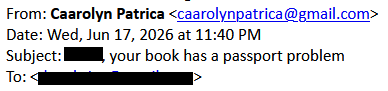
One name in the email address, another in the body of the email.
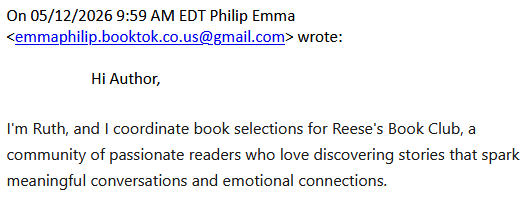
Same problem (my emphasis):
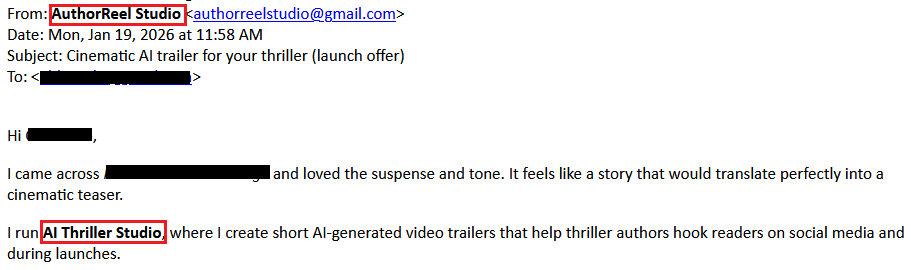
In this one, the sender’s email address in the “From” line doesn’t match the email address in their signature.
![From: Camille Jones <thecamillejonesofficial@gmail.com>
Date: Thu, 14 May 2026 at 07:56
Subject: [redacted]
To: [redacted]
Dear [redacted],
I hope this message finds you well.
My name is Camille Jones, and I work with select literary properties for potential screen adaptation in Los Angeles. I collaborate with a network of producers and development executives who are actively seeking compelling, original material for film and streaming platforms.
I would welcome the opportunity to review your work for possible introduction within my producer network.
For initial consideration, please reply with the following information:
• Title and Genre
• One-paragraph synopsis
• Link to the book (preferred) or a short excerpt/sample
• Current rights status (available / previously optioned / currently represented)
• Best contact phone number, including your time zone
Providing this information helps ensure that the material can be properly evaluated and positioned before being shared with producers or development partners.
Please note that there is no obligation at this stage. The purpose of this step is simply a professional evaluation to determine potential fit and interest. If the material resonates with a producer or company representative, communication can then move forward directly and efficiently.
If you have any questions regarding the process, I would be happy to provide further details. I look forward to learning more about your work.
Camille Jones
Development & Submissions
jones@filmrepresentative.agency](https://writerbeware.blog/wp-content/uploads/2026/06/email-scams-mismatch.png)
Just Plain Weirdness
Scam email addresses–especially for the editor impersonation scam that’s become so widespread over the past months–often feature awkward mashups of personal and company names. Beyond the fact that someone from Hachette or Trellis Literary Agency is unlikely to be using a Gmail or AOL address, they also won’t be combining the publisher’s name with their own, or tacking the publisher’s name onto a personal domain. (Here, as above, note the prevalence of periods.)
- shannonkelly.hachette.uk@aol.com
- carolinamancheno.harpercollins@aol.com
- caitlino.thebookgroup@gmail.com
- natalieedwardstrellisliterary@gmail.com
- aevitas.jenmarshall.literayagent@gmail.com (note the mis-spelling of “literary”)
- brendanbpenguinrandomhouse@gmail.com
- stmartins@vicki-lame.com (this domain and the one below resolve to identical placeholder webpages)
- sourcebooks@shana-dreh.com
- saraquery.megibowlitagent@gmail.com
Additional Email Scam-Spotting Tips
Wonky email addresses are just one of many potential scam signs. Others currently popular with publishing scammers include:
Non-typical salutations. Using myself as an example: Dear Victoria Strauss, rather than the more normal Dear Victoria or Dear Ms. Strauss. Ditto for Dear Author. Or no salutation at all. (First name/last name is the one I see most often.)
Extended and apparently accurate discussions of your book’s theme and plot points, coupled with effusive praise. A genuine contact won’t necessarily not include these–but both are established scam M.O.s, and should always prompt extra caution.
Emojis. When I first started getting reports of AI-driven marketing scams in the summer of last year, many of the emails were littered with emojis (you can see an example toward the end of this post). Marketing professionals communicate professionally, which means not writing emails that look like social media posts. I’m not seeing this so often nowadays, but it is still something to watch for, and a big caution sign.
Interminable email exchanges. AI-driven marketing scams, especially, employ a boiled-frog approach, where they ease you gently toward the actual money ask over the course of multiple, often lengthy emails, with each email re-emphasizing how great they think you are and how excellently they can help you. It’s classic emotional manipulation: the deeper you’re drawn into the interaction, the more invested you become, the more plausible the scammer’s promises start to seem, and the harder it will ultimately be (the scammer hopes) for you to say no.
Insistent nudging. Scammers want to close the deal as fast as possible, so if you don’t respond right away (especially to payment requests) they may repeatedly check back in with “just following up on my last email” or “wondering if you’ve had a chance to evaluate my offer” communications–sometimes within hours of when they last contacted you.
Fees where they aren’t normally charged.This is always a warning sign. For example, real book clubs, radio shows, and conferences don’t charge fees to invited guests.
Non-reversible payment methods. Instead of credit card transactions, scammers will often require payment by methods that are difficult or impossible to dispute or reverse: wire transfers, Upwork or Fiverr invoices, Paypal Friends and Family, apps like Zelle or CashApp.
Invoices that lack vital information like names, addresses, and phone numbers. Scammers want to avoid accountability. Never pay an invoice that doesn’t offer full disclosure of the provider, their business, and how to contact the person.

A comprehensive post Victoria thank you… I must get three or four a day and some of them sound so plausible. However, whilst extolling my wonderful book and its riveting characters only a few actually address me by name. I got one for an author I often promote the other day addressed to me but saying Dear Sandra and talking about one of her books… 100% these days it is an instant click into the junk file and deletion.
It is a rare day when I am not hit with another email scam. They all sound the same after a while. (Likely, some of them originate from the same people). One person must have emailed me six times.
I received a long, detailed email about one of my published books for Pantheon from “Am Everett Mitchell, Professional Book Marketer,” offering a new marketing campaign. If I hadn’t been aware of the proliferation of these scams, I probably would have fallen for it.
Yeah, this seems real legit. *Eye roll*
Thanks for your information. What I really want to know is not who the scammers are, but who are the real deals.
Writer Beware’s mission is to track and report on the scams, schemes, and pitfalls that threaten writers. With posts like the one you’re commenting on, we try not just to expose specific scams and scammers, but to give writers the tools they need to identify those scams themselves. The more you know about the tricks and traps scammers use, the better equipped you’ll be tell the difference between the good guys and the bad guys–and, consequently, to find the “real deals” for yourself.
There’s another reason Writer Beware doesn’t provide “recommended” or “good guys” lists: they’re only of very limited use. Agents, editors, marketers, and others specialize: they have different focuses and areas of expertise–so the best agent or publisher or marketer for one writer might be the worst for another (and vice versa). There needs to be a good match between the skill or focus or culture of the provider and the writer’s own work and goals. Just another reason why it’s best to do your own research.
What if they sent several emails and never asked for money and insist they are the person when you confront them?
Eventually, if they are a con artist, they’ll get to “the ask”- which is for money.
AI scmamers often take several emails to get to the point (which is money, always). It’s a psychological manipulation tactic: the deeper they can draw you in (and many of the scam emails ask for your consent to receive the next one, which is another manipulation tactic), the more persuadable you’ll be when the money ask finally arrives. At least that’s the hope. Since the emails are all AI-created, it’s not like a human has to hand-craft each response, so they can afford this kind of slow, boiled-frog approach.
Got an email from favour8martin@gmail.com claiming to be from the Author Credibility Society about how much they love my published work. Small detail here…..I’m not a published author.
“Our production desk is currently preparing our next series of author segments, and I wanted to see about adding your literary journey to our schedule.
Our international network reaches readers in over 100 countries, keeping a dedicated focus on independent publishing and original storytelling.
Are you available for a brief exchange next week to determine if this initiative fits well with your current schedule?”
Author Credibility Society? LOL
The website address of a “Book Marketer” with “20 Years Experience” instilled immmediate confidence:
https://6a367709878c9.site123.me/
Just one example from a recent spate of emails sent to the SF Encyclopedia, personally addressing authors who alas died in 1906, 1990, 2010 and various dates in between.
Site 123 is one of the free/cheap website builders the current crop of scammers prefers–lovable.app is another. I see both quite a bit.
randallfloyd47@gmail.com
Received a most infusive email about one of my published titles. The email came from someone named “Daniel Ehrenhaft,” so-called senior editor at Blackstone Publishing. Raved about the book. Wanted to work with me on my forthcoming projects. Always kept pushing a lit agent, even though he was foaming at the mouth to nail down my catalog of titles.
I knew Blackstone as a small–but rising–indie publishing house (Oregon and NYC), but when I investigated, I discovered that a real Daniel Ehrenhaft does work there as senior acquisition editor. But the emails that came to me were–although beautifully and professionally written–all wrong and linked to the cosmos.
These scammers who prey on bored housewives and retired senior citizens should be rounded up and shot without a mournful prayer.
I believe I have received one today from the same scammer. Like yourself, I looked up Blackstone Publishing, and then the name attached to the email. Said person does exist (like yours Daniel Ehrenhaft), but the email address included @blackstoneaudios.com When I looked up http://www.blackstoneaudios.com it ended up nowhere. Note the s at the end of audios.
I’m embarrassed to say that I’ve been hooked – line and sinker. Not your usual way so I thought I’d put the warning out. On the legitimate children’s book Facebook page an editor posted looking to review new authors. I, and other, commented then she put up her credentials including scwibi membership. I sent manuscript to editor@SLPEditing.com and she sent a contract and then did a brief review of both manuscripts then said for $100 she’d do a deeper edit of one of them. Including 2 reviews. Payment on Stripe. I did this, she sent the review but it was clearly done by ai and further emails have gone unanswered. I feel foolish. But I want to put this warning out. I have now contacted scwibi and they don’t have her listed as a member.
Don’t use May-Ellen Rozak Story Lane Post
Thanks for reporting this, Bronwen. When I’m researching scammers, I sometimes see them being welcomed as new members in FB groups, and apparently these kinds of solicitations are also a big problem on Discord.
I also see scam-sign at the SLP Editing website: vague claims of expertise with no specifics that can be verified, no client or portfolio (both things you’d expect on a legitimate editor’s website). The “About” info, which does not actually include the editor’s name, suggests the business has been functioning for some time but the web domain was only registered this past January. And my AI image detector indicates that the tiny image of the editor is AI-created (also, its meta tag identifies it as “ChatGPT-Image-Dec-28-2025”).
Bronwen~
Thanks for sharing. I’ve been scammed by a fake movie producer. All the “credentials” seemed real. The website, the Hollywood “connections.” The imposter even helped me with writing a screenplay based on my novel Beast of Bengal. It seemed to be a dream come true – until the phony bilked me for thousands of dollars. A kind attorney took my case (I wanted my money back). The attorney was working pro bono. Meanwhile, the imposter skipped town and was nowhere to be found. We learned that the crook used several names. He’d conveniently disappeared. I reported the saga to the state’s film commission and this “producer” had scammed others in my area. I learned that if something sounds too good to be true, it probably is.
Just this week I received one of these emails from one of the fake addresses mentioned in this post, the one from “Kathryn Riggs” (a real editor) with the email address that had two i’s in “publishiing”. That part stood out to me as soon as I noticed it, but what was additionally weird to me was that the message was sent to my work email address (which is unrelated to any writing I’ve ever done) and not one that I have ever included on an author profile or LinkedIn. The content of the email did concern things I have written blog posts about over the past few years, but I have no idea how the sender found my work email address and directed the message there instead of others I could more easily see a scammer finding.
I’ve had a really odd one. Sent me a message saying they had difficulty leaving a review on Amazon and was I on Goodreads. I sent a link to my Goodreads listing and some many, many weeks later they posted a review, which I saw and thanked them for going to the trouble. Now the person is trying to engage with me further, saying “I work with a targeted reader community through Royalty Readers and Book Lovers Society people who genuinely enjoy discovering, reading, reviewing, and discussing books within specific genres.”
I’ve been too busy this last week to carry on the conversation or look into who the heck those societies are (I’m in Australia), but my suspicious nose is twitching all over the place. Curiously, the person hasn’t followed up, even a week later.
This article has caused me to look closer at the email address (yes! a Gmail), and I see that the surname Brown has become Browm in the email.
Off to the delete basket. And yet the 5-star Goodreads review remains posted. I’ll take that as a win 🙂
I’ve gotten several reports of this, and got one of these solicitations myself. I often respond, just to see where it goes; the scammer left a 5-star review for one of my books, and after another email exchange, sent me obviously AI-created “marketing materials”, presenting this as something they’d done for free because my book was so wonderful. After a couple more exchanges, they got to the money ask (for marketing activities). I got them to give me bank transfer info: as I expected, the account had a Nigerian name and was with Wells Fargo, one of the Nigerian scammers’ favored banks.
The elaborateness of the scheme, with multiple stages a willingness to engage in extensive email exchanges, is a frequent feature of Nigerian scams. Since they do everything with AI, it’s a cinch for them to create the reviews, the free materials, and the often-lengthy reply emails. The very large amount of communication that can happen with these scams, along with the sheer volume of them, is a marker for AI–an individual scammer or even a boiler room of them could never make money if they were investing that amount of personal time–but the adaptability and responsiveness to individual writers and their objections and/or questions does indicate that human operators are involved, at least to the degree that they have to prompt the AI agents’ responses.
What actually happens if you pay and say yes to the scam reading group thing? Do the scammers actually try to set up some knock off zoom call?
I’ve gotten varying reports: the scammers disappear, they set up Zoom calls but every time there’s an excuse why it can’t happen, or they come up with some other thing the writer has to pay for in order for the call to happen.
Thank you. Another scam outfit is bnpublishingservices.com and The Global Publishing Agency takes their money. I was scammed by them and they would try different reasons for me to purchase more services. I am now waiting to see if my CC investigation will result in getting mu money back. I reported them to BBB and to B&N.
Got this on July 4th from my website contact form:
Submission summary:
Name:
Nadxieli
Email:
algonquin.nadxieli@aol.com
Subject:
Editorial enquiry — Nadxieli
Message:
Dear Nikkole,
I hope this message finds you well at Howard.
My name is Nadxieli Nieto, and I’m Editorial Director at Algonquin Books. We are drawn to work that uses theatrical form to make urgent global crises feel immediate and personal rather than distant and statistical. In the Continuum, co-authored and performed with Danai Gurira, does exactly that with remarkable formal intelligence and emotional force.
The structural decision to tell the story of AIDS through two women navigating parallel crises — one in Zimbabwe, one in Los Angeles — through a two-person, multi-role performance is a choice that makes the global scale of the epidemic feel simultaneously intimate and vast. That formal economy, where so much is communicated through so little, reflects a playwright who understands that theatrical constraint can produce greater emotional truth than elaborate staging. The Pulitzer Prize nomination confirmed what audiences and critics felt immediately: this is political theater of the highest order, grounded in specific human lives rather than abstraction.
Your OBIE Award, the John Gassner Award, the Global Tolerance Award, your BFA from Howard and MFA from NYU, and your current role as Chair of the Department of Theatre Arts at Howard — building the next generation of theater artists while continuing your own creative work — reflect a career of sustained artistic and institutional commitment.
I would love to hear about what you are currently writing or developing, and to learn whether you are represented by a literary agent for book projects.
If there is potential alignment with what Algonquin is building, I would very much welcome a conversation.
Warm regards,
Nadxieli Nieto
Editorial Director, Algonquin Books
This is the editor impersonation scam that’s become so widespread over the past couple of months–the goal is to refer you to an agent, and then to someone who can “fix” your query letter or manuscript. The scammer inhabits all three personas. I wrote about the scam in detail a few weeks back.
I have just received one of these too. Claude Fable told me it was fake and sent me here (thank you, Claude). Nikkole, my letter was very similar. Claude probably wrote them, that’s how s/he knows they’re fake!
I’m not dunking on you with this comment–since so many people and so much writing about AI does the same–but I think it’s really important that we don’t fall into the trap of anthropomorphizing chatbots. They’re machines regurgitating ingested material, not intelligences.
July 4th Independence.
I cancelled my Duotrope account. It was helpful and a timesaver for awhile.
I found the recent 20% price increase for a monthly paid subscription very annoying. I shan’t have it.
“Is that the hill you want to die on?” hissed Voxtango1, in a past echo from the AOL Authors Lounge.
“Yes. Yes it is. Along with the fact that I have 2,945 *publishers* (hacks and fees predators) on my Ignore List. It has become a daily CHORE blacklisting inferior listings. Along with the fact Duotrope isn’t transparent with their membership numbers. Yes, I will make my last stand due to the price increase. And I wish eight thousand were cancelling along with me!”
“Noted,” the serpent replied.
Ahhhhhh. The good old days. When a chatroom reptile was one’s sounding board.
I’m grateful for this; it represents a considerable amount of work on your part, and it’s helpful. I’ve been targeted innumerable times in recent months, no doubt via my website. Thanks for all that you do. I share your posts on my social media and my own blog in the hope it might help others.
The cover art on How Not To Kill a Spy is very good.
It’s like a movie poster seen out of the corner of your eye as you’re at the cinema ticket booth. A 1960s or 70s lettering that would be highly lusted after by members of the Letterform Archives.
It reminds a bit of some of the work by the late Jim Parkinson.
Bloody well done.
When I received an email that opened with “I hope this missive finds you disillusioned, depressed, and near death…. “, I knew it was authentic and that it really was from my besties at Penguin Random House.
Twice I’ve gotten a response from an agent I had actually queried — only the “request to explore representation options” were both sent by a scammer. The gmail address gave it away and the agency verified the reply was fake. I would love to know how they got my email and knew that I had sent queries. If I were paranoid, I would suspect the scammers of having access to submittable.
Just because you might be paranoid doesn’t mean that they aren’t out there trying to destroy you.
Thank you for this. I’ve received most of these. My reaction is to report and block.
You’ve been a trusted scam avoidance place for me to go ever since I started writing.
Express Book Writing/ Think Tech services. Got me for $200,000. I am 76yrs old. This is currently under investigation. It was the Spoof Email that finally got them. (Imposters name@penguinerandomhousepublishing.com.) I have filed 25 disputes with my bank for their charges to my credit cards. They sold me a store: dianeupton.com and falsified sales and accolades,… because the store does not exist. They showed me a falsified Federal Document from the DOJ threatening to confiscate my royalties if I did not pay to register my EIN in every state. $17,500. Sold me NYT’s book reviews (never published) by a woman who has not worked for NYT’s book reviews since 2015. Sold me European Copyrights, $20000+ because they got an email from the US Copyright office (no letter head) that someone was stealing a book. German Translations for a non-existing Frankfort market. And offered me a giant contract with two large publishers who both contacted me with the information that it was all a scam.
Diane, I am so sorry for your experience with Express Book Writing (I’ve gotten other complaints about it, BTW). I really hope your bank is willing to work with you to recover your funds.
I’m collecting information on scammer extortion schemes–would you be willing to share some documentation with me? I’d like to see the fake DOJ document about your royalties, and the fake email from the US copyright office (there is no such thing as a “european copyright”). My email is beware@sfwa.org. Thanks so much.
This is a distressing post. It’s like you’re on the Nostromo fighting against a relentless xenomorph.
You have my sympathies.
Agencies, printing houses, editors get much more manuscripts than they can read. They never contact an author out of the blue. And if they would that’s a clear sign that they are out of business.
The Fab Four of Cley
🙂 🙂 🙂 🙂
There have been instances where agents went after people, but it is rare and usually related to real-world timely incidents. I am willing to bet that before Captain Sully made it to the shores of the Hudson River, agents were contacting him to get the rights to the story behind how he landed that plane in the river. BUT, you’re absolutely right – the average book is NOT that time-sensitive and the average author is NOT that notable that an agent is going to seek them out RIGHT NOW.
But, that’s what the scammers are counting on – giving you that immediate gratification. Giving you the impression that after all this time someone has noticed you. It’s a siren call that is best ignored, but I can understand why it’s tempting.
I like the Godzilla shirt.
That says it all. Perfect convention attire.
Has anyone ever had contact from Judith Bruno Knight, who claims to an unlisted moderator from a very large Goodreads readers’ group? In this case “Turning Pages At Midnight”.
Or Marnie Joyce from the “You’ll Love This One” group?
There is no such thing as an unlisted moderator on Goodreads and TPAM has been used by scammers in the past. As for the other, you’ll want to contact the mod to let them know they are being impersonated.
In fact, last I checked, TPAM has a post about people using them for scams towards the top of their page.
Thanks, Elle–that’s helpful info.
One of the best ways to not fall for a scam is to cultivate humility.
One of the best ways to not fall for a scam (all most all of them) is to not be venal.
And by owning a blue-eyed canine that will rip rodent scammers apart if met face to face.
Excellent primer on scam detection. I know from experience, when I was recently contacted by a scammer impersonating a real-life editor, who referred me to another scammer impersonating a real-life literary agent, who referred me to an editor/book designer who still claimed to be legitimate. Through this debacle, however, I found Writers Beware, where I learned that one person may be all of these fake personas.
Writers, trust your intuition, but as the saying goes, trust, but verify.
Excellent information and thank you for doing this. I get at least two or three of these a week.
They’re persistent buggers, aren’t they?
I should add that when you question their bona fides, they usually begin with the same opening: ‘Thank you for your honest response.’ The irony of it all.
Yes, or “thoughtful response”. That kind of obsequiousness is a big AI tell.
Thank you for helping authors spot scams.
One thing I picked up on was in the body of the letter. “I hope this [letter/message] finds you well.” Almost every email I received — whether about recruiting, writing, publishing, or whatever — with that phrase in it turned out to be a scam.
Interesting. I almost always have a “Hope you are well” somewhere in my message. ^^;;
Incredible insight and utility.
I have two websites at different domains. One focuses on my books, the other features me wearing my other hat, reviewer/editor. I know right away that someone’s sent a scam as both email addresses get hit, every time. How joyous to see my email filled with a dozen scams… times two!
Wow, this is great. It’s up-to-date and covers so many types of scams. Thank you for your hard work!
Thank you, Victoria. This info, and the examples you shared, will save authors money, time, and grief.
I think I have had at least one of each of these in the last month. Always good to know my trash move was a good one.
I actually got a message from JANE AUSTEN!!! (jane.bookstorm@gmail.com). I complimented her on her new career as a publicist and asked her for some beauty tips, since she looks younger at 251 than I do in my late 50’s.
And of course, I played BINGO with her. 🙂
My BINGO card is on Pinterest if anyone wants to download it and play Army of Bots BINGO:
https://www.pinterest.com/pin/496521927695312433/
Thank you, Victoria, as always for warning authors, myself included of so many scammers out there. They seem to be increasing by the day. Celia Straus
I’ve now published 3 fantasy novels over the past 2.5 years and in that short time, I’ve encountered every single one of these described scams! Thanks for the excellent reminder to stay vigilant!
Thank you for all the good information.
I’ll stupidly engage these people and ask how much they want upfront. They’ll send me a price with all their services. I’ll counter offer $5 plus 1/3 of the sales from my 99c book for a specific time period. The scammers will try and negotiate their offer and tell me it’s not possible with all the “work” they’ll be doing. I’ll explain that’s all I can afford, they can take it or leave it. Not only have people gone away, but they must be talking to each other and I don’t get any special offers from the scammers any more.
Earlier, I saw a news article or post somewhere that mentioned that some legitimate-looking email addresses are being spoofed by using non-English characters that resemble English characters, such as cyrillic, Greek alphabet, etc.
To identify these:
Check the raw header: View the original message source in your email client to see the encoded sender string.
Use a text editor: Paste the address into Notepad or TextEdit and change the font; foreign characters often stand out or fail to render properly.
Look for mixed scripts: Attackers often mix Cyrillic or Greek letters with standard Latin letters.
Good advice–thanks!
Thank you!!! Wish I had seen this six months ago.
Excellent advice. I have seen all these tricks.
Very helpful and detailed, indeed! And a great reminder. Thank you for your hard work and helping us all!
The ones where a single dot or single hyphen differentiates the email address are the trickiest. Except, it an author recognizes that, say, the acquisitions editor at Penguin is NEVER going to email them out of the blue to report how much they love a book and want to engage about it, then the author doesn’t have to bother analyzing the email address. Hitting delete (or block sender) will suffice.
I thought an email was from a scammer, but when I saw he was head of “bookgrowth,” I rested easy and turned over my my credit card info.
Thank you for this detailed, helpful information. I get about 10 emails a day from scammers.