

We’re currently waiting for Judge Araceli Martinez-Olguin to issue final approval of the historic settlement in the Bartz v, Anthropic copyright infringement lawsuit. (If you need a refresher, my past blog posts include a general overview of the settlement and an April update.)
One of the interesting outcomes–so far–has been that while participation by class members has been extraordinarily robust (91.3%, with claims filed for 440,490 of the 482,460 works on the elgible works list), the number of class members who opted out has been quite small–just 350, according to a motion for final approval filed by plaintiffs in March (the opt-out deadline was February 9).
Opting out preserved those individuals’ right to sue Anthropic on their own. And indeed, in recent months, several lawsuits have been filed, representing approximately a third of the writers who opted out. Each suit is interesting in its own way.
Carreyrou v. Anthropic
If you’ve been following the progress of the settlement, you may remember a group called ClaimsHero. A law firm whose leadership team members do not appear to have law degrees, ClaimsHero got in trouble last year with the court over its attempts to recruit Anthropic class members for representation in alternative copyright lawsuits, using the lure of a higher payout (since the settlement will pay around $3,000 but the statutory maximum for willful copyright infringement is $150,000) without adequately disclosing to potential clients that signing with ClaimsHero meant authorizing ClaimsHero to opt them out of the settlement. (I wrote about this at the time.)
ClaimsHero was forced to change its recruitment and advertising tactics. However, it continued to seek clients, and in December 2025, its efforts bore fruit: six authors, including author and journalist John Carreyrou, filed suits against Anthropic and several other AI companies, based on allegations similar to those that led to the settlement they’d opted out of: that the AI companies had infringed their copyrights by copying and storing pirated books in order to use them for AI training.
The suits, which seek a judgment of willful infringement, statutory damages of up to $150,000 per infringed work, and attorney fees and expenses, are being litigated not by ClaimsHero (one of the things that came out when ClaimsHero was hauled into court was that it had no litigation experience) but by a partner law firm. You’ll also notice that I said suits, plural. The Carreyrou filing isn’t a class action, but six individual lawsuits related by a common cause of action and filed together.

Class action settlements, the plaintiffs argue, serve defendants rather than creators, sidestepping creators’ right to have statutory damages individually determined and allowing companies like Anthropic to “easily extinguish thousands upon thousands of high-value claims at bargain-basement rates, eliding what should be the true cost of their massive willful infringement.”
This unusual approach, with individual cases joined together into a single action, is used by third-party claims filers, companies that specialize in recruiting claimants in class action settlements and batch-filing individual claims on their behalf. The tactic doesn’t always pan out, and whether it will succeed here remains to be seen. The plaintiffs have already suffered a setback, with most of the AI companies named in the original complaint severed from the case. The case has also been consolidated with several other infringement cases against Anthropic.
Back to ClaimsHero for a minute…ClaimsHero’s recruitment efforts have been aggressive. Between February and April, I got at least seven of these emails.

“Potentially” in that first bullet point is doing a lot of work; as far as I know, the Carreyrou action is the only one ClaimsHero has facilitated to date. And although I haven’t gotten a solicitation in a while, ClaimsHero is still recruiting–and there’s still some, well, lack of transparency. Here’s its current website pitch:
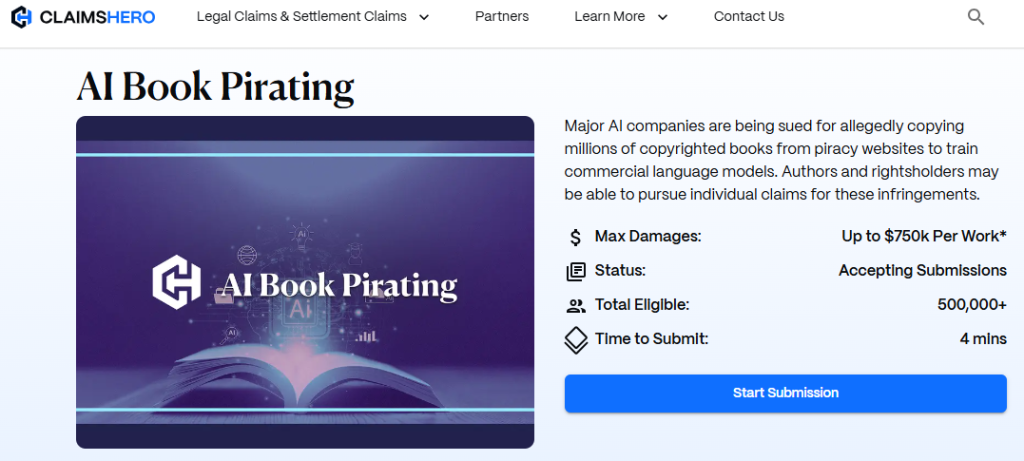
But wait, you’re thinking, where is that $750k per work figure coming from? Isn’t $150k the maximum for statutory damages in a copyright suit? Well, yes, and ClaimsHero does clarify that, but only if you bother to scan down the page to find the asterisk:

This is the same kind of bait-and-switch advertising as calorie claims on food packaging that don’t mention that the calorie count is per serving.
UPDATE 8/18/26: One of the plaintiffs in the Carreyrou action has voluntarily dropped out of the suit. No reason was given.
Daniel Benjamin Gilbert v. Anthropic
This second infringement case filed by an author who opted out of the Anthropic settlement touches on a sore issue for writers who did not opt out: they must split their payouts with their publishers if their contracts are still in force and the publisher files a claim.
Originally filed in May and amended on July 7, Gilbert’s complaint makes familiar allegations (infringement based on Anthropic’s copying and storage of pirated books) and seeks familiar relief (including full statutory damages, attorney fees and costs, and destruction of the infringed material). However, Gilbert also wants to make sure his publisher, Wiley, can’t share any of the proceeds.

Gilbert says that he notified Wiley in writing of Anthropic’s infringement, and “asked Wiley to advise within thirty days whether it intended to pursue the claim, and stated that if Wiley did not, he would proceed as provided in Paragraph 16.” Wiley did not respond within that time. Later, however, it notified Gilbert that it had submitted a claim under the settlement–but that the claim was moot thanks to Gilbert’s opt-out (under the terms of the settlement, an opt-out by one rightsholder opts out all other rightsholders as well).
The question here is whether, should Gilbert win his case, Wiley could claim a share of the recovery by arguing that making a claim under the settlement counted under Paragraph 16, despite the opt-out issue and even though it took more than 30 days to respond to Gilbert’s notification. Gilbert argues that it can’t: “Because Wiley declined to pursue the claim after Plaintiff’s request, as between Plaintiff and Wiley any recovery in this action, which Plaintiff prosecutes at his own expense, belongs solely to the Author, and Wiley has no contractual entitlement to share in it.”
Whether a court will agree remains to be seen. It’ll be interesting to watch how this particular case unfolds.
UPDATE: Mr. Gilbert has contacted me, and given me permission to publish this statement.
Twenty years ago, thousands of ordinary people were called thieves for downloading a few pirated songs. They were pushed into settlements for thousands of dollars or, if they fought back, were subject to judgments of hundreds of thousands more (including one Massachusetts student ordered to pay $675,000 for 30 songs). Anthropic downloaded millions of pirated books, including mine. The Bartz settlement offered a payment with no acknowledgment of wrongdoing and no apology. I opted out because I wanted the chance to pursue accountability. Anthropic is a public benefit corporation and I expect them to live up to that standard and take responsibility for their actions.
Shakespeare v. Anthropic
Filed June 17, this is the most recent infringement suit by Anthropic settlement opt-outs. Defendants are not just Anthropic, but Dario Amodei, Anthropic’s co-founder and CEO, and Benjamin Mann, who is identified as “a founder and member of the technical staff of Anthropic” and who the suit alleges personally handled the downloading of the pirate datasets that included the plaintffs’ books.
Plaintiffs bring this case to address Defendants’ unlawful downloading and exploitation of their works from library websites known to consist of pirated works by using BitTorrent, a file-sharing technology widely used for mass copyright infringement. Defendants downloaded works by torrenting an enormous number of unauthorized copies of Plaintiffs’ works from illegal shadow libraries to avoid paying for those works, while at the same time uploading via torrenting unlawful copies of the same works, all in violation of Plaintiffs’ copyrights.
The case is similar to Carreyrou in approach–“joined individual actions pursuant to Federal Rule of Civil Procedure 20”–but much larger, comprising 100 authors, authors’ estates, and publishers who either timely opted out or are seeking permission from the Bartz judge to opt out late.
Plaintiffs are seeking damages not just under the Copyright Act, but under 17 U.S.C. § 1203(c) of the Digital Millennium Copyright Act, which allows awards of up to $2,500 or up to $25,000, depending on the violation. They demand individual judgment on each of their claims, statutory damages “up to the maximum provided by law”, attorney fees and costs, a permanent injunction barring Anthropic and its agents from future infringement of “any of Plaintiffs’ exclusive rights under copyright”, and “[a]n order requiring that Defendants destroy under the Court’s supervision all infringing copies of Plaintiffs’ copyrighted works in Defendants’ possession or control.”
Again, this kind of joint action is “unorthodox”, in the words of some of the news coverage of it, and it remains to be seen how the court will respond–especially since the number of plaintiffs is so large and they are each demanding a separate jury trial.
Keeping Track
There’s a tremendous volume of AI litigation right now. Keeping track of it is a monumental task.
The best resource I’ve found for that is Chat GPT is Eating the World. This extensive resource provides overviews and updates for every case that’s being litigated (128 of them as of this writing), news and articles, a master case calendar, and more, including a data center lawsuit tracker. It’s an essential resource for keeping up to date with an issue of vital importance not just for writers, but for…everyone. (Forgive its clunky formatting.)

“This is the same kind of bait-and-switch advertising as calorie claims on food packaging that don’t mention that the calorie count is per serving.”
This is why we all love you! You make everything understandable for the lay person. 🙂 BTW, there are ads for ClaimsHero ALL over Facebook.
I’m not surprised. Their website shows that they’re recruiting for multiple “potential” lawsuits, and FB is ground zero for scammy ads.
Thank you!
Nice job !
Thank you for this updated information.
Thanks so much, Victoria. Your updates are extremely valuable to those of us indie authors who are not constantly researching and following the developments. Kudos to you!
Is there any indication when the judge is going to sign off on Bartz v Anthropic?
Not as far as I know, but I’m not aware it’s because of any problems or unexpected issues. I’m watching the docket, and there hasn’t been much activity since the Fairness Hearing, though there are objections to be considered, some late opt-out requests, and attorneys’ fees need to be decided. It takes a while.
Once the settlement is approved, there’s a whole other process involving payment, where there may also be some disputes (between rightsholders, for example). My guess: don’t look to receive a check before the end of the summer, and perhaps much later.