
NOTE: Several appeals of the final settlement have been filed. See updates at the bottom of this post
On Tuesday, Judge Araceli Martínez-Olguín granted final approval to the historic class action settlement in the Bartz v Anthropic copyright infringement lawsuit.
At $1.5 billion, it’s the largest recovery ever in a copyright infringement suit, penalizing Anthropic for downloading, storing, and copying pirated datasets consisting of millions of illegally uploaded books in order to use them for AI training. (If you need a refresher, my past blog posts include a general overview of the settlement and the issues surrounding it and an April update.)
Judge Martínez-Olguín’s ruling can be seen here.
Top Takeaways
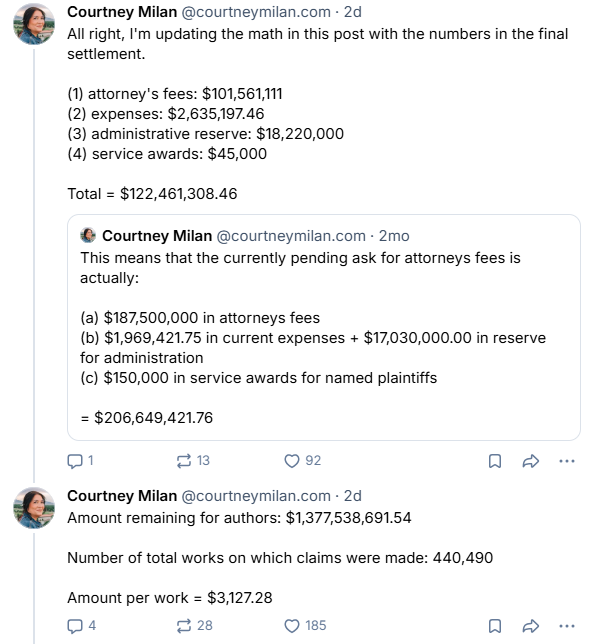
- Attorneys’ fees have been reduced. Class attorneys had requested 12.5% of the settlement fund, or $187.5 million, plus expenses of $2.5 million and a cost reserve of another $18 million (out of which the settlement administrator would be paid). Rather than a percentage-of-settlement, the judge chose to use a different method of calculation, reducing fees to $101.5 million; this works out to 6.8% of the settlement fund, as opposed to the 12.5% requested–which itself was a reduction from lawyers’ original ask of 20%. The judge granted the expense and cost reserve requests.
- Service awards to class representatives have been reduced. The original request was $50,000 for each of the three class representatives. While acknowledging the time and effort the representatives contributed to the case, the judge deemed those amounts “unreasonable”, and reduced the awards to $15,000 apiece.
These reductions should slightly increase the payout to authors. The math:
- All objections to the settlement are overruled. There were quite a number of these, including objections to the notification process, objections to the composition of the Works list, objections to the copyright registration requirement (which locked large numbers of authors and pirated works out of the settlement), objections to the size of the settlement (too low), objections to the attorneys’ fees and expense requests (too high), and objections seeking miscellaneous (and in some cases somewhat absurd) additional relief.
- Late opt-out requests have also been overruled–with two exceptions. There weren’t a lot of these requests, and the judge deemed that most of them hadn’t shown the “excusable neglect” that would justify approving them. Not so for Laura Esquivel and Jordi Castells, whose requests the judge granted. As it happens, both Esquivel and Castells are plaintiffs in a group of joined lawsuits recently filed by 100 authors and publishers who opted out of the settlement.
The Big Winners, Though? Publishers
The terms of the settlement require publishers and authors to split the per-work payout 50/50 (assuming that publishing contracts are still in force and both parties file a claim). The split is a somewhat arbitrary figure based on a common provision in publishing contracts stipulating that authors and publishers share equally in the recovery from any copyright suits.
This is a sore point with authors, many of whom feel that they are the parties most damaged by pirating and AI training, and shouldn’t have to cut their publishers in on a payout which, though higher than the common award in copyright cases ($750 according to the settlement agreement) is very far short of the $150,000 statutory maximum for willful infringement.
This recent announcement from Bloomsbury demonstrates the lopsided benefit publishers will derive:

14,087 titles x $1,500 (half the estimated $3,000 payout) = $21,130,500.
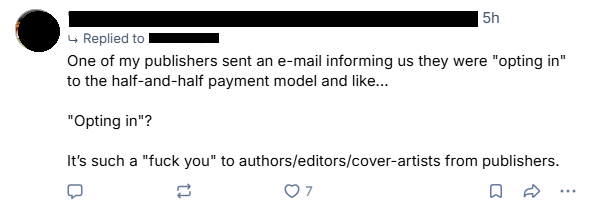
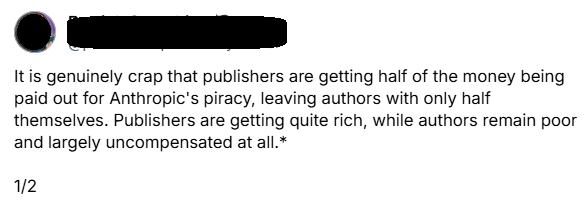
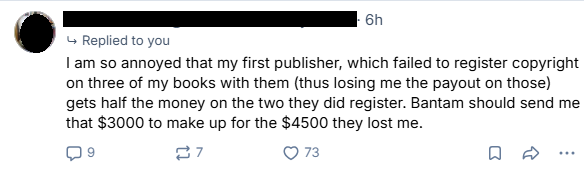
I posted Bloomsbury’s announcement on social media yesterday.
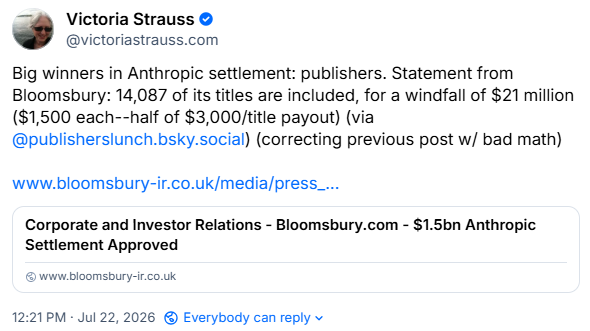
The response was…sour.
What’s Next?
In many class action settlements, the number of claims isn’t enough to exhaust the settlement fund. This doesn’t necessarily mean more money for those who do respond: settlement terms may direct any excess to be distributed to charity, or it may fall to the court to decide where the extra money goes.
The Anthropic settlement ensures that the entire settlement fund, less attorneys’ fees and expenses, goes to claimants, regardless of how many or how few claims there are. Fewer claims, in other words, means higher payouts. Participation in class action settlements is typically miserable (below 10% on average, according to some estimates), and at the start of the claims process there was speculation that claimants could receive much more than the estimated $3,000 per work payout figure. But participation has been unusually robust: 91.3% according to the motion for final approval, with claims filed for 440,490 of the 482,460 works on the elgible works list. So even with the reduction in attorneys’ fees, any increase will be modest.
When might claimants start to see the money? Per the settlement agreement,
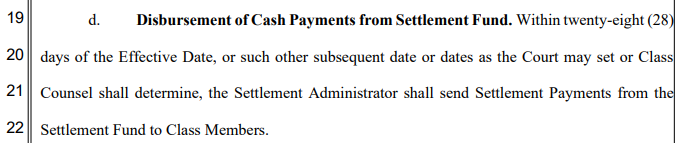
The “effective date” is defined as “the later of” the date on which the time to file an appeal expires (30 days after final approval) or the date on which the resolution of an appeal either upholds approval of the settlement or is dismissed. So…checks could start going out in August. Or, if there’s an appeal, some much later time.
Additionally, Anthropic is depositing funds into the settlement account in four tranches, the last of which isn’t due until 2027 (though Anthropic can choose to deposit earlier)–so it seems likely that payments will go out in waves, or be broken into installments, rather than disbursed all at once. There may also be disputes among rightsholders to be resolved, delaying payments to individuals (a Special Master has been appointed to adjudicate such disputes). Not to mention, simply managing such a massive number of payouts is a monumental task.
Bottom line: no one knows exactly when checks will start arriving. Estimates I’ve seen range from sometime in September to, according to one lawyer I’m in touch with, “not in 2026.”
More Reading
Courtney Milan on the timing of Anthropic’s contributions to the settlement fund and when writers might expect to be paid.
Authors Guild on final approval.
Ars Technica on final approval (including Anthropic’s effort to block late opt-outs)
UPATE 8/8/26: Some information on payment timelines, from the Textbook & Academic Authors Association–assuming no one appeals the final settlement (the 30-day time period in which to do that ends on August 19).
Payments will also be made in two stages, roughly 70% in the first stage and 30% in the second, as Anthropic will be making settlement payments in installments through September 2027.
If no appeals are filed, an online portal will be launched by the end of August that contains claimants’ consolidated claim forms. The portal will include the title of each work, its copyright number, the names of other claimants and the percentages each are claiming. If the claim percentages match for all claimants of a work, said Class Counsel, funds will be dispersed via the method submitted by each claimant.
The article also discusses the dispute resolution process (for example, if you and your publisher disagree on percentage splits).
UPDATE 8/19/26: At the last minute, a group called Publishers Coordination Counsel has filed an appeal.
Because the appeal focuses on “issues related to the Order Granting in Part Motion for Attorneys’ Fees, Reimbursement of Expenses”, rather than payments to class members, it may not hold up the disbursement of payouts. But stay tuned.
The group filing the appeal is not class counsel nor part of the class, but rather a pair of law firms that signed an agreement with class counsel to represent the publishers who are part of the class. However, because the original judge in the case, Judge Alsup, was concerned about the number of “add-on” (his words) law firms making claims on settlement funds, he made clear that only class counsel was eligible to be paid. With its appeal, Publishers Coordination Counsel is challenging that exclusion.
For a detailed look at all of this, here’s Courtney Milan on Bluesky.
UPDATE 8/20/26: Another appeal has been filed at the last minute, by another law firm that’s not class counsel or part of the class. This appeal “does not seek to alter the total amount of attorneys’ fees awarded and is limited to the Order as it pertains to CDAS”, which per Courtney Milan, means that “they are probably going to ask for a piece of the $100 million or so that the class counsel were awarded.”
UPDATE 9/2/26: Just when you thought it was over…yet another notice of appeal has been filed, on August 31–this time by a class member whose objection to the settlement was tossed by the judge. The class member is unhappy with several aspects of the settlement, including the exclusion of books whose copyrights weren’t registered, the amount of class members’ payouts, and the amount of attorneys’ fees.
Since the last day to appeal the settlement was August 19 (30 days after the date of the final settlement), and this new appeal was filed on August 31, hasn’t it been filed too late? Apparently not; as Courtney Milan notes in a lengthy thread on the filing,

A notice on the docket indicates that the appeal wasn’t filed in the proper form, and instructs the class member to re-file. If she does so timely, Courtney speculates that payouts could be delayed, perhaps substantially.
Meanwhile, the settlement website continues to languish un-updated. Stay tuned.

New email today from info@anthropiccopyrightsettlement.com. Text reads:
“You can now review your claim summary in the Anthropic Copyright Settlement.
For each work included in your claim, you can review the combined information from all claims and see the proposed payment allocations.
Please log in with the Claim Number and PIN above using the link below.
https://secure.anthropiccopyrightsettlement.com/allocation
If you still agree with the allocations shown, select “No Changes” and submit your response. All claimants currently agree on the allocations for these works, so you do not need to take any further action to receive the share you claimed.
Please submit your response as soon as possible, and, if possible, no later than 30 days from the date of this notice to allow for prompt claims processing.
If you have questions, please contact us by phone at 1-877-206-2314 or email at info@AnthropicCopyrightSettlement.com.
Sincerely,
Settlement Administrator”
Any else receive this? After they ask you to agree with the allocations they ask for your SSN or TIN.
I’ve gotten one other report of this email. Other authors are getting notices indicating that there are disagreements with their claims. I’m guessing the settlement admins will eventually contact everyone.
I have claims to seven books. I’m an Apub author, and they reverted all rights to authors (at least to me) in January 2026, which is questionable, since so many other publishers did not. I’m wondering what Apub’s participation was/is with this lawsuit. Did they revert the rights to save face? Did they pay/hire the lawyers? Or are there other less visible factors? I can’t help but be dubious, especially because my colleagues must now split their payout with their publishers 50/50, even after earning out their advances, etc. Thanks for your diligence on this case. Watching closely.
I’m an APub author also (both my APub books were downloaded by Anthropic, but APub failed to register copyright for one of them–thanks, Amazon!). My understanding is that Amazon is a major investor in Anthropic, and chose to assign their rights in the settlement to authors because of conflict of interest concerns.
In reading the ruling in which the court granted final approval, I was struck by how the discussion of the issue of group copyright registration contained much less substance than the discussions of the other objections. For example, the ruling took as given that claims counsel’s works list should be taken as the master, even though Victoria Pinder’s objections seemed to demonstrate otherwise. If the court felt that the harm caused by a delay in approval would be greater than the harm caused by failure to make any necessary corrections to the works list, then I think the reasoning for this should have been included. (Disclosure: I’m not a lawyer.)
I’m so disgusted my publishing opted in. they didn’t write a word and already got every single dime of my advances paid back. My contract with them was honored. They see nothing wrong taking half of the money from a single, barely-surviving small farmer because how could they say no? it’s more for them!
Thank you for laying it out so clearly. All of the information you pulled together is valuable for me!
Maria Schneider
Theft never had it so easy. Sadly those that put in the blood, sweat, and many, many tears to produce the ultimately stolen work, as per usual, are being treated like the whiners while everyone above gets their hands in the pie first throwing only crumbs to the authors. What a total miscarriage of justice and horrible precedent to be set. Why does Anthropic, the thieves, get off so easy?
Good info, positive reads, sad stories. Appreciated. Gil
Help. I get no response from IC3, CFPB, or my States Attorney. The state police are investigating this company (Express Book Writing,EBW) who scammed me out of $200,000 for the publication of 6 books, I am still paying off my credit cards for services that never existed. I am 76 yrs old and none of the Elder financial abuse hot lines answer. I filed disputes on every charge and have sent my banks the invoices, and correspondence. I have called Capital One over 40 times to stop closing the disputes in favor of the merchant. The only bank that has listened is Bank of America who managed to recover 7 thousand. Why do I feel like I am alone in this battle?
EBW & Think Tech services, showed me falsified Federal documents claiming to confiscate my royalties if I did not register my EIN in every State $350×50. Another falsified email from the US Copyright office claiming that a European party was trying to steal my book. End of day: $37,000. (6 books) I was contacted by the “Director of Retail sales for Penguin Random House (PRH) who required me to hire a Literary agent: $18,000 up front, and to translate 3 books into German: $10,000. They had me pay to print thousands of books at the request of Books A Million (BAM) Simon and Schuster (SS) and Penguin Random House (PRH) for trial runs. When I questioned why no book orders were listed in my Imgramspark account, I was locked out of the account and the accounting sheets stopped coming. They sold me NYT book reviews by Janet Maslin and NYT press releases. Janet Maslin has not worked for the NYT since 2015, no press releases were ever published. EBW sold me a Spotify Store that would generate $10,000 every cycle: $24,000. There is no store, they showed me a place holder, and a falsified list of customer reviews for a store that was opened for one week and most of the books they listed as reviewed were still not published. I requested a refund for this store after I found the store unavailable in every search, so they sent me three pages of fake names and arbitrary numbers of books purchases with no titles or counts. The Literary agent contacted me with a large book contract with BAM and PRH that required me to pay a $51,000 deposit. Long story short: the Director of retail sales was an imposter, no books were ever printed, I am locked out of the account were the books are printed and shipped. I have no books because all the books published on those 450+ retail sites were just pictures, so I can’t even order one of my own books. I have already paid $21,000 toward that large deposit when the Fraud Dept of all three publishers contacted me to say it was a scam. There was no big contract, they had never met these agents of mine, and do not do trial runs. Can someone please help me?
Please post the email addresses of the people who contacted you so that others can stay clear of them. I’m so sorry this happened to you.
I would imagine that there would be a much lower claims rates had the publishers not been involved, as I’m sure they were key to many authors even learning they were affected. I agree that it seems like a giant windfall to the publishers but the 50/50 split is far more generous to authors than the typical royalty agreement. Quite a few of a family member’s books were included in this case and, from their perspective, they are happy that their scholarly works are being used to give “answers” to people using Claude and they are happy that they are being compensated for the piracy of the works.
Actually, my publisher never contacted me. I doubt they considered anything I wrote worthy of much. When they purchased the smaller imprint I was published through, they buried all of our work. Previously, the editor worked virtual miracles, and we were all mentioned in USA Today when titles were about to be published, received Kindle special deals, BookBub deals, you name it. Then it all disappeared. I obtained the rights to my books back, but I can just see them trying to claim their portion for three of the seven titles pirated.
Same here – I was never contacted by any of my publishers at all about this. I found out through writing communities and authors groups.
You could also have found out by subscribing to this blog! 🙂
Yes, no publisher contacted my family member either. But I believe publishers had to provide information on authors and I imagine a good number of authors will get settlement money who would have otherwise not heard about this case or filed on their own.
I’m sorry about the way your books were handled. It’s frustrating to work so hard on something and then you see it virtually disappear. I’m glad you obtained the rights to your books back!
If your publisher opted into the settlement for its eligible books, and yours was among them but you didn’t know about it/didn’t file a claim form, you could still get paid–but you’d have to have received notice from the settlement administrator. From the Anthropic Copyright Settlement website FAQ:
“Can Class Members who do not submit a Claim Form receive payment?
If one copyright owner submits a valid Claim Form that identifies another rightsholder, that other rightsholder may receive payment.
If a copyright owner can’t be reached or does not respond after reasonable notice efforts, their claim to Settlement funds for the relevant work will be deemed forfeited.”
I’m really curious re: the publishers and the 50/50 split. Does this mean if the author CURRENTLY has their rights to the book, they still split with the publisher? Or is the split only if an author is currently with that publisher? (I’m not assuming WB has an answer for this—just tossing it out into the ether.)
The publisher receives the default 50% if the contract is still in effect and they are still the “legal owner” of the publishing rights. If the contract has terminated, either because the author reverted their rights or the contract has a termination date, the author gets 100% and the publisher gets nothing.
How long are publisher contracts with authors in effect typically and publishers get the bulk of book sales anyway! Doesn’t seem fair?? If the publisher’s agreement has expired is the publisher obligated to return the money to the author? How does this work operationally?
Every contract has reversion clause which outlines the procedure for the book(s) included on that contract. For example, mine for HC included a sales threshold that, once the book sold below it for 4 consecutive royalty periods AND had not been reissued, I could ask for my rights back. The onus was on me/my agent to make such a request and it would usually take several weeks/months to process and actually get a reversion letter. They also definitely take advanctage of the reissue policy, as four of my titles that were below threshold were reissued (for the sole purpose of retaining rights longer, IMO).
Thanks for keeping authors informed! I will be waiting for my check. They used four of my books.
Do affected authors like me have to do anything else? Contact the special master or someone to let them know to send me the money?
If you filed a claim form, you don’t have to do anything else.