
In the wake of the widespread errors that have marred the claims process, the deadline to dispute a claim and provide documentation has been extended from 30 days to 60 days (from the day class members received their allocation notice).
This week, many authors who are part of the Anthropic copyright class action settlement began receiving notices like these:
![Anthropic Copyright Settlement Claim Notice
Claim Number: [redacted]
PIN: [redacted]
One or more works included in your claim have been identified as having an allocation difference that requires your review and response. Based on the claims submitted for these works, claimants have not yet reached agreement on how the settlement payment should be allocated.
Please log in with the Claim Number and PIN above using the link below. The portal shows you the information submitted by each claimant to help you identify differences and facilitate discussion and resolution where possible.
https://secure.anthropiccopyrightsettlement.com/allocation
You may confirm rightsholders, propose a new percentage, or upload additional documentation to support your position. You may also meet and confer with any co-claimants to resolve identified disagreements.
Please submit your response as soon as possible, and no later than 30 days from the date of this notice. The Court-approved Settlement provides co-claimants 30 days from now to try and resolve any differences regarding payment allocations.
If you have questions, please contact us by phone at 1-877-206-2314 or email at info@AnthropicCopyrightSettlement.com.
Sincerely,
Settlement Administrator](https://writerbeware.blog/wp-content/uploads/2026/09/Anthropic-publisher-claim-notice.png)
![Anthropic Copyright Settlement Claim Notice
Claim Number : [redacted]
PIN : [redacted]
You can now review your claim summary in the Anthropic Copyright Settlement.
For each work included in your claim, you can review the combined information from all claims and see the proposed payment allocations.
Please log in with the Claim Number and PIN above using the link below.
https://secure.anthropiccopyrightsettlement.com/allocation
If you still agree with the allocations shown, select "No Changes" and submit your response. All claimants currently agree on the allocations for these works, so you do not need to take any further action to receive the share you claimed.
Please submit your response as soon as possible, and, if possible, no later than 30 days from the date of this notice to allow for prompt claims processing.
If you have questions, please contact us by phone at 1-877-206-2314 or email at info@AnthropicCopyrightSettlement.com.
Sincerely,
Settlement Administrator](https://writerbeware.blog/wp-content/uploads/2026/09/Anthropic-publisher-claim-notice-2.png)
The one on the right invites authors to review and confirm their claims: just making sure all is as it should be. If you received the one on the left, however, all is not as it should be: there’s some conflict between rightsholders’ claims that needs to be resolved.
Upon accessing the portal (which doesn’t seem to have a formal name, so I’ll call it the “disgreement portal”), many authors who received the left-hand notice made an unwelcome discovery: their publishers are making claims on their allocations (aka the payouts for their works) that are simply…wrong.
(UPDATE: I originally said that notices were only going out if there were claims disagreements. I was mistaken. The section above has been edited to correct that.)
Wrongful Claims
Just to refresh: per the stipulations of the settlement, authors who’ve self-published, or whose contracts have terminated, or who have reverted the rights to their published books, can claim 100% of the allocation. The publisher isn’t entitled to a share.
For in-print books, the settlement imposes a 50/50 split (the “default split”) between author and publisher (this is based on common publishing contract language that divides recovery in copyright infringement litigation equally between publisher and author).
Publishers
Most of the reports I’m receiving fall into two categories: publishers making 50% or 100% claims on rights-reverted works (where they should receive no share), and publishers making 100% claims on in-print works (where their share should be 50%).
Being a fairly cautious person, I’m always reluctant to attribute to malice what can be plausibly explained by poor recordkeeping (or poor checking of that recordkeeping)–and do I suspect that poor records, or poor checking, or overworked or inexperienced staff assigned to the task, are responsible for many if not most of the wrongful claims on rights-reverted works. Not that that’s an excuse–especially where multiple books are involved (one author told me that 16 of their rights-reverted books were being claimed; another had 11).
For the 100% claims on in-print books, in some cases that may reflect the publisher’s ownership of copyright. Where the author holds copyright, it’s harder to figure what’s going on. Since several Kensington Publishing authors reported such claims, I reached out to Kensington CEO Steve Zacharius for comment; he indicated that it wasn’t Kensington’s intent to claim 100%, and told me that the settlement administrators were aware of the issue and were correcting it. Three other publishers, when contacted by authors, said essentially the same thing. (UPDATE: On Bluesky, McFarland has said the same.) Given this, and the fact that so many authors are reporting the exact same wrongful claim by multiple different publishers, I can’t help wondering if, rather than greed or evil, some kind of glitch in the settlement claims system or metadata is responsible for the errors. Or maybe it’s an artifact of batch claims by publishers? I don’t know.
Publishers and imprints reported, in alphabetical order (I will add to these lists as information comes my way):
- 50% or 100% claims on rights-reverted works: Albert Whitman (!!! AW is in bankruptcy proceedings), Ace Books, Angry Robot, Astra Publishing House, Baen, Ballantine, Bloomsbury, Desktop Broadcasting Inc., Globe Pequot, Harlequin, Hachette (including for Grand Central), HarperCollins (including for Houghton Mifflin/Harcourt), J. Boylston (successor to Byron Preiss’s ibooks), Kensington, Little Brown, Llewellyn, Macmillan (including for Tor, St. Martin’s Press, and Feiwel & Friends), North Star Editions, Orbit US, Penguin Random House, Red Hen Press, Silhouette, Simon & Schuster, Siren Bookstrand, Sourcebooks, Tekno, Titan Publishing, Warner Books.
- 100% claims on in-print works: Abington Press, Abrams, American Library Association, Bolinda Audio, Chronicle Books, Coffee House Press, Columbia University Press, Feminist Press, Georgetown University Press, Inkshares, Johns Hopkins University Press, Kensington, McFarland, Melville House, New Harbinger, Overline Capital LLC, Page Street Publishers, Red Wheel/Weiser, Rutgers University Press, Scholastic, University of Washington Press, West Virginia University Press, Wizards of the Coast.(Odd how many university presses are in this category.)
UPDATE 9/5/26: The Authors Guild is noting that “certain publishers have informed the settlement administrator that they mistakenly selected a 100 percent allocation rather than the default option. The administrator is updating those publishers’ allocation percentages accordingly.”
The AG also suggests why some authors with rights reversions may be seeing a publisher claim (my emphasis):
The Authors Guild’s position is that an author whose rights reverted before August 10, 2022 (the “download” date in the settlement), should be entitled to 100 percent of the funds for the title, depending on the contract….Note that if rights in an author’s work reverted after August 10, 2022, the publisher may have a valid claim (assuming it was the legal owner of the rights at the time infringement occurred), and as such the author (and any co-author) may be entitled to only 50 percent of the award.
It would have been nice for this to be made clear at the start of the claims filing process, rather than now, so long after the fact.
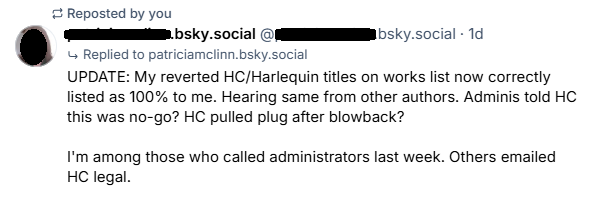
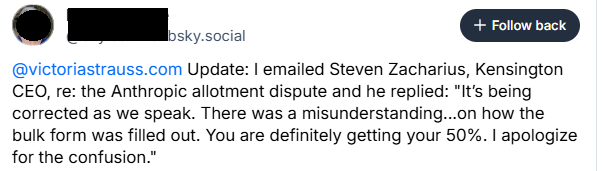
UPDATE 9/8/26: Per several reports on social media and to me via email, HarperCollins/Harlequin has corrected the claims on rights-reverted books. Kensington is doing the same.
I also heard from George Sandison of Titan Books, who says:
I can see that Titan is listed on your site as one of the publishers who may have claimed for titles where the rights have reverted. This certainly isn’t anything I intended to do, and as part of our bulk claim we aimed to strip out a wide range of titles for a lot of reasons – including the rights having reverted to authors….
If we have made any errors in our bulk claim I’d really like to get them addressed, but knowing where they are is half the battle.
UPDATE 9/10/26: Writers with 100% claims on in-print books are receiving this email from the settlement admins:
Dear Class Member:
You are receiving this email because at least one of your works was claimed by a publisher at 100%. Certain publishers have informed us that they intended to claim the default option and we are updating the claim selection accordingly. Your combined claim form will be updated to reflect their updated selection and will no longer show 100% for the publisher. You may log in again next week to confirm the updated allocation. If all other rightsholders originally selected the default, the Work will no longer be in disagreement.
Thank you for your patience, and feel free to reach out to us or to Class Counsel with questions.
Literary Agents
Before the claims filing window closed, I heard rumors that some literary agents were considering making claims on books they’d sold. The general consensus among people I talked to about this was “Nope”. The Anthropic settlement arose from a class action lawsuit; the class, and therefore those eligible to participate in the settlement, is limited to rightsholders. Agents are not rightsholders in the books they sell.
It appears, though, that at least some agents don’t agree. So far this morning, I’ve heard from five authors with six different agencies that have made claims for between 15% and 25% of the allocation on books they repped. Speaking as an author, I would absolutely contest those claims.
UPDATE: I am honestly surprised how many authors are reporting claims by agencies. Here’s what’s been reported so far, in alphabetical order by first letter (again, I’m updating as reports come in). Writers, if you’re with any of these agencies, check your claim (note that at least some of this may be the same kinds of errors that are afflicting publisher claims).
Dystel Goderich & Bourret, Elaine Markson Literary Agency, Global Lion Intellectual Property (formerly PMA Literary), Harold Ober, JdeS and Associates, Jean V. Naggar Literary Agency, Jeanne Fredericks Literary Agency, Joelle Delbourgo and Associates, L. Perkins Agency, Malatesta Literary Agency, Sanford J. Greenburger, Seymour Agency, Waterside Productions, Wylie Agency.
Important to note: as with the incorrect publisher claims, it’s entirely possible that some of the agent claims are also mistakes. Here’s what one agent, whose authors found that the agency was a claimant, told me: “I can’t speak for others but on many of my authors’ statements the publisher lists [the agency] as the recipient, this is not because I signed up for anything but is probably due to publishers pulling the payee info from the agency clause in the agreements which generally does send all income to the agent on the author’s behalf. It also shows that some of the publishers may fundamentally not understand that the settlement is for authors and agents aren’t included. Publishes are treating this money as though it’s some kind of license.”
UPDATE 9/8/26: It’s increasingly clear that many of the apparent claims by agents are errors. I’ve heard from authors with Elaine Markson Literary Agency and Joelle Delbourgo and Associates who confirmed with the agencies that they did not intend to make a claim. In an email to clients, Jean V. Naggar Literary Agency has also confirmed that the claims are errors. And I heard from Michael Bourret of Dystel Goderich & Bourret, who says:
[W]e were rather shocked to see our name on a list of agents who had submitted claims for our authors’ work. We have not submitted any such claim, and we’re not commissioning our clients’ settlement payments.
We’ve received no notifications from the settlement administrator and have no claim numbers, so there’s no way for us to even see if claims have been made in our name. We also haven’t had any clients reach out to us about this issue.
It’s possible that a publisher somehow incorrectly listed us as a claimant, but we want to make clear…that we have not made any claims directly and will work with authors to make sure any mistakes are corrected.
Educational Publishers
Educational publishers (defined in FAQ #22 on the settlement website as publishers that “specialize in creating and publishing works, including but not limited to textbooks, for the instruction of students and professionals, which are distributed for and through educational and professional markets,”) are exempt from the default split.
I’ve heard from authors with Wiley and Pearson that the publishers are claiming between 75% and 90% of the allocation. This isn’t necessarily a wrongful claim, but I’ve seen advice to contest it anyway and let the settlement administrator sort it out.
UPDATE 9/5/26: The Authors Guild has guidance for authors with educational works. The Textbook & Academic Authors Association also offers guidance.
Other Discrepancies
I’ve also heard about a number of issues that fall more into the types of snafus or opportunism you might expect in a massive claims process around works that are in sometimes extremely complicated publishing arrangements.
- A book originally published in the UK whose author and publisher are each properly claiming 50% but whose US publisher is claiming 100%
- A trade publisher claiming a higher percentage than the 50/50 default
- Works by a defunct publisher that are being claimed by a company the authors have never heard of
- An author with multiple titles claimed 100% by an individual they never heard of who appears to be a scammer
- Conflicting claims around anthologies and individual stories in anthologies
- A self-published book that somehow, between the author filing a claim and the correction notices going out, acquired PRH as an additional rights holder
- A rights-reverted book with an outstanding audio contract where the audio publisher is making a 100% claim
- An in-print book with the same audio publisher, also making a 100% claim
- An author whose publisher probably filed a claim, but who missed the deadline to file their own claim. Per the settlement FAQ #46, this wouldn’t necessarily lock the author out of the settlement, but any payment would presumably be up to the other party.
What Should You Do If You Receive a Notice?
The notices include a link to the portal to either confirm your claim or make corrections. It’s here: https://secure.anthropiccopyrightsettlement.com/allocation. You’ll need both a claim number and a PIN, both of which should appear on the notice.
If your notice indicates a disagreement:
- Accessing the portal will bring you to a Disagreements page. You’ll see a list of your titles, with Expand buttons to see the claimants on each.
- Gather documentation: rights reversion letters, publishing contracts (look for language in the Copyright clause that stipulates an equal split between you and the publisher of any recovery from copyright litigation), anything else that supports the correction you want to make.
- Review the information, make the corrections, and upload any supporting documentation. Instructions for doing that are here. You’re supposed to get an email confirming your corrections.
- Additional suggestion: if your publisher or agent is making a wrongful claim, contact them to ask about it. For publishers, I’m guessing that many will respond that it’s a mistake, especially with the 100% claims on in-print books where authors own the copyrights. It can’t hurt to get that in writing.
If your notice doesn’t mention disagreements:
- Accessing the portal will bring you to a No Disagreements page with a list of your titles. Use the Expand buttons to double check the claims.
- Very important: Don’t assume, just because the page says No Disagreements, that everything is all good! Upon checking, you may discover claims you didn’t know about with which you definitely disagree. (I did.)
- If you want to make corrections, click the Update Allocation button at the bottom of the page. This takes you to a Disagreements page, where you can make corrections.
UPDATE 9/17/26: I’ve gotten several questions from non-US authors about how to handle tax information on the allocation form. Here’s guidance, sent out today from the settlement administrator:
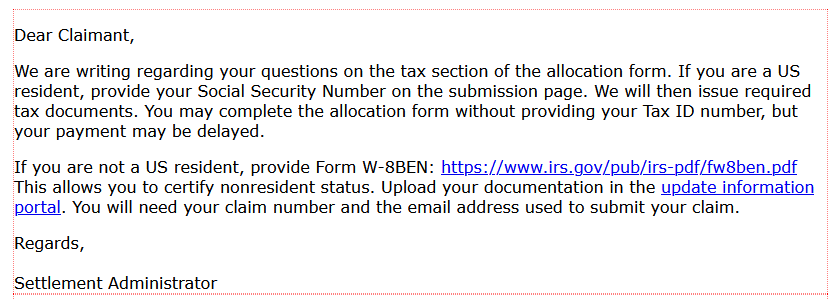
What happens when you make corrections? I’d assume it generates another set of disagreement notices, but that’s just a guess. Any disagreements that can’t be resolved will go to the court-appointed Special Master, whose decision is final.
Some authors are encountering portal glitches (the portal won’t log their corrections) or expressing frustration with the instructions, including the lack of clarity on what happens after corrections are filed. Author Shelley Powers has written about this.
Helpful social media threads from Courtney Milan, who has been on top of the Anthropic settlement from the start:
- On the general process of correcting a claim
- On what to do if a publisher makes a claim on a rights-reverted book
How Big Are These Problems?
My guess: big.
Obviously I can’t say for sure–it’s a huge settlement, with tens of thousands of authors and hundreds of thousands of works. So any insight I have is just a peek through a small crack in a massive wall.
But the unusually large number of reports I’ve received over the last two days, as well as the fact that authors are reporting the exact same errors over and over, suggest to me that these aren’t the kind of routine glitches you might expect from such a large operation, but something much more widepread and systemic.
I’ll continue to report on all of this as information comes my way. Stay tuned for updates.
UPDATE 9/5/26: The NY Times weighs in, with an article that doesn’t really reveal anything new.
The Authors Guild has a detailed article addressing how to navigate the claims portal and some of the issues described above, including righs reversion and educational works. Of note:
Please note that certain publishers have informed the settlement administrator that they mistakenly selected a 100 percent allocation rather than the default option. The administrator is updating those publishers’ allocation percentages accordingly. Authors who are concerned that their publisher seems to have mistakenly selected a 100 percent allocation instead of a default 50-50 split should log in again next week to see if the issue has been corrected. Those changes may resolve any apparent disagreements as to this issue.
They also address a possible reason some authors with rights reversions may be seeing a publisher claim anyway (my emphasis):
The Authors Guild’s position is that an author whose rights reverted before August 10, 2022 (the “download” date in the settlement), should be entitled to 100 percent of the funds for the title, depending on the contract….Note that if rights in an author’s work reverted after August 10, 2022, the publisher may have a valid claim (assuming it was the legal owner of the rights at the time infringement occurred), and as such the author (and any co-author) may be entitled to only 50 percent of the award.
UPDATE 9/6/26: The vultures are circling. Authors are reporting receiving emails like this one:
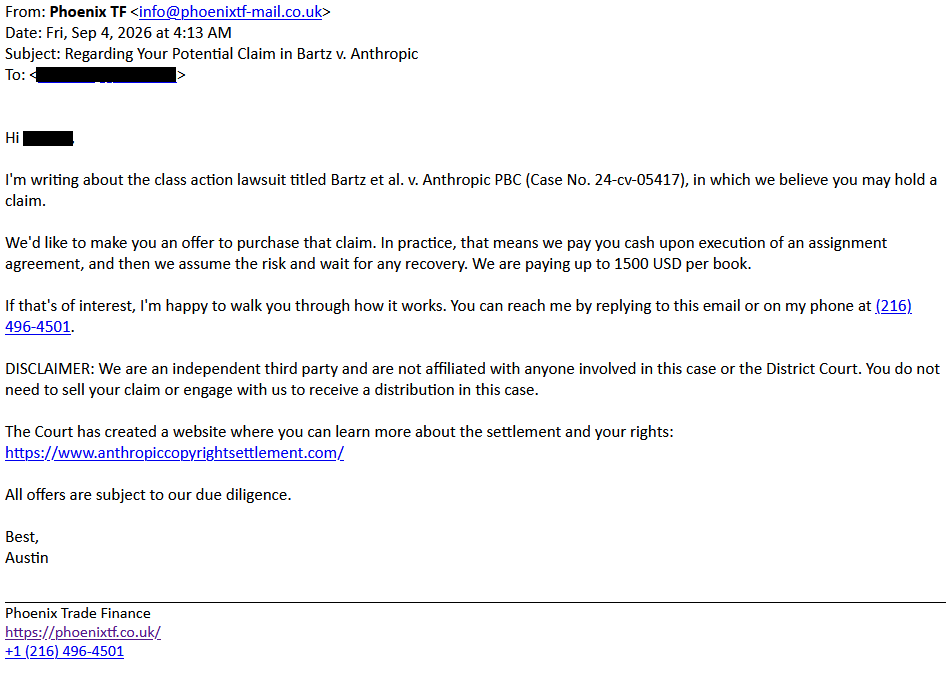
If you click the link in the email, it defaults to the website of VL Capital Management, a company that “provides immediate liquidity to creditors of distressed platforms”–i.e., buys up claims in bankruptcy and other situations, offering a lump sum that’s less than what’s due but has the attraction of being available right now, rather than in the future.
This may be predatory, but it’s not illegal (assuming that VL Capital isn’t just a scam front). However, I imagine Judge Martinez-Olguin might have something to say about such offers. And they really aren’t applicable to the Anthropic settlement, where payout is probably only weeks or months away and the offer of “up to” $1500 per book doesn’t really improve on what many authors will collect anyway.
Opportunists gonna opportune, I guess. I wouldn’t be surprised if there are more groups out there.
UPDATE 9/15/26: The Authors Guild has updated its comprehensive guidance on the settlement with info about publisher corrections, as well as dedicated publisher email addresses for contact about corrections.

In my case, my novel that was originally correctly listed as Non-Education has been somehow changed to Education with the publisher claiming 75%!
I didn’t get an email, but a letter. I spent today denying publisher claims.
Hopeful someone can help – I am a UK author (my publisher is listed above and they have claimed 100%…). I have gone to update the allocation and as a UK citizen I do not have a SSN or US tax number and so cannot proceed. Have emailed the info@ address a week ago, heard nothing. Does anyone have any suggestions?
I’ve heard from several non-US writers with the same issue. I don’t know the answer, but am trying to find out and will add an update to my post if I do.
I decided to just go ahead and click submit and it worked – I didn’t see a way around it! I’ll report back if I hear anything.
Hi there, you need to upload a W-8BEN form to the update information portal. This is the email I received today: “If you are not a US resident, provide Form W-8BEN: https://www.irs.gov/pub/irs-pdf/fw8ben.pdf. This allows you to certify nonresident status. Upload your documentation in the update information portal. You will need your claim number and the email address used to submit your claim.”
The W-8BEN form is not as intimidating as it looks. Provide your NI number in box 6 (foreign tax identifying number); in Part 2, box 10, write “Article 12”, “0%” and “copyright royalties” in the three spaces; and when it asks you to explain, write: “Beneficiary is a resident of the United Kingdom meeting the requirements of the US-UK Double Taxation Treaty, exempting copyright royalty income from U.S. withholding tax.”
I hope that helps.
Hi there, I got the same email, and I have filled in a W-8BEN, but literally have no idea what the ‘update information portal’ is. If you can tell me, I’d be grateful, but I’ve searched the website, and there is no such place, as far as I can see. I have access to the Works Allocation portal, but that’s it.
I found it, eventually, so no need to respond. To anyone following this and wondering the same thing, I went back into all my correspondence with the law firm, and finally found a link deep into a response from them to a question from me earlier this year about something completely different. The link to update-information appears not to be accessible in any way from the class action website. I emailed them and asked them to please include the link to others they send the W-8BEN info to, to save themselves and everyone else time.
This is the link to the update information portal: https://secure.anthropiccopyrightsettlement.com/update-information
Enter claim number and email, click next and then tick “I would like to add notes or upload additional documentation for my claim.”
On the next page, you can upload your W-8BEN.
PS Forgot to say: just click “proceed” when it tells you that you don’t have an SSN or US tax number.
I’ve written a ton of books in the “…for Dummies” series. As you mentioned, Wiley is claiming 90% of the settlement, even for out-of-print titles. When I wrote to the publisher, they responded:
“Wiley has determined that For Dummies works are classified as Education Works based on their instructive nature and, as with other Education Works, the substantial editorial and production investment Wiley makes in developing each For Dummies title.”
(In the Anthropic settlement, Education Works give 90% to the publisher.)
The only problem is, “for Dummies” books are NOT Education Works at all, at least not as defined by the Anthropic settlement itself:
“Education Works are works published by education publishers. Education publishers specialize in creating and publishing works, including but not limited to textbooks, ***for the instruction of students and professionals, which are distributed for and through educational and professional markets.*** ”
The “Dummies” books are sold, obviously, through regular retail bookstores—not through educational or professional markets!
I’m challenging this outrageous money grab, but the website doesn’t seem to retain any of the changes I’m making to the allocations. So frustrating!
I’ve heard from several “Dummies” authors about this predicament. You may wind up having to go to the Special Master for resolution.
Keep trying; the website seems to be regularly afflicted by glitches.
Decades ago I published technical books through one of the big guys. They are considered Educational in the Anthropic settlement, and the publisher has made a claim according to the royalty rate for the books.
The books are long out of print, which per the contract would permit reversion, but I’d never requested it Who knew? I’m not primarily an author!
Is there any option now besides licking my wounds and claiming according to my author’s royalty sliver?
If a reversion request was required in order for the rights to return to you, and you never made the request, the publisher still holds the rights, even if the books are OP. Sorry–I’m hearing from many educational book authors who are furious about what the publishers are claiming.
Thanks for this. HarperCollins has claimed 50% of two reverted titles by my late father and the claims are still there as of today. I’m trying to get copies of the reversion letters from the publisher since they’re not in estate files I have.
You have 30 days from the date of the notice you received, so you don’t have to rush. Publishers do seem to be making corrections, so maybe wait a week or so and check back in to see if anything has changed.
Obviously if a book reverted before the infraction occurred then the publisher should have no claim. And, if an author made a claim on a book in which the publisher also made a claim, they should split the fee 50/50.
But there are lots and lots of books for which there is only one claim (by a publisher) and so the only way for an author to get a share of that is for the publisher to claim 100% and then split the fee later (as they would with rights income, for instance).
All that said, I’ve found the process to be remarkably straightforward and clear. Which means that those publishers or authors who made mistakes should be able to fix them pretty easily.
Stable Book Group has claimed 100% of the allocation on the Anthropic claim for my book. They only bought my publisher, Trafalgar Square Books on January 1, 2025. The book I authored which was published in 2009, is now out of print but has been published in digital form since 2020 and the rights are not reverted. That was a bit of a shock to learn on Friday from the administrator’s email. 100%, really?
It’s possible this is an error (multiple such errors have been reported). Correct the allocation to “default”.
Thank you for rallying the troops, Victoria 🙂
Hi Victoria, thank you for this. I’m finding the process very unclear. Both the UK and US editions of my book appear in the Works List with distinct ISBNs, but I’ve been allocated only one US copyright registration number (the one beginning TX). My book is still in print so my understanding is that each publisher is due 50% of the claim but since the total must be 100% that doesn’t leave anything for me! Has anyone else encountered this problem?
I’ve heard from a couple of other authors who are encountering the same thing. I don’t know what to advise–my suggestion would be to call the settlement help line (I hear they are actually helpful).
I think I’ve sorted it out. The site says that if you choose ‘default’ then 50% is split between all authors and 50% between all publishers. You don’t have to enter a percentage. That information may be useful to authors included in anthologies.
My publisher claimed 90% – 92.5% and listed my agency as the author. The amounts correspond to my royalty rate for each book. Has anyone else seen this?
Is your publisher an educational publisher? I’ve seen multiple reports of these high claims from such publishers. The Authors Guild article linked in my post has some guidance on that issue.
Yes. I publish textbooks, and Wiley is making claims on the books I’ve published that reflect the royalty rates. On the other hand, my other academic publisher (Taylor & Francis) has the expected 50-50 split.
For all twelve of my books under one pen name, originally contracted to Harlequin, Harper Collins have asked for either 50% of books that have reverted to me, or 100% of books that are still under contract.
My understanding is that the 100% Harlequin claims are errors, and that they are being corrected by the settlement administrators. It still makes sense to correct the allocations, though.
HarperCollins which now owns Harlequin (the original publisher) has filed a 50% claim on SEVEN books of mine that all reverted to me 1996-2008. Obviously, I’ve uploaded all the reversion documents to refute their false claim to my rights.
Additionally, someone using the name “Stephen Edgington” has filed a 100% claim on EVERY ONE of my Works in the Anthropic settlement. I’ve been informed by an anthology editor that “Stephen Edington” filed a claim in one of their anthologies… and it’s the only one of their anthologies in which -I- had a story. So it appears “Stephen Edgington” deliberately targeted me. (No idea why. Never heard of this person until finding “his name” claiming my copyrights in the allocation form.) This is easy to refute by uploading my copyright registrations, but it’s INFURIATING. Curious about who else “Stephen Edgington” has targeted. (I checked, btw; no such name appears anywhere in the Works list. No idea where this jerk came from.)
I’m unable to submit the Anthropic form. I’ve corrected the allocation, uploaded the supporting files (2-3 for each of 6 books), entered my SSN, signed my name, hit the submit button – and got an error message saying that “an error occured [sic] during your submission. Please try again. If this problem persists, please contact the settlement administrator at the email below.” I tried multiple times over the course of four hours, and then emailed the administrator. (Of course, it being a holiday weekend here in the US, I don’t expect a response until Tuesday.)
I submitted early this afternoon–had to correct several allocations and upload several documents. It went through for me. I suspect that the portal may be having high traffic problems. Maybe try tomorrow? There’s actually no rush–you have 30 days from the date of the notice.
Still unable to upload. I had problems claiming my affected titles at the beginning and had to submit a special spreadsheet, so whatever glitched then may be glitching again.
So sorry. What a hassle.
I would like to note that my small press publisher, Wizard’s Tower Press, should also be added to the list of publishers trying for 100% of the royalty settlement (in this case Wizard’s Tower is a publisher who issued a reprint of my works. )
Thanks, I’ve added it.
Thank you for this article. I received my Update Your Claim” letter right after reading this article, so I was prepared for it when it came. You can add Wizards of the Coast to the list of publishers demanding 100%. Oddly, Hasbro was already listed at publisher and hasn’t claimed any portion, but WotC has swooped in to try to take the entire claim for my novel. I would assume they are doing that for other authors in their stable as well.
Anyone have a claim on a reverted book that says the author’s allocation is 100% and the publisher’s allocation is Default? I think that’s 150%. Not sure how to proceed when the publisher’s allocation should be zero, not Default. Any suggestions? I think I’m calling the help line.
I would change the publisher’s allocation to zero and upload my reversion letter.
Any thoughts on books that had been reverted and then resold? Open road is claiming and I suspect they have a lot of dead authors whose estates are not necessarily aware of what is going on.
It would depend who owned the rights to the edition infringed at the time of the infringement (specified in the FAQ for the settlement, but I don’t remember the dates right now). I had rights to two books reverted, then sold them to another house, but it was clear from the notice from the court that it was the earlier version that had been used — and those rights had already reverted to me long before the infringement.
I have re-sold Open Road titles that are currently “in print”; OR is claiming the default split, and I have no quarrel with that, since they are the current publisher of record. Presumably everyone who filed a claim will get a notice from the settlement, so hopefully estates will be aware.
Filling the form left me a bit confused. My one book that is eligible was published in 2000. I cannot find the original contract as I have moved twice and left the original agent in 2010. I figured default 50-50 was the best option but when I clicked next the allocation page doesn’t update. It still says both I and the publisher have 100% claims. Does that mean the publisher has to agree to the new allocation?
Thanks for this, Victoria. Llewellyn Publishing is also claiming a default 50% share for books published by its imprint, Midnight Ink, which stopped publication in 2018 and which Llewellyn stopped distributing in 2020. I’ve talked with half a dozen authors who saw the same thing, and I assume there are more. We have reversion letters and are uploading them.
Imagine my surprise when I found another “author” on my two books, claiming 100%. Here’s the name and you can decide if this is a bot/scammer/hacker: . (Google search doesn’t show any writers.) When I called, the administrators didn’t seem overly concerned, didn’t have any suggestions about what files I should send in to prove my claim that I wrote my own books. I’m guessing this name has been attached to 1000s of claims, hoping to scrape up some money from inattentive writers. I haven’t found anyone else with this situation, but what are the chances I’m the only one???
What’s the author’s name? I don’t see it in your comment. (I’ve heard from one other writer who found a fake author claiming 100% of their books, wondering if it’s the same scammer.)
Got a rival claim on one of my books from an agency claiming to represent the *cover artist*, now deceased. Cover art seems to not be covered by the settlement language and also is a separate work? Anyone else get this?
Wow, that is really out of left field. The settlement is based on text infringement; I can’t imagine any way that cover art would be included. I’d say definitely dispute that.
I think there’s a fair bit of opportunism going on with some of these claims.
University of Iowa claiming 100% on in-print book.
Open Road Media has claimed 50% of 6 books they have no rights to. My agreement with them ended in 2017.
I saw a comment on Bluesky today that a sort of unwritten understanding is that if the books were under contract _at the time of the infringement_, then publishers are entitled to make a claim. But that raises the question of which infringement–Anthropic’s or the pirate site’s? Your books might have been infringed by pirates well before 2017 (although how would anyone know?), so even if Anthropic downloaded them later than that, the publisher might still feel justified in making a claim. What a mess.
Unwritten rules are for the birds, so speaking for myself, I’d dispute the claim anyway.
HarperCollins claiming two books which have reverted. Submitted the paperwork.
Waterside Productions claiming my husband’s copyright… which is neat from an agent who is not a rights holder.
Frankly, I don’t know how an anthology should be divided after rights are reverted, in this situation. The AI companies stole manuscripts to feed AI, not publish as a story. They really should consider each story separately for the authors only, separate from the anthology, and not consider the publisher, or the editors. I’m open to other interpretations. I may try to contact them again but I don’t want to have to give them a stack of contracts and long winded explanations of who owns what now. Especially when so many authors have passed, and companies have evolved/dissolved and been sold.
As an anthology writer and editor, this has been a data/user nightmare. Anthropic doesn’t understand what I’m asking them, the forms don’t reflect anthology variations in contracting, and the latest form has entities I’ve never heard of.
Agreed. It’s a shitshow.
I suspect (since I am hearing this elsewhere) that one of the “never heard of them” entities is Overline Capital. They are a venture capital firm who took over the assets of Tekno Books via Hollywood Media (IIRC).
I have has years of less-than-satisfactory dealings with them, and they appear to have relocated from Florida to Georgia. They are claiming 100% on all the Tekno anthologies, so there are a LOT of us in that particular bucket.
That explains that claim on an anthology I edited. I attached the filed copyright stating me as one of the rights holder. I also had a couple of agents try to make a claim.
That explains a few things I’ve noticed. I did not know this.
Not just anthologies. They are claiming 100% of my novel, Forced Conversion, which reverted in 2009.
I’ve heard privately from authors who confirm that it’s Overline Capital. The whole situation around anthologies is an unholy mess.
I’m an indie author and the books in the claim are mine only, never been trad pubbed or produced as audiobooks. I have an 100% claim from a Sam Hargreaves against two of my books. I have no idea who this is and why they think they have a claim against the books, especially as I basically ignored the Anthropic suit as I’m Australian and was tapped by the lawyers involved as they found my copyright info via the LOC (I had filed mine for US copyright).
Is it possible Sam Hargreaves (or a name close to that) is someone who edited the book, made a cover, etc.? I had the same thing happen with my book except the other “author” was a misprint of my editor’s name. I know exactly how it happened, too, as years ago I found my book on a pirated website and it had my (misprinted) editor’s name listed as a co-author. They pulled the pirated book and the wrong author listing came along for the ride.
I emailed you a couple others yesterday in case you didn’t spot them yet.
I just got an email and my publisher (Macmillan) was listed as disputing two of my books that have reverted back to me. So I went through the steps and uploaded the rights reversal letter, but haven’t gotten any emails confirming that the proof was received. Guess I’ll check/try again later.
I am a self-published author. I received a notice from Anthropic (exactly like Alec). I have never used a publisher, or an agent. I always file my copyrights asap.
I am always troubled by any report that includes the phrase “as far as I know.” It would be better to cite a source, since this is journalism, we’re led to believe. A direct email to a reliable authority on the matter would suss this out nicely.
Thank you. A threshold problem is that many authors (including me, times seven) have books on the Atlantic list of pirated works, all in the relevant time window, yet none appear on the Anthropic Works List, so SOL.
Thanks for keeping us up to date. Seven of my books were used by Anthropic and were originally part of the claim. Unfortunately, I was notified that they were infringed upon BEFORE I had them copyrighted, and I was excluded from the settlement. The notice I got said if I could prove otherwise, that I had 28 days to provide my proof. Sure…like I know when they did it, and of course the judge ruled that I couldn’t file my own claim because I had missed the opt-out deadline. Good thing I never got my hopes up. Bob
Actually, I got one and I have no disagreements and 100% allocation to me as the author, so… I think everyone is getting one, no matter the allocation or agreement/disagreement.
I got a notice to submit my claim as is, which was 100% of the settlement payment for my books. It asked to agree or disagree asap.
Hi, Victoria.
I received my notification today. Apropos of this statement in your blog… “Just to note, since several people have asked me this: as far as I know, you only get a notice if there’s a disagreement. So if, like me, you haven’t received anything, there’s no disagreement and nothing you need to do.”
The allocation of all twelve of my claimed titles in the class were properly attributed. Once I accepted that I had no changes, I was prompted to enter either my SS # or my TIN # in order for them to process payment. Once I completed that step, I got a notification that my filing was successful.
Thanks for commenting–I’m just starting to get reports of notifications like this. Would you please forward me the notice you received, so I can see it?
Hi Lynn Ames, so you did provide your ssn? I got to that page, too, and hesitated.
My issue with this is that I’m not American and don’t have an American SSN, so not sure what to do with that page. Will it allow me to sign off on this? It says that if you don’t provide a SSN payments ‘will be delayed’, but there’s no option to let them know that you’re not American.
Same issue here. I’ve emailed them. This is going to affect a lot of people. I didn’t proceed with the form because I don’t see why IRS bureaucracy should delay my payment when I’m not a US taxpayer.
I’ve just spotted the advice to email them, too, so have done so. Hopefully replying to the notification email will do the trick!
Would you please let me know what you hear back? I’ve gotten several questions about this via email, and don’t know what to advise.
Same with me. I emailed them because I wasn’t sure how to proceed.
Just to be clear. I’m a self-published author. I received a notice from Anthropic that is worded similar to your notice but lacks the words “allocation difference”. Everything was correct on my form for my 14 books. I’ve never used a publisher, or an agent. I always file my copyrights before I hit the publish button. I’m that rare author in this lawsuit’s process with no issues. Of course now that I’ve boasted about that, I won’t see my check for three years. Sigh.
You’re the first person I’ve heard from whose notice wasn’t about an allocation difference. Would you forward the notice to me so I can take a look? beware@sfwa.org Thanks!
I also have no difference to note in the listing of my self-published books. I had two buttons to select: agreement or disagreement. Everything was as it has been from the beginning, so I chose agreement. This process has been smooth to navigate. I always handle my copyrights on my own after I self-publish.
I’m a self-published author and also filed copyrights before publishing. The info on the page was correct. I had no disagreements and no changes. The allocation process went smoothly.