

Raymond Love just wanted to publish his children’s book with a trustworthy self-publishing company. Instead, he found a scam that took his money and delivered nothing of value.
For most authors in this situation, lost cash and lost dreams are unrecoverable, but Raymond Love’s story has a different ending. He sued–and won.
The legal documents in his case provide fascinating insight not just into the techniques scammers use to bleed their victims of resources–manipulating them with constant and egregious lies into believing that services are being delivered and promises fulfilled–but also the complex web of shell companies and shady operators that keep the scam humming.
The Scam: Wiley Book Writers
In January 2023, Canadian citizen Raymond Love responded to an online ad from a purported Illinois-based company called Wiley Book Writers (WBW), engaging them to provide publishing services and paying $3,200 for a “premium publication package” (WBW’s website is gone but you can see an archived version courtesy of the Wayback Machine). The invoice he received carried the name of a different company, but all seemed on the up and up; there were even assurances on WBW’s About page that it was affiliated with John Wiley & Sons in New York City, a major publisher of academic and scientific books.
In reality, WBW was part of a large group of scams with extensive connections to South Asia, particularly Pakistan. These pose online as publishing, marketing, and distribution service providers, but are really pig butchering schemes, designed to drain their clients of resources through the sale of services and products that may be substandard, fraudulent, or never delivered at all. As part of a smokescreen of fake verisimilitude, they often “borrow” the names of reputable publishers and organizations.
(I’ve written several posts about these scams. Here’s the main one, which describes how they operate and the consequences of using them. I call them ghostwriting scams because in contrast to other foreign scams that target English-speaking writers, virtually all of them sell ghostwriting or book writing services).
Having snagged its client, WBW embarked upon the process of fleecing him. A few months after purchasing the publishing package, WBW offered Mr. Love a “book distribution agreement” that proposed to “distribute 2,000 copies of the Book to Harper Collins [sic] Publishing for sale in the United States of America” (see Exhibit 1 of Mr. Love’s complaint). Not for free, of course–Mr. Love would have to pay a “consolidated sum of $10,000”–but the promised return was more than double, with guaranteed royalties of $24,980.
Book order or book distribution scams are a frequent offering from fraudsters like WBW (here’s another example). Unlike the publishing packages, which are overpriced and often of poor quality but often (though not always) are actually delivered, they are pure fraud: there are no books, there is no distribution, and the big return is a lie to incentivize purchase. The client who pays signals their willingness to hand over large sums of cash, incentivizing the scammers to come back for more.
Mr. Love did pay the $10,000, which was invoiced from a third company name. Two more fraudulent distribution agreements followed, totaling $15,500. More “opportunities” materialized: $1,000 for bogus “copyright proof”; $1,200 for a “showcase” at a fake book fair; $2,160 for fake insurance to “protect you from lawsuits and financial losses”; miscellenous promotional and other offerings, such as a billboard in Times Square; and $10,495 for additional book printing connected to the mythical HarperCollins offer (a fake letter from Harper is exhibit 2 of the complaint), paid to yet another company name.
In October, when royalties from the first book order scam were supposed to arrive, Mr. Love began to ask WBW representatives how to track sales and payments. They responded with excuses and false promises: don’t worry, payment coming soon! He continued to make requests as January, the supposed date of the next royalty disbursement, came and went; WBW continued to fob him off. When he became fed up enough to threaten legal action, they attempted to pacify him by wiring $3,000, promising to pay a similar amount every two weeks.
That too was a lie. The $3,000, plus 50 hardcover copies of his book, were all Mr. Love ever received for his investment of nearly $50,000.
Lost in a Forest of Names
Mr. Love engaged one company to publish his book, paid invoices to three others, and as of this writing, his book remains on sale with yet another company listed as the publisher. He dealt with at least three sales reps, all of whom went by American-sounding names but were likely foreign nationals using aliases. This proliferation of monikers is a typical feature of ghostwriting scams, which use multiple fronts to recruit clients (here’s one especially egregious example) and funnel payments through webs of related businessses.
The three businesses that took payment–Techture, Inc., CodexLab, Inc., and Vox Studios, LLC–are all under common control, according to Mr. Love’s lawsuit:
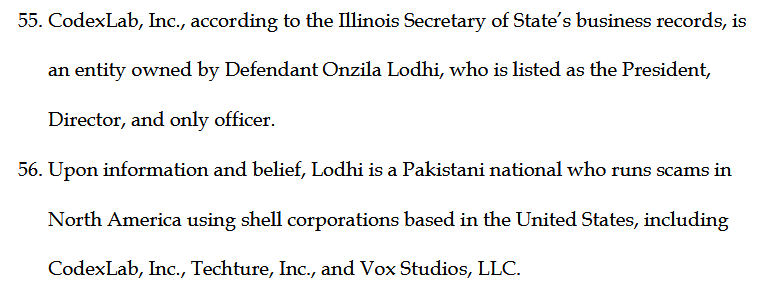
Additional defendants are Muhammad Khan, the registered agent for Techture (which in addition to having an F rating at the BBB was sued in 2023 by Amazon thanks to its misuse of Amazon trademarks); and Salman Ali Khan, the “managing member” of Vox Studios (which currently runs at least two other ghostscams, Publishing Bridge and 48 Hours Publisher).
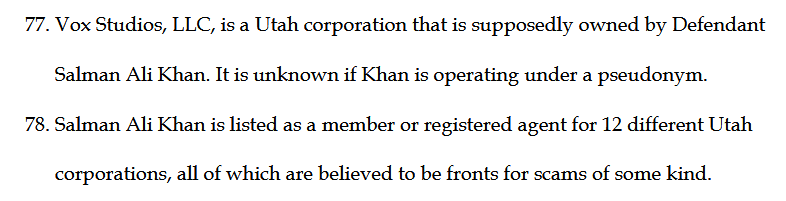
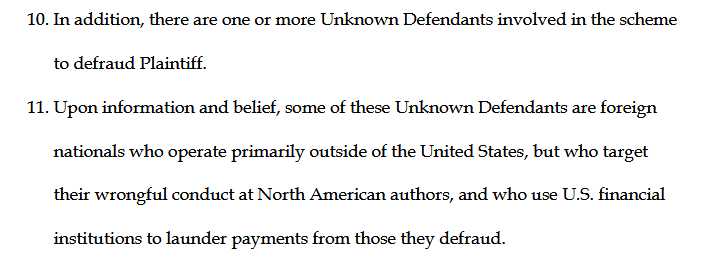
It’s probable there are even more that Mr. Love’s lawyers weren’t able to unmask:
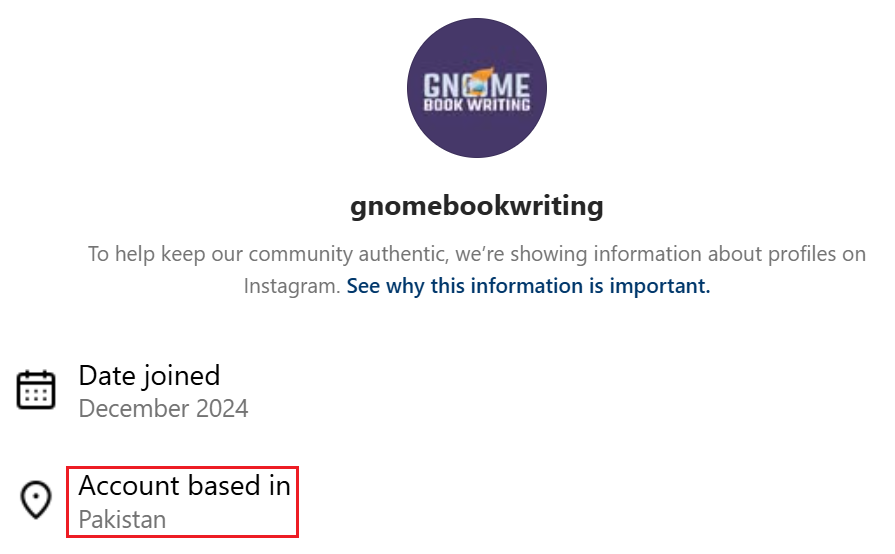
Not named as a defendant, but almost certainly a dba of one of the companies named above, is Gnome Book Writing, the current publisher for Mr. Love’s book. Gnome also has an F rating at the BBB. It claims a New York City address, but per the transparency information on its Instagram account, that’s not quite accurate:
The Lawsuit
In April of 2025, Mr. Love filed suit against WBW and associated business names and business owners in District Court in Illinois. The complaint alleged a RICO conspiracy as well as fraud, consumer fraud, and violations of the Lanham Act, and demanded a variety of relief, including removing Mr. Love’s book from sale, compensatory damages including all payments made by Mr. Love, punitive damages, and attorneys’ fees and costs.
Mr. Love’s lawyers were able to successfully serve Onzila Lodhi, Salman Ali Khan, CodexLab, and Vox Studios, all of whom (somewhat to the lawyers’ surprise) responded to the complaint. After some legal maneuvering, including a motion to dismiss by Lodhi and a potential cross-claim against Lodhi by Ali Salman Kahn, the parties arrived in February 2026 at a settlement, with the defendants agreeing to pay a lump sum to Mr. Love by April 30 and accept judgment in the case if payment wasn’t made by that date.
It wasn’t. On August 26, judgment against all four defendants was entered in the amount of $75,000.
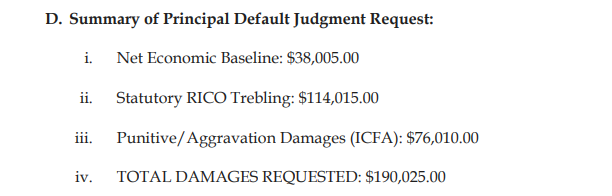
As for the other two defendants, Techture and Muhammad Khan, they did not respond to the complaint despite several attempts at service, and in August 2026 the court granted Mr. Love the entire amount of his requested default judgment against them–an extra-hefty sum thanks to the RICO charge:
Difficult But Not Impossible
Most victims of ghostscams and other publishing frauds don’t have the resources or the resolve to take legal action against their defrauders. It’s difficult and expensive–not just financially, but emotionally–especially with scams like WBW, which have foreign connections and opaque business structures and require intensive research to trace them even a little way toward their source. Still, this case shows it can be done.
The challenge, of course, will be collecting on the judgements. So in that sense, the win may be limited. It is a win, though, in that the fraud was recognized by the court. Also, the lawsuit is public record, and turns up on a websearch on any of the defendants.
Often the reaction to the stories of scam victims–especially where the scam is as egregious as WBW’s–is to marvel at how anyone could be dumb enough to fall for something so transparently bogus. The thing is, though, it’s only transparent if you have some prior knowledge and context. Many people who write books don’t have that, because they aren’t looking to make a career: just to publish a story for their kids, or a memoir, or a spiritual testimony. They don’t know–in fact, don’t realize that they need to know–that fraud is rampant in the self-publishing space, that they shouldn’t respond to ads on Facebook or sponsored links on Google, that it’s unwise to accept the claims of online publishing services at face value.
Caveat emptor and all that–but it doesn’t mean they deserve to be ripped off.
Resources
How to avoid scams in the self-publishing space? As with everything related to publishing, it’s important to invest in some knowledge acquisition before jumping in.
The Alliance of Independent Authors is a global professional advocacy group for self-publishers. Its Self-Publishing Advice blog covers subjects of interest to self-publishers, its Watchdog Desk provides scam warnings and other cautions, and it maintains a very useful directory of vetted service providers.
Writer Beware maintains a resource on self-publishing on our website (as distinct from this blog), including a general overview, various warnings and cautions, and links to trustworthy resources.
Ghostscams are everywhere online. They advertise extensively and aggressively–Facebook is a major offender–and pose a major risk for would-be self-publishers. My article on ghostscams can help you recognize them: it covers how they work, the markers that identify them, and the potentially very bad consequences of using them.
The other major scam from overseas targeting English-speaking writers: publishing/marketing scams from the Philippines. These differ from ghostscams in significant ways, including relying on direct solicitation rather than advertising, and poaching already-published writers from their publishers rather than recruiting first-timers, They are also big into impersonation. I’ve been keeping a public list of them since 2018.

I’ve been aggressively solicited by a group on Facebook calling themselves The Book Writing Group. They will promote you to Barnes & Nobles stores for book signings. Beware, it is a scam. I checked with a manger of a local Barnes and Noble who confirmed they have no relationship with them at all. Just putting the word out!
Bless you, Victoria, for your diligence on behalf of us all. Thank you for publishing this chilling, eye-opening story. We freelance writers/self-publishers are indebted to you!
Victoria, you have done it again! What a great catch. For so many of us you are a mighty angel. So many have survived or avoided such scams, and even to be more aware of the tricks they play, is beneficial to every author no matter how experienced. We can all fall. You pick up the pieces. Grace to you.
As stated many times before I was scamed by a woman calling herself Mia Dawson, Monica Reeds and an individual calling himself Richard Williams, claiming to represent Page Bloom Publishers in NYC. Mia Dawson promised she would get my book into Barnes & Noble if I paid for the printing of the books in advance. $12,000, This was after they charge me $3,500 for the all sorts of other charges. Mia and her team of women redirected income from my book to another account and I have not seen a dime of the sales. After many, many calls and text Willmans claimed he would release 0ver $51.000 in sales if I paid Page Bloom Publishers a Writer’s Tax of $9,999. As of today, I have not seen a dime of any royalties, nor heard a peep from this company who continues to do business and claims to do wonders. Mia Dawson and many others apparently operate by using alternative phones Numbers and addresses. They use PO Boxes in New Jersey, Staten Island, New York and Houston Texas. I’ve found Mia’s photo on facebook as well as other of those who misrepresented themselves. All the people I spoke with at Page Bloom seemed to be Indian or Pakistani speaking with heavy accents, which could have all be false, including their names. I’ve made several complanits to NYPD, FBI, Governors etc and have not heard anyting in response. Williams stated Mia was pregnant, recently married and on her honeymoon in Europe. Monica Reeds said the was sick and couldn’t be reached. The Libary of Congress has newsletters from other agenices which mention her name. So, it appears as if her crimes are catchingup with her. I alleges she has a little girl who she claims to have her living in Houston TX with her parents. Mia Dawson’s deception, and obviously scam has left me off balance internally which has affected my writing and my perception of women. As a senior Citizen and 100% disabled veteran her crimes rank up there with those of a person who pulls the wings off of small animals just to watch how they react. Looking back I shamefully acknowledge I fell for her manipulation and believed she was trust worthy, such betrayal can not be forgiven. If anyone can help me find her so I can have her served and sue her I’d be very interested.
I actually contacted Facebook to report a scam ad guaranteeing they could help publish 11 books in a year for any author. Facebook did, supposedly, investigate yet informed me the ad did not violate their policy.
Pretty much their standard response. So frustrating!
Yes, it is, as Facebook seems to enable and provide cover for these scammers, which is one of the reasons I no longer post there or on any Meta-owned platform.
I no longer trust Zuckerberg because he seems to be in bed with POTUS the monster.
Thank you, as always. Could you address in a future article dealing with unauthorized posts on Spotify and Amazon Music purporting to offer free or unauthorized audio versions of books?
The pirate posts on Spotify go back a ways–I put out some warnings a year? two years? ago, and reported posts about my own books. Not surprised this is still a problem. I’ll take a look. Thanks!
This is great news to hear . However the settlement barely covered the author costs and does not take into account the health hammering anguish , the massive time delays and the fact having gone through all this he has start all over again . These scammers are killing the publishing industry and they are killing creativity Until the courts really pull their fingers out and really crack down on what is a very serious crime indeed that should involve many years on incarceration, this will continue !
After recently being scammed out of $750 in an impersonation scheme, someone else tried the same thing. I had posted a comment on a Youtube posted by the well-known Dave Chesson of Kindlepreneur. I got an email from someone claiming to be him, using his email footer and photo, and using his business name but with a gmail address. The first email referenced a memoir I recently released. It didn’t sound like one of those AI texts, it fooled me at first, and didn’t ask for anything.
I responded. He responded and suggested I talk to someone on his team who could help with x,y,z. Then he asked for my WhatsApp or Telegraph. That was enough for me. I wrote back and asked how he could prove he was who he said he was. Crickets. I reported this to gmail, and let the Real Dave know. He assured me the emails were not from him.
I’ve been writing as a NEVER AI indie-publisher since 2010 on Amazon ( also Barnes & Smashwords, but they became too labor-intensive). Until recently, I would receive upwards of +/- 200 emails A DAY: SCAMS. It’s interesting too, to see how scammers have monetized Amazon’s algorithm. It’s so clear how callous some of these people are. They truly see authors as stupid and desperate, when to write any decent book takes above-average intelligence and discipline.
For instance, I would, as a courtesy, leave a review for my favorite authors whenever I read a good book. It’s a common courtesy. Last week, I received a solicitation from a LinkedIn person who charges $65 per review. $65 dollars. I’ve published more than 54 books. Another quote I received (I won’t mention names here) is from a publisher who will help you position and publish or re-publish your book in such a manner, plus get you reviews so that you become a best seller– guaranteed. He charges upwards of $1000 or more. People pay it. But his covers aren’t better than mine — at all. Nor does he give his clients 4 formats that I do for myself: e-book, paperback, hardcover and audiobook. So what would I be paying him for? What am I missing? I do know I need reviews and views.
Admittedly, I’d rather write than do anything else; so for me to get motivated do the onerous work and grind of promoting and marketing etc etc what I’ve written — I find, just… Off-putting. Still, I must do something. If people only knew how easy it is to indie-publish and create their own author bio, there would be a lot less scams. It’s not just luck that has guided me, however. I’ve been a reader of WRITER BEWARE since the early days; besides always being guided by my intuition. My motto is: Don’t capitalize on my work; you show me yours. – Valda de Dieu
If anyone here has any suggestions on how to get reviews and views that aren’t unethical, nor cost a ton of money — or has any constructive feedback, here’s my author profile: amazon.com/author/valda.
“… a ‘consolidated sum of $10,000’ – but the promised return was more than double, with guaranteed royalties of $24,980.”
I have seen this mentioned in the past. I do not understand how someone cannot see that this is a scam.
Meanwhile in Reddit, I see that yet another person wants to end their relationship (the “money goes one way” kind) with Austin Macauley.
Being a victim of scams nearly 10 years ago, before most of were even aware such people were out there, I can undertand how it can happen so easily. I will never and I mean never answer an email from someone offering to publish my book. I will either self publish through Ingram Sparks or KDP if I can’t get a traditional publisher to publish my book.
It’s refreshing to see a report up here supported by some legal documents. This is a hollow victory, since our author spent thousands of attorney dollars to get a judgement that is unlikely to be paid. It’s as if getting fleeced once wasn’t enough. As for a lasting victory for anybody else, I can’t see it.
The only thing this proves is that an author needs better information about how the industry works, and I don’t mean just traditional publishing. Indie publishers behave admirably and with integrity, and criminals like WBW behave like lawbreakers. Knowing the difference is not as simple as consulting a list from 2018 onward.
Not all of the work with a real publisher “means the short end of the stick,” and you’ll know plenty about what the stick costs once you try to publish yourself. You can trust lots of the players in a self-pub, since you’re only trusting yourself. But you’re always going to want an expert to do some things better than you do it yourself. Vetting any company or provider is important. Reading a contract is essential to the reporting of what’s going on.
The trouble lies in getting your book into a special place where it’s all about family and legacy, without any regard for what you should risk for that.
I too was scanned by Wiley Book Writers and the Dream Publisher. I have described these briefly in an email response to this email. My book is, “The Not So Ordinary People on the Roads I’ve Traveled.?
Thank you for your workand this information.
Larry Laverentz
The best article as always. Thank you Victoria. Your work on our behalf as authors/writers is invaluable. Celia
Hmm, any information on Booksurge? I saw you mentioned Amazon in the article, so I had to ask.
Booksurge no longer exists. Amazon bought it in the early 2000s, when it had a very poor reputation for quality and service, and cleaned it up and merged it with or re-branded it as Createspace in (I think) 2009. Createspace eventually merged with KDP. Why do you ask?
I asked because I felt like I was totally ripped off by them. They published my poetry book Journey Through Darkness back in the mid-2000s. I spent $250-$1000. It went through MULTIPLE rounds of editing, there were STILL errors in it, and they PROMISED it would be available in in bookstore catalogs. It was Print on Demand. I tested this promise when it was released. I went to my local Barnes and Nobel. They WERE able to pull it up in their system. But it said Out-of-Print!
I learned my lesson the first time dealing with one of those publishers for self publishers. While they did not take my money with no return they just half assed everything. Badly half assed it. I found out later when I was fully self publishing my second book in the series they had never completed the ISBNs for the first book. Bowker sent me the screen shots of the listings with the little red circle “incomplete” Nor did they complete the LCCN, and half assed what the did fill out. There was a “contract” in my email from them. Sent that to my attorney, they completed the work 9 months after publish under the threat of a breach suit. Once was enough, I don’t trust or deal with any, and I mean any of these shady, cons anymore… Same for “providers” from places like Fiverr, Reedsy, Up Work, and such. Have never dealt with one that followed through as they were supposed to, mostly substandard or very late offerings. Reedsy I was completely ghosted by a cover artist, never produced a thing for review… due date… nothing! Reported to Reedsy a week before the delivery was due… obvious what was coming… Reedsy sided with the provider and said a had to work through this with them… I filed a charge back and won…! This is the norm for the self publishing business, not the exception… I did do my own copyrights way before contracting anyone, but I know authors that fell for the $500.00 to do your copyright – right bull crap and wound up finding out the copyrights were never filed!
My point of this whole rant is, Don’t fall for any of these scammers, either learn it and take on your own publishing or find and work with a real publisher, accept the short end of the stick your will get, but at least your work will get published for the agreed contract, and hell some of them might actually reallio-trulio file your copyright! Basically any new self publisher has 2 choices. Roll up your sleeves or drop your drawers,
I was also scammed – of $60,000. I am a disabled widow and they never even gave me my printed copy. The CEO of Barns and Noble phoned me from Piccalilli Circle in London, welcoming me to their “family.“ I wrote a 400 page revenge suspense novel that is a great book, but I am afraid to do anything with it.
Carolyn Demchar Wilson
So sad to hear this. You deserve much better. If your book is true it will help many others. No Ai in there, even better. Look into self-publishing and even use a pseudonym to get through the process. You know that you can trust yourself. And others, but you need to get to know them first. You are possibly still suffering from a type of PTSD after this horrible extortion by criminals. All the best and many blessings be your future. (And some money)
Great article! I really appreciate your resources and advice. I stumbled on to your website after almost signing with a ghostscammer and am SO thankful! Now, I have an automatic algorithm that scans my email, finds the fraud ‘publishing companies’ and then automatically drafts an email I can choose to send, that strings them along and keeps them interested – they wasted my time, so I figure turn about’s fair play. 🙂
Thank you for this! And Bravo to Raymond Love for persisting. Though he might not get the money,
he has helped all of us by his lawsuit.
You are welcome. I hope my experience helps others. FYI I have successfully published 4 books since the scam.
I have a graduate degree and am very scam conscious, and I still almost fell for one of these scams. The web page looked real, the trustpilot rating looked solid and the person spoke midwestern-accented english. It wasn’t until I got the amateurish revisions and noticed that the address on their web page pointed to a farmhouse. Yikes!!! Thankfully the credit card company accepted my complaint of fraud and I got all of my money back (although the pig butcher did threaten to sue me in an email for breach of contract LOL– so fine sue me and we’ll talk about fraud). The speed with which the credit card company refunded my money (within a day) told me everything I needed to know. I probably wasn’t the first.
I was lucky. Point is, they are very smooth and it’s easy to fall for these and so no one should feel ashamed.
I wish I were retired lawyer with copious free time. I’d make myself a nuisance to every single one of these firms