
Back in March, I warned about a generative AI-driven scam that was impersonating multiple editors at major publishing houses, along with the literary agents they “referred” to. The goal: to trick writers into buying editing services, supposedly to fix up their query letter or manuscript. The scammer inhabited all three personas: editor, agent, referral editor.
Between then and now, this scam, which I’m calling the Editor Scam, has become the single most-reported fraud to Writer Beware. I get two or three reports of it every day–hundreds of reports in total (and Writer Beware typically hears from only a fraction of affected writers). My Impersonation List has more than doubled in size. The scammers seem to be burning through the staff rosters of every agency and publisher they can find; names are used for a few weeks and then abandoned for others (so I rarely see a repeat).
Scams keep going because they work: and this one shows no sign of slowing down.
Given how extremely prevalent and aggressive the Editor Scam is, I’m taking another look at it, from a slightly different angle. Documentation recntly shared with me illustrates the full process, from the initial solicitation to revelation of the source. I’ll also be pointing out some of the telltale signs of generative AI use that I see over and over, not just from the Editor Scam but from AI-driven scams in general, so you can do your own scam-spotting.
Phase 1: The email of your dreams!
The Editor Scam (like other AI-driven scams) arrives in the form of an email that purports to be from an editor at a prestigious publishing house.
The email is extensively personalized, with details that make it seem the sender is genuinely familiar with the writer’s book, and includes ego-warming praise. Both the editor and the publisher are verifiably real; links in the body of the email or in the signature may also be genuine The email address, however, is always bogus–a real contact would come from a company email domain, not a Gmail or AOL or other non-professional address–though it may nod to authenticity by including the name of the publisher or the title of the editor somewhere within it, as in the example below. If the target doesn’t check, or isn’t aware of how fond today’s scammers are of Gmail, they may not spot this.
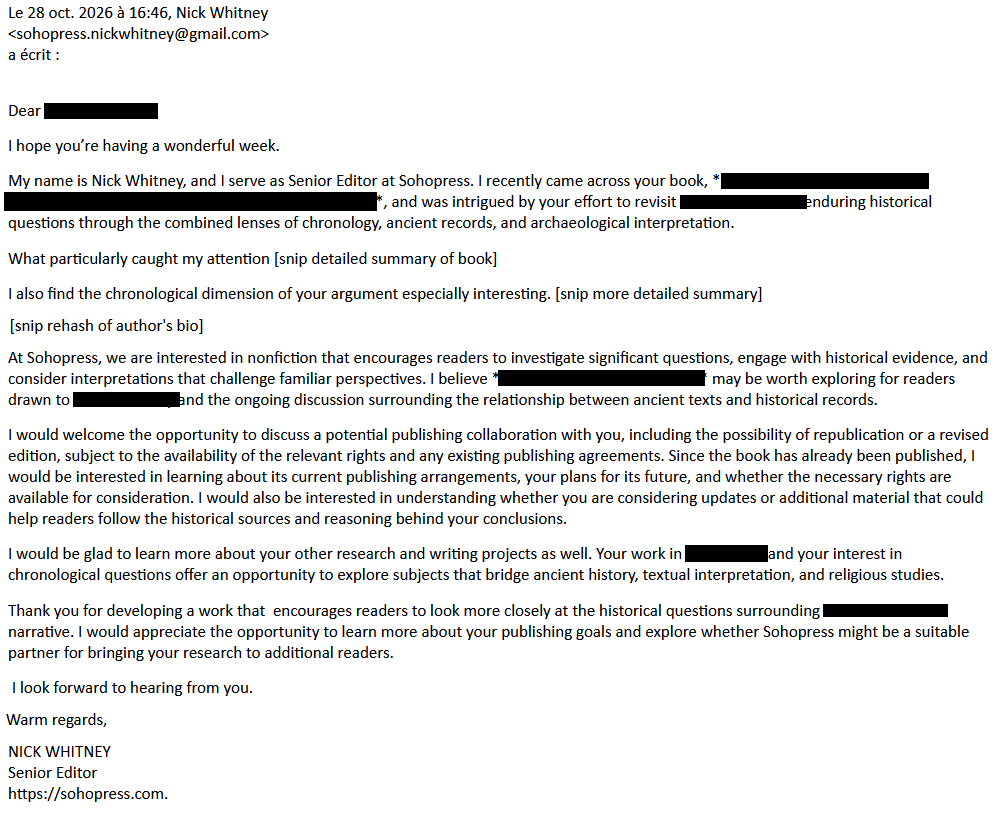
I’ve stripped out the personalization, to avoid identifying the writer–but I’ve left in several phrases I see often enough in AI-generated solicitations that for me they are an automatic AI tell. They can be for you too: once you’re aware of them, you’ll never not be able to see them.
- “I recently came across your book”. Usually present at the start of the solicitation.
- Variations: I recently had the opportunity to learn about / I recently spent some time with / I recently had the chance to review / I recently spent some time looking into
- “What particularly caught my attention”. This often introduces the personalization.
- Variations: I was particularly drawn to / What struck me immediately / What I found most intriguing / What stood out most / What impressed me most
- “I also find X especially interesting”. Piling on the personalization.
- Variations: I was also particularly interested in / X also strongly drew my attention / I was also especially intrigued by / I was also struck by / I’m interested in learning more about
- Warm regards. Others have commented on how often AI-generated emails use this closer.
- Watch for particularly, especially, and intriguing/intrigued. They are all favorite AI word choices.
Be alert to other inauthenticities: for example, it’s Soho Press, not Sohopress. And, other than memoirs, Soho does not publish nonfiction, let alone the kind of academic work written by this author.
Phase 2: The literary agent of your dreams!
The writer responded to Fake Nick Whitney on October 30. Fake Nick replied the same day, buttering the writer up with more complimentary verbiage and asking for the writer’s manuscript. The writer sent it on November 3. Within hours, Fake Nick emailed an enthusiastic expression of interest–yet more personalization and praise–plus a thrilling referral.
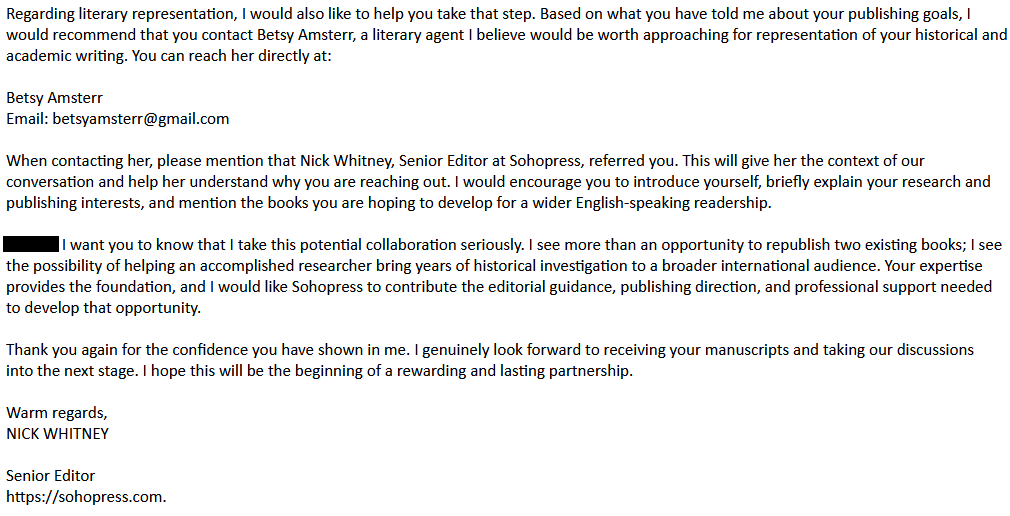
Given how brazen the impersonations of the Editor Scam are, I’m not sure why the scammer felt moved to add an extra “r” to Betsy Amster’s name–maybe there was already a Betsy Amster Gmail address with one “r”? Anyway, the writer took the bait. On November 4, they contacted Fake Betsy, sending their manuscript a second time.
Fake Betsy (who, remember, is also Fake Nick) replied that afternoon. Astonishingly (or maybe not), she’d managed to review the entire manuscript in just those few hours. Good news! She liked it! But…it was not quite ready for prime time.
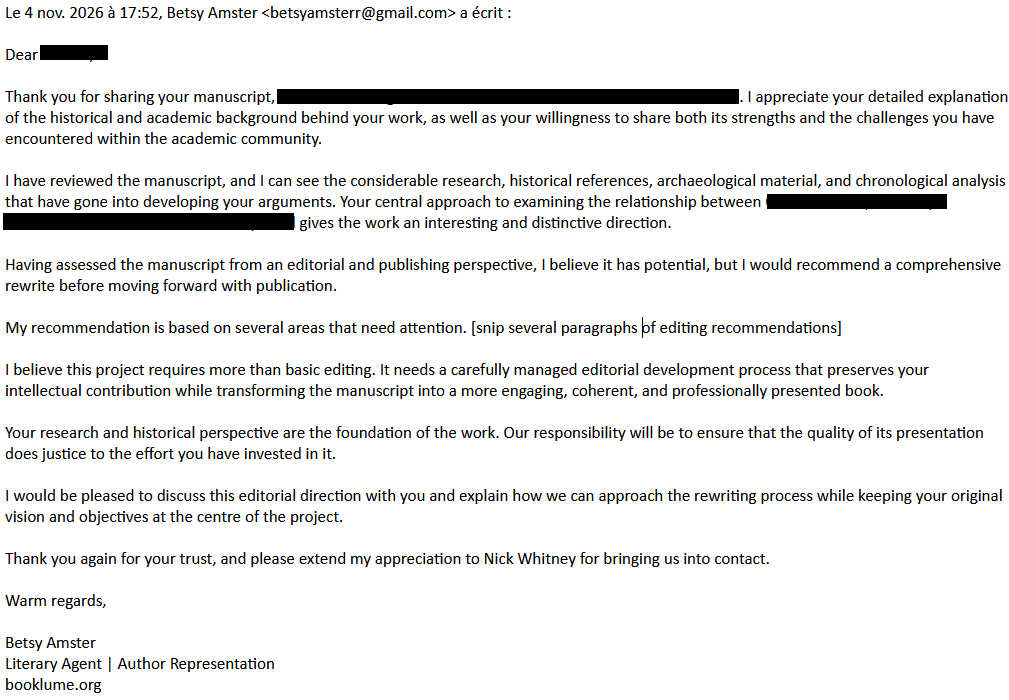
Editing recommendations are a potential break point in the scam, at which a writer who may not have questioned the authenticity of an out-of-the-blue email from a publishing house editor might detect a rat. Not in this case, though.
Phase 3: The psychological manipulation continues
In most iterations of the Editor Scam, the next step is a referral by the “agent” to a third party, described as an “experienced editorial professional” who, it’s promised, will fix up the writer’s manuscript or submission materials. In this case, Fake Betsy herself promised to do the editing, via her own company, Booklume (see above: the URL is included in her signature).
Here is another rat-exposing checkpoint: Booklume’s single-page website is a joke. No staff bios or resumes (not that those can’t be faked); no client list; a portfolio of just four books, two of which have dead Amazon links; and, importantly, no mention of Betsy Amster, with or without the extra “r”. Again, though, an inexperienced writer might not spot these problems, or think to do important things like asking for references (which, again, scammers can and do fake).
Once again the writer chose to proceed. Fake Betsy promptly sent an editing proposal. Aware that a nervous target might slip away at this point, she piled on the psychological manipulation in the form of repeated reaassurance about the care she would lavish upon the work.
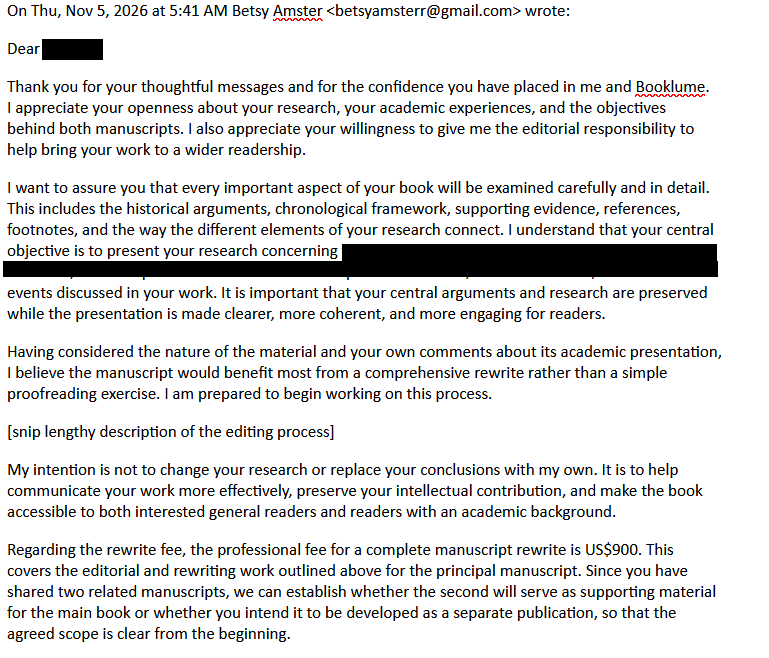
Another element, not just of the Editor Scam but of all impersonation scams, is that they don’t want to give their target time for consideration. When the writer didn’t respond by the next day, Fake Betsy sent a nudge, again assuring the writer of her interest and care. “I would be pleased to hear your thoughts on the proposed scope of work and the $900 fee for the complete manuscript rewrite”, she wrote on November 6. “I look forward to hearing from you.”
Phase 4: Payment protocols
On November 7, the writer emailed Fake Betsy to agree to her proposal and ask how to pay the fee. Scammers don’t always give their targets a choice, but Fake Betsy did: wire transfer, PayPal, or a payment app. The writer chose wire transfer.
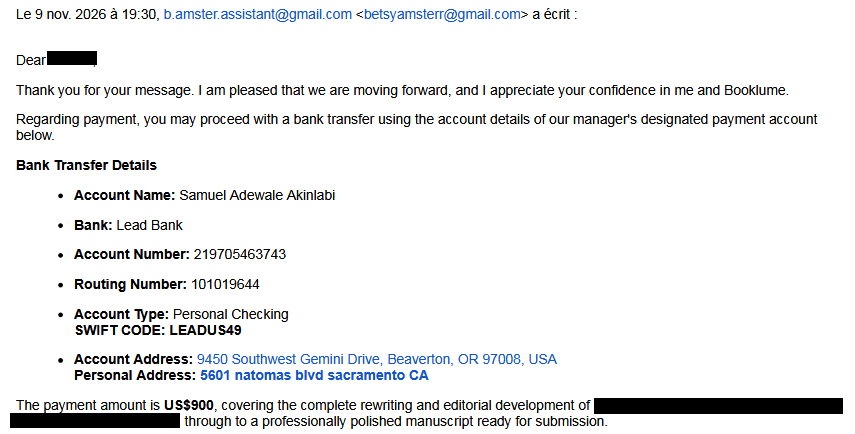
I can’t emphasize enough how much you should never pay for writing- or publishing-related expenses via wire transfer! Unlike credit card payments, and to a lesser extent PayPal, wire transfers are almost impossible to reverse.
In this case, though, it’s lucky the writer chose that option, because being asked to send a fat sum of money to the account of a third party they’d never heard of, and who moreover had no apparent connection to Fake Betsy or even Booklume, was what finally woke them up. They did some internet research and contacted the real Betsy Amster, who confirmed that they were being scammed.
The story has a happy ending: the writer didn’t lose any money or compromise their finances by sharing their banking information. They did, however, lose the time they wasted over nearly two weeks of responding to Fake Nick and Fake Betsy, not to mention the hope they invested in the illusion the scammer spun for them.
Tracing the source
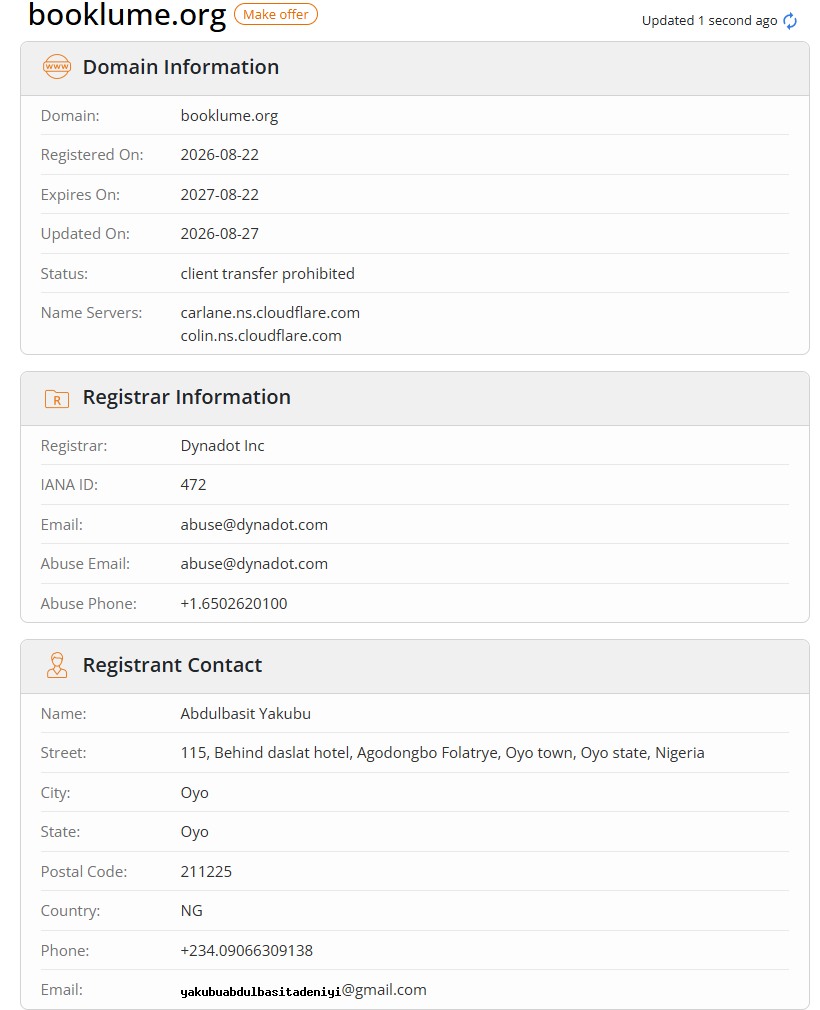
It’s often not possible to determine the provenance of a scam. But where I’ve been able to do so–not just for the Editor Scam, but for the marketing, book club, reading group, and various impersonation frauds that are part of the AI-driven solicitation scam wave that kicked off a couple of years ago–they most often trace to Nigeria.
In this case too. One indicator: the name on the bank account above. If you google it, you won’t find the person, but you will confirm that the name is likely Nigerian. A more solid indicator: the domain registration for Booklume, for which, unusually, the registrant did not choose domain privacy.
Tools for AI scam-spotting
As always whcn I do these detailed deconstructions, my goal is not just to expose one particular scam or scammer, but, by sharing the techniques I use and the markers I identify, to give you tools you can use to do your own deconstructing.
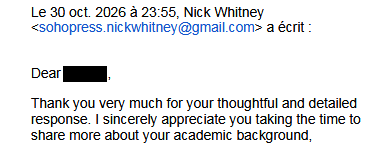
Above, I’ve listed some of the phrases that I constantly see in AI-generated scam solicitations. Along with those phrases and “warm regards”, here’s another marker: the “thoughtful response” or “thoughtful message” opener that appears in so many AI-generated scam replies. If you’re not sure whether you’re corresponding with a real person, the repetition of this opener can be a hint that you’re not. It also showcases the obsequiousness that’s such a feature of gen AI writing.
From Fake Nick:
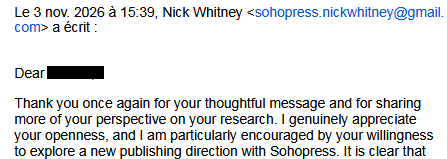
From Fake Betsy:



One tell here for me was the fee the scammer quoted. $900 is WAY too little for the kind of develpmental rewrite they were proposing.
Yes, that’s a good point. From a qualified editor, I’d say mid-four figures at least.
Another typical sentence is the very opening one: I hope you’re having a good day/week/etc. I see it repeated in one form or another in every scam I receive. And I’ve received many hundreds.
Dear,
Thank you for sharing all this information.
My Name is Gustavo Mazali, I’m illustrator for children’s book.
I came to you through literary agent Juliet Mushens who confirmed that the Richard Osman who was emailing me turned out to be a scam.
It all started when this fake Ricard Osman
appeared writing about a children’s Bible that he had illustrated a few years ago. From there an exchange of emails began.
I didn’t know this Osman until I looked him up on the internet. It caught my attention that this personality stopped at an illustrated Bible.
The most curious thing is that weeks before other people wrote to me offering me a service to position this Bible on Goodreads and Amazon so that sales would improve. So I suggested they write to the editor and not me. But they insisted on offering me their services.
My exchanges with all these people and especially with this fake Osman were of total innocence, believing in the exchanges that took place.
As they say in my country: “I entered like a horse.”
I became suspicious when this Richard Osman offered me the contact of his marketing agent for his books, to help me sell more. I looked for that contact on the internet but it turned out to be very suspicious.
Because I deleted the emails, I don’t have that contact.
Both Richard Osman, their marketing agent, and the rest of the people who offered the same service had a “generic gmail” in their emails. Triple suspicion.
That’s why I wrote to Osman’s direct agent, JUliet M, who confirmed the scam.
For what it’s worth, I’m passing on the emails and names of the people who have written so that they don’t fall for these possible scams:
masonmary536@gmail.com
janiceismael@gmail.com
richardosman62@gmail.com
Take care of yourself!
Thank for reading.
Best
Excellent advice Victoria! I receive umpteen scam emails of this nature. The latest being from arclengroup.com – a domain only set up 28th October 2026, the email being sent on the 12th November, from catherine.ellis@arclengroup.com Needless to say I did not pursue it. I did check out the website (as I say, only a few days old) which did have a Catherine Ellis featured on its team, an impressive list of books previously published and an info email address. Forewarned is forearmed. A little more research and it threw up red warning flags all through. Thank you. 🙂
I meant to add that this site pretends to offer film and TV opportunities. LOL!
The Arclen Group scammers must have done a HUGE solicitation campaign–I’ve gotten a lot of reports of this. Much of the content on the site was stolen from a legit agency, Park, Fine & Brower. They were alerted, and the Arclen site is gone.
I’ve had two this month. So processional. And they had registered a finding and built a website that looked authentic. Until I realised the website was only two months old with registered name as private. and some of their claimed successes were copied from genuine agencies and were years and several months old I insisted if they wanted to discuss direct with me then it had to be over FaceTime or Zoom. They stopped contacting me
Not “finding” * registered a domain
I’ve gotten many of these letters, full of the same tell-tale phrases. I report them, send them to spam, a d delete. I do feel sorry for unsuspecting writers who are taken in.
Hello Victoria. Thank you for once again pointing out the telltale signs of the email scammer. You might be interested to know that I have come across (!) a new one. The email sounds almost like a reader reaching out, with no mention of referral, just a friendly chat. I have received two such, the first one of which I binned, but here is the second. I’m planning to respond to it to see where it goes and I’ll report back to Writer Beware.
Roqqie <office.roqqie@gmail.com>
Thu, Nov 12, 5:36 AM (2 days ago)
to me
Dear Patricia,
I hope you’re doing well.
My name is Roqqie, and I recently came across The Knucker’s First Christmas (and Other Seasonal Fare). I was intrigued by the variety of stories gathered under one Christmas collection, especially the idea of a Sussex dragon discovering the pleasures of Christmas Eve. The mix of unexpected visitors, two dogs bringing people together, and a character finding an unexpected seasonal role suggests a collection that approaches the holiday from several delightfully different angles.
I also liked the suggestion that Christmas means something different to each character. Rather than focusing on one familiar holiday experience, the stories seem to explore romance, surprise, companionship, and the little turns of fortune that can make a season memorable. Crispin de Beaufort Wynter’s mysterious role in particular left me wondering what sort of festive trouble he gets into.
I’m curious, did you write these stories independently and later bring them together as a seasonal collection, or did you always imagine them sharing a place in the same Christmas book?
Best regards,
Roqqie
I routinely get two or three emails like this every day. I’ve learned that this is just the opening part of the scammers’ marketing dance. From there, it devolves into meaningless, lengthy discussions meant to earn your trust. Then they hit you up with the pitch. I mark these as spam, block and delete.
I’ve seen a lot of solicitations like this. They want to sell you something–editing, promotional materials, an interview, something else.
The open-ended question at the end is designed to incentivize response–engagement is what the scammer is after, the reasoning being that if they can get you to reply, you’re more likely to listen to their proposals, and the more likely you are to listen, the greater chance they can win you over. It’s a boiled frog approach that typically unfolds over multiple email exchanges.
My advice always is not to engage. At best, they’ll waste your time.
I had a fellow author friend who fell prey to these scams over and over despite my best efforts to convince him they were not legitimate.
This is such valuable information and so well explained. All of your examples are dead on. I hope the word spreads so others are not caught up as my friend was. Writing is such an intensely personal thing that betrayals cut very deep.
Thank you for being a staunch advocate for writers.
Thank you again for sharing this information, Victoria. I have learned so much from you and this site. I receive multiple emails like this every day. I’ve gotten to the point that I don’t even read them all the way through. I just mark them as spam, block the sending address, and delete the email.
I worry about what will happen if all office work goes to AI and responses of actual agents and editors become indistinguishable from the scammers’. I’d hope no self-respecting agent or editor would stoop to using AI, but who knows?
Thanks once again for such useful info. I am now planning to publish with a local publisher with a well-earned reputation and people I have actually met in person at their office and I participated in their annual book festival in August with my previous book, also via another local publisher.
Thank you for continuing to research and provide ever more detailed information about these scams. Man of these forms appear in my email daily. Most I delete, but once in a while the joker in me gets pissed and I reply with something along the lines of, “Hey scammer, get real job!” 😎
Beth Gibbs: http://www.bethgibbs.com
Wonderful newsletter. Thank you, Victoria. I get about 3-4 of these in my inbox most every day — a new one for me was to put my book into audio — you know AI would be doing it. Another was to try to sell me a book trailer. Like you said, I’m beginning to see AI phrases in all of these and usually it is a gmail address. Unfortunately for genuine people trying to promote themselves, I delete these on sight.
Thanks so much for your detailed analysis of how these scammers work. Question: Is that French I see in the source emails at the top of the scams?
Yes. The writer is based in France.
I was sent a very believable AI generated interest letter – the issue that made it seem believable is that I had just queried the agency 10 days earlier and believed that this was the response. When they wanted me to purchase editing and cover development from their partner WriteLuxe there was more skepticism. Please do not hire editors named Stephanie Laurent or Jeff Samuel. It’s an AI scam
I get these several times a week now. The key tipoff (besides if it sounds too good to be true…) is that none of the information in the email couldn’t come right from my books descriptions and reviews on Amazon. I’ve never gotten even one that led me to believe the writer had even seen my books, much less opened any of them.
I always check the “from” email address, and if it’s gmail, I pass it by.
I have receive this scam at least three to four times. I just found the wording too strange so I filed it. After a couple of timed i shortened my website contact form to 1000 words only. Now it just truncates spam and you know it’s spam as there is no human verification of the text being cut. It actually works better than the verify your human which doesn’t work btw.
Good luck and thank you for this great resource.
I’m the author of The palace of angels and the Hair of pigeon (US/Godine)
Morsi
That’s a great tip. Thanks!
Thanks for this comprehensive post. It’s really a shame that so many writers get taken in by these scammers. My personal big red flag is when they start their email with “My name is …” No real person says that.
I get these constantly as well. One of them yesterday from “Mina Horlar” of “Mina Book Marketing” (sure, Mina) actually left two AI prompts in the message to me:
[Insert 1-2 short real reader review quotes here after signing in.] and [Verify in Amazon autocomplete before sending.]
Sloppy, sloppy…
Would you forward that to me? I wrote a post a few weeks back about these kinds of screwups, and I’d like to add it. Thanks!
Ms. Strauss, I came to your page via a Reddit thread among authors. (Whilst I an not an author, I do compose written works for social welfare, that is, I develop non-profit organizations and assist with “fielding” grant opportunities for which they’re most suited for.)
That said, I have many close friends who are (or are aspiring to be) a published author. This post opened my eyes to something I my mind never would have thought affable.
I hope it’s okay if I share this website with my friends so they’re aware and can recognize phishing scams aimed at financial exploitation. I can’t help but to wonder, do you think Fake Betsy/Faux Nick would, with the manuscripts of writers (s)hes fraudulently obtained, then cause further harm by trying to publish them?
Please feel free to share this blog, or individual posts! The more people, the better.
No, Fake Betsy–and scammers in general–will not steal and publish writers’ work. They have no interest in it–only in writers’ money. In nearly 30 years of working with Writer Beware, I’ve never received a single report of IP theft by a scammer. The more realistic worry is what they will do with your personal information–credit card numbers, bank accounts, KDP accounts–if you give it to them.
Not only do I get several of these scams on a daily basis, I got a new one this week.
A phone call with a NY number and the name “Ink Well.” As I answered I heard something like, “Transcription started.” Then a voice that didn’t sound entirely human but may have been, asked for me. Already suspicious, I simply said “speaking,” after which he informed me that this was not a sales call, he was with Ink Well and was following up on the inquiry I made last year. Then he asked if I remembered. The number popped up again on my phone a few minutes later. I didn’t answer.
I should have just hung up, but I just said “no,” and hung up. It’s my belief that if I had engaged in a chat with them that they would have used AI to capture and use my voice, the way I’ve heard scammers are doing with Zoom calls (e.g. with job applicants), capturing images and voice.
Thanks for your work,
Sheila Lowe
There are AI applications now that can alter voices while the sales rep is speaking, so that accents are hidden or minimized. It also wouldn’t surprise me at all if scammers were using agentic AI for phone soliciting.
They tend to come in 2 or 3 at a time purportedly from different publishing houses!!!
They are also using fake TikTok profiles as real big authors ( with links to the real authors Amazon pages ) to strike up conversations that very quickly lead to a introduction to their marketing advisor who will be able to take you book to low sales to high sales once you pay a large fee !!!!!
I have received hundreds, if not thousands of these email scams–agents, publishers, reviewers, film development, etc. I look for a DOT gmail address, usually the giveaway. If there IS a company name in the email address, it’s also simple to run an AI query –the one today came back as “no internet trace of this company, probably a scam”
Thank you for sharing this info. I get these scam emails all the time, and it pains me that some indie authors are scammed out of their money.
There are also impersonators pretending to be high level television or film Executives at notable companies who say they want to develop your book tofor a movie …they use real names. I don’t know why these people whose names they are using do not sue them if they can figure out who is doing it…. beware of those as well.
I get those too! Now I reply that I am already in talks with a rival network!
Hahaha, Brandi. I love that.