
A quick refresher on the largest copyright recovery in history (for a lot more detail and context, see the post I wrote last year):
In 2024, a group of authors filed a copyright infringement class action lawsuit against AI company Anthropic over its creation of an enormous library of digitized books to train its Claude chatbot. In addition to buying and scanning physical books, Anthropic also downloaded millions of works that had been illegally uploaded to pirate sites—all without permission from the works’ creators.
In 2025, the judge in the case ruled that Anthropic’s digitization and training on legally acquired physical books was fair use, as Anthropic claimed—but its use of pirated works was a massive infringement of copyright that justified a trial. Facing potentially catastrophic payouts for hundreds of thousands of infringed works (under US copyright law, the maximum award of statutory damages for willful infringement is $150,000 per work), Anthropic chose to settle, agreeing to create a fund of $1.5 billion from which rightsholders would be paid.
The final settlement was approved this summer, and payouts are scheduled to start going out this month.
The settlement and the process of navigating it have raised some new considerations for writers, and also shed light on some surprising lapses in the publishing industry. Even if you weren’t eligible for inclusion–and far too many writers weren’t–they are issues that are likely to be relevant to you going forward.
Will there be more?
It’s possible. A host of other copyright infringement class actions that also focus on AI companies’ training on pirated works are working their way through the courts. Most have not yet been resolved or even certified, and the companies are likely to drag things out to take advantage of a short statute of limitations (three years after the rightsholder’s discovery of the infringement). But additional settlements are at least a possibility.
It’s something to keep an eye on. One of the best resources for doing so is a website called ChatGPT is Eating the World, which is tracking all copyright lawsuits against AI companies across the world (a gobsmacking 164 of them, as of this writing). I am also following this issue closely, and will report on any new information.
The claims process shouldn’t have been so messy
The administrators of the Anthropic settlement created a list of works eligible for inclusion in the settlement—which, because of the way the judge in the case defined eligibility, excluded most of the pirated works Anthropic had downloaded (see my post for why)–along with a process for copyright owners to claim and receive payouts from the settlement fund (estimated at around $3,100 per work).
Both publishers and authors were entitled to make claims–something that many in the writing community felt was unfair, but again, it’s how the judge defined eligibility. While self-published authors, or authors whose rights had reverted, could claim the entire per-work payout, the default split for non-educational publishers and authors was set at 50/50 (a somewhat arbitrary decision based on common publishing contract language that divides recovery in copyright infringement litigation equally between publisher and author).
With nearly 500,000 works, many with multiple claimants, there were bound to be errors. But I don’t think anyone expected the level of chaos that ensued.
At the beginning of September, when rightsholders began to get notices from the settlement administrator inviting them to access an online allocations portal to review and confirm their claims, it became clear that the entire process was riddled with errors. In addition to the predictable confusion caused by things like multiple authors of a single work, multiple editions from different publishers, anthologies with multiple individual authors, foreign editions, claims by estates, and the like, writers discovered that publishers were claiming 100% on books where the split should have been 50/50, or 50% on books whose rights had reverted. There were claims by agents, who weren’t included in the settlement at all. There were claims by people and companies writers had never heard of (and who in some cases appeared to be scammers). There were claims by publishers on self-published books. And more.
Cue a major freakout in the writing community (you can see my reporting on the madness here). As it turned out, most of the incorrect claims were unintentional mistakes rather than nefarious greed grabs, born in some cases of a confusing bulk claims process used by many publishers. Many of the errors were corrected shortly after they were discovered, and the settlement administrator expanded the review-and-confirm window from 30 days to 60 days. But the review-and-confirm process itself has been deeply frustrating. Where errors haven’t been corrected, authors can go into their allocations portal and make corrections themselves. But the corrections don’t always stick. Next time they check, they see the very same mistakes.
Per recent reporting from industry newsletter Publishers Lunch, this is because all corrections have to be manually reviewed by the settlement people. Okay, but why wasn’t that disclosed upfront, so claimants wouldn’t be repeatedly visiting their portals and making the same corrections over and over? (Raising my hand here.) It’s not the first time that information helpful to claimants has been revealed after the fact.
A new notification in the portal indicates updates are imminent. Will this process be smoother than what’s preceded it? I don’t think anyone is holding their breath.
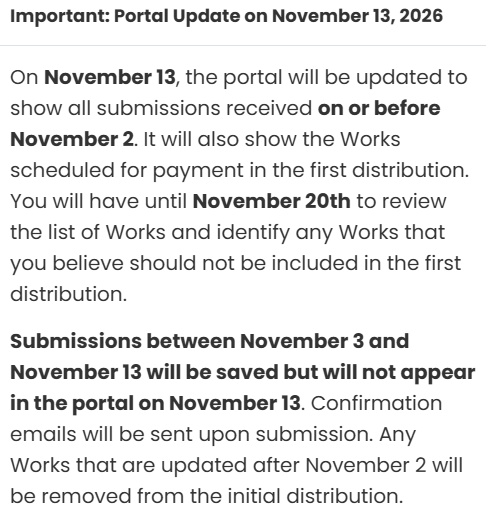
What happens if mistakes and disputes aren’t resolved by November 20th? Presumably the next step is resolution by the court-appointed Special Master (see the settlement website’s FAQ #25 and #26)–although in the lack of transparency that has marked this entire process, how exactly that will work hasn’t been divulged.
Given the size of the settlement, the hundreds of thousands of works, and the inherent complexity of publishing, it was inevitable that there would be hiccups in the claims process. But what has actually happened, with a poorly-designed process, incomplete information, and a deluge of errors that have been left almost entirely up to claimants to address, seems to go well beyond that. There are lessons here for the administrators of any new settlement, if they choose to heed them.
Yes, we will be paid
There’s a certain amount of doomerism on social media around the settlement payouts. The AI bubble, Anthropic’s impending IPO, the big drop in tech stocks since the election, general evildoing–some writers are positive that Anthropic will manage to weasel out of payment.
That’s not going to happen. Per the requirements of the settlement, Anthropic must fund the settlement by making deposits into an escrow account in four installments–at least two of which, and probably three, have already been made. Here’s the schedule (preliminary approval was granted September 25, 2025, and final approval was granted July 21, 2026).
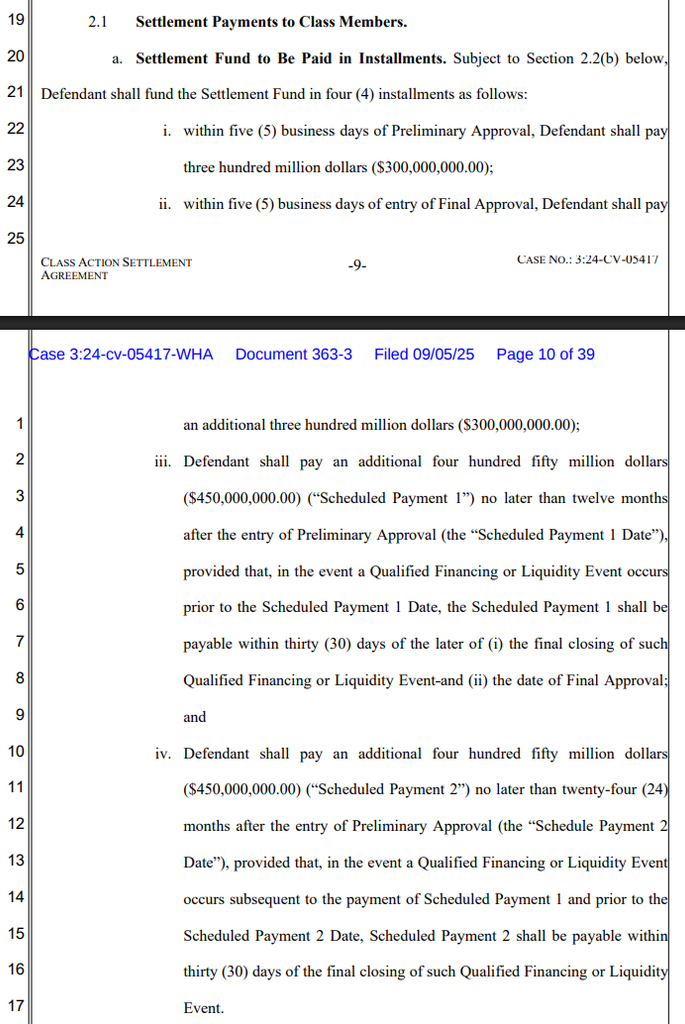
Given how chaotic the process has been so far, there may well be further hiccups and delays. But we will get our money.
A new importance for copyright registration
Eligibility for the settlement was limited to works that had been timely registered with the US Copyright Office (within three months of publication and before August 2022, the date of Anthropic’s last download of pirate datasets). Similar class actions, if they proceed to settlement, will likely propose the same limitation.
Self-publishing authors, and authors with small presses that don’t register on their authors’ behalf, often skip the registration process: it’s a hassle and also an expense. Ditto for writers from countries other than the US, which is unique in making registration a requirement for legal action against copyright infringement. That only around 500,000 of the millions of pirated books Anthropic downloaded were eligible for the settlement is in part due to how many of them weren’t registered.
Writer Beware has long recommended registration for writers whose books will be sold in the USA, even if they are from countries where there is no registration requirement. The possibility of future AI training settlements makes that an even more important consideration.
Was your publisher supposed to register your copyright? Surprise!
A couple of years ago, while searching the US Copyright Office’s public copyright registration database on behalf of an author wanting to know if their copyright had been registered as required by their book contract, I decided on a whim to look at my own copyright registrations. To my surprise and considerable annoyance, I discovered that one of my nine books was missing. Although my contract required the publisher to register on my behalf, it had failed to do so. Infuriating, right? Still, I figured, it was probably the kind of rare mistake that just happens sometimes.
Except…it doesn’t appear to be rare at all.
When the Anthropic settlement was announced, authors began checking their copyright registrations to make sure they were eligible. And many discovered, as I had, that their publishers had neglected to register one or several of their books, despite being contractually required to do so—locking them out of the settlement for books that might otherwise have been included. Not small presses, either: big names like Tor, Harlequin, Penguin Random House
This unwelcome surprise, which uncovered an issue no one realized was an issue, unleashed a lot of discussion (and fury) in the writing community (my blog post chronicles some of the spicy reactions). It’s possible that publishers may be more diligent going forward. Don’t take it on faith, though. If your contract requires your publisher to register your copyright, make sure they do (within three months of publication). Here’s the US Copyright Office’s registration database, where you can look yourself up.
ISBN vs. ASIN
In addition to limiting eligibility to works with copyright registrations, the Anthropic settlement limited it to works with ISBNs or ASINs (ASINs are Amazon’s product codes: every item on its platform has one, including books). A similar infringement class action against Meta recently excluded ASINs, limiting eligibility to copyright-registered works with ISBNs only.
Publishers generally obtain ISBNs for all formats of their books, including ebooks. Many self-published authors, however, obtain ISBNs only for print. An ebook with only an ASIN could potentially be excluded from any settlements with an ISBN-only requirement. As Writer Beware’s Michael Capobianco notes in a recent blog post, this is another important consideration going forward.
Grifters gonna grift
Of course scammers and opportunists were going to come for the Anthropic settlement, and if there are other, similar settlements, they’ll come for those too.
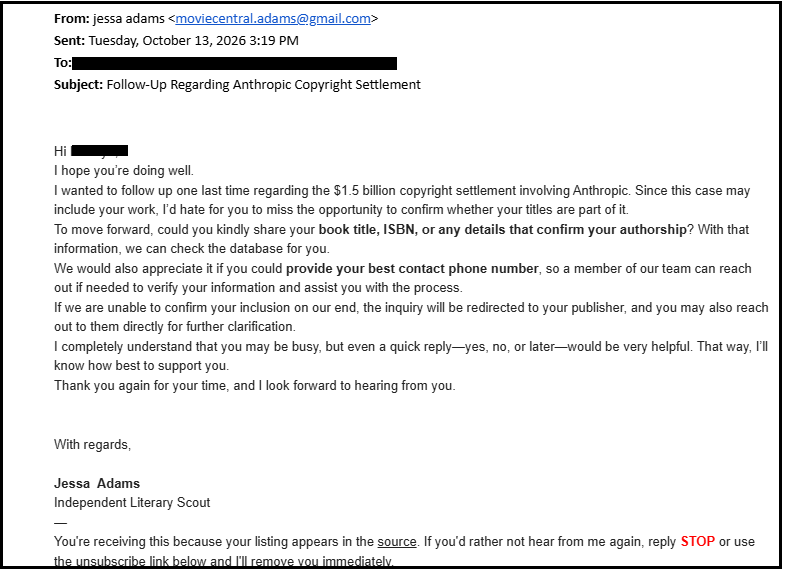
Here’s a recent scam approach (never mind that the deadline for filing a claim has long passed). See the word “source” at the bottom? It’s a link, and it goes to the Library of Congress, which confirms that scammers are harvesting contact info there—a time-honored scam technique that Writer Beware has been hearing about since our inception. They use US copyright registration records too.
This one falls more into the opportunism category. It’s from a company that buys up claims in bankruptcies and class action settlements, offering a lump sum that’s less than what’s due the claimant but has the attraction of being available right now, rather than in the future.
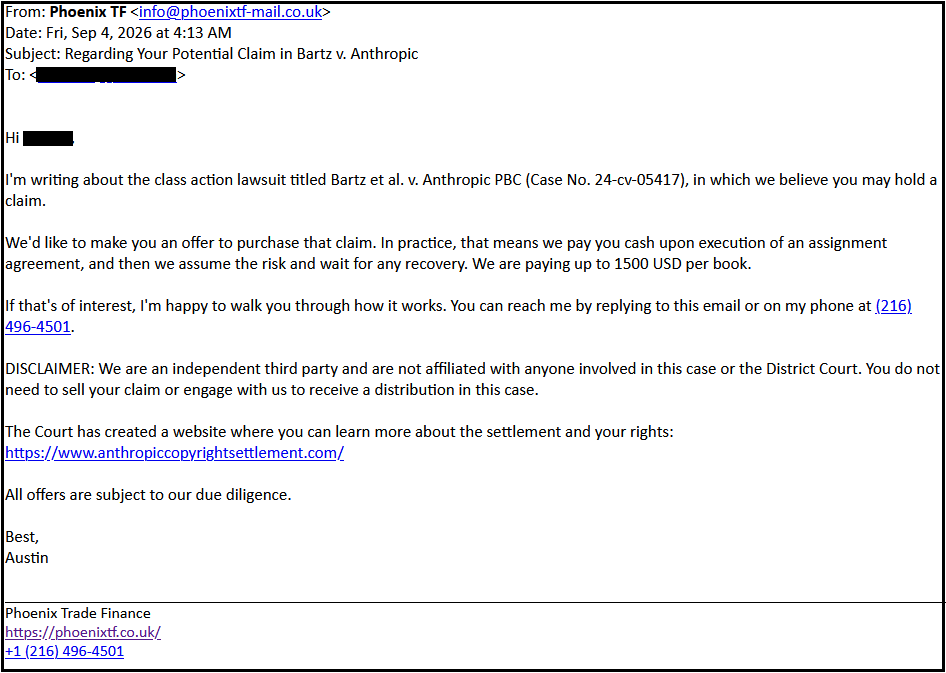
This may be predatory, but it’s not illegal. However, it’s really not applicable to the Anthropic settlement, where payout is only weeks away (if the settlement folks are to be believed) and the offer of “up to” $1500 per book doesn’t really improve on what many authors will collect anyway.
