

When I first began reporting on the aggressive AI-driven email scams that have been plaguing the Inboxes of authors everywhere for well over a year now, they were limited to marketing scams offering supposedly expert “visibility” for writers and their books.
In the year-plus since then, the scams have adapted and expanded in response to writers’ reactions and increasingly widespread reporting and discussion. In addition to marketing offers, they now include book club and review scams and a wide variety of impersonation scams, where the goal of initial contact is to steer writers through one or more referrals into paid editing or marketing arrangements. They’ve impersonated well-known writers, literary agents, editors at publishing houses, book festivals (with fake invites), and radio stations and hosts (with fake interview requests).
The one thing the scammers haven’t changed or adapted is the set of markers that have characterized the scams from the start: hyper-personalization coupled with lavish praise (thanks to generative AI) that makes it seem the sender has actual knowledge of the writer’s book; the almost universal use of Gmail addresses; banking/payment information that traces to scammers overseas; and extreme aggressiveness that paradoxically undercuts effectiveness (when you’re getting multiple flattering yet suspiciously similar solicitations every day, they start to seen a tad inauthentic). It’s a business built on volume, so only a small fraction of writers need to be fooled in order for the fraudsters to make money.
I’ve been trying to keep track of this scam wave, which is the most prolific and aggressive I’ve ever chronicled. Here, for example, is my list of frequently-impersonated companies and individuals, which I’m adding to daily, sometimes multiple times a day (not exaggerating here). And you can see all of my posts about the scams here.
All of this to say…sorry, I’ve got more for you.
Production Companies
While an earlier wave of foreign impersonation scams heavily focused on filmmakers and production companies, usually with the goal of tricking writers into paying big bucks for screenplays and other “book to screen” services that might or might not arrive and wouldn’t get them any closer to a movie deal even if they did, the current tsunami of AI-driven scams has exclusively–as far as I can tell–targeted books, publishing, and areas surrounding them (such as author interview shows).
Till now, that is. In recent weeks I’ve started getting reports of production company impersonations that bear the AI scams’ distinctive markers, including hyper-personalization and praise and the ubiquitous Gmail addresses.
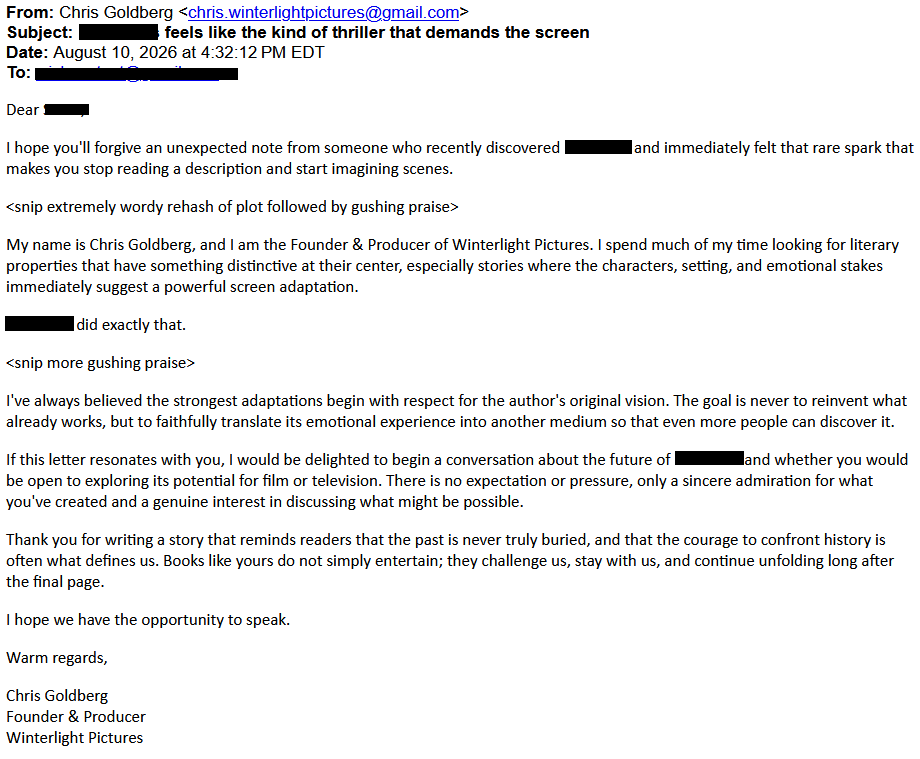
Note the way the address is formulated in the example above: sendername dot company name @ gmail.com. That’s very characteristic of impersonation scams (I’ve written a whole post about that and other scammer email tells).
The earlier production company impersonation scams are still active, so you could be targeted now on two fronts. The most important things to remember are that a) a production company reaching out to you directly is one of the least likely things ever to happen to you as a writer, and b) in the incredibly rare event that it does, the email will come from a company domain, not a Gmail or other non-professional address.
Literary Agent Impersonation Scams
This wouldn’t be the first time AI scammers have impersonated literary agents, but this new one I’m seeing is a bit different.
Basically, it’s a variation on the editor impersonation scam that is absolutely everywhere right now, except it’s a two step scam (fake agent to scam “editor”) rather than a three step scam (fake publishing house editor to fake agent to scam “editor”) and the emails tend to be less flowery and over-the-top. A literary agent (who, if you google them, is confirmably real) emails you out of the blue. As with the editor impersonation scam, they’re impressed with your work and want to know if you’re currently represented by a literary agent. Or they simply claim to want to know about you and what you’re working on. If you respond, the impersonator asks you to submit your query letter and manuscript, and after an improbably short period of just a few days, refers you to an “editor” who can fix whatever is wrong with your query letter or manuscript–for, of course, a sizeable fee. The scammer inhabits both personas.
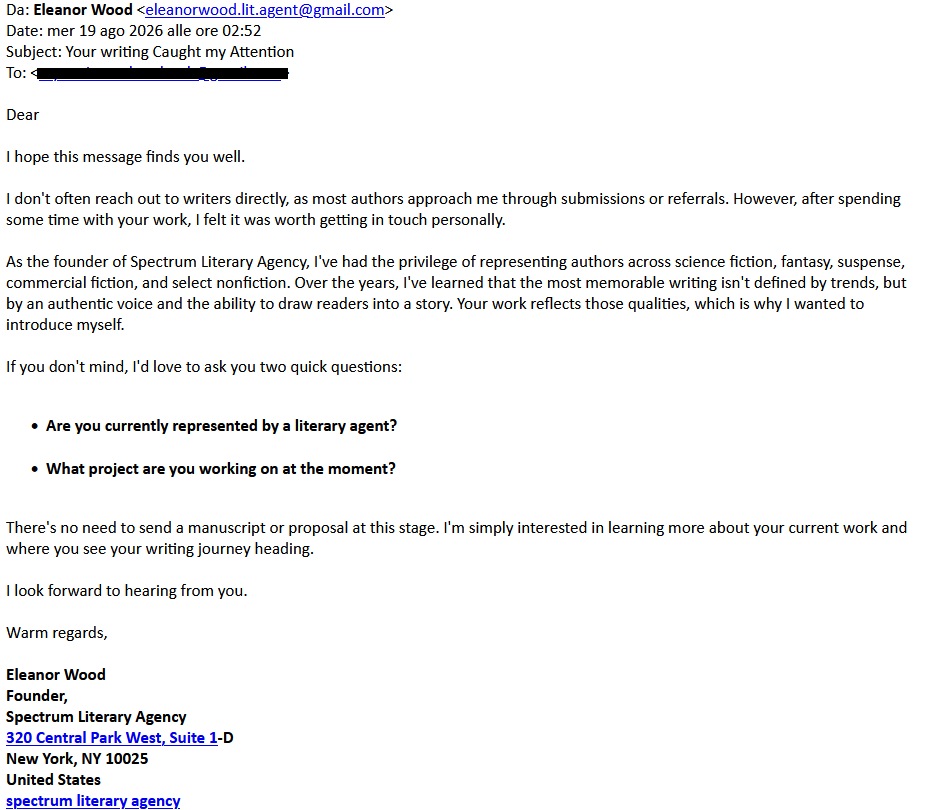
I’ve seen emails identical to the one above purportedly from Andrea Brown and Julia Churchill at AM Heath.
This one skips the flattery, but also features the type of wonky Gmail address formulation you often see with these solicitations, where the name of the impersonated person is mashed together with their agency or publishing house.
Congratulations, Non-English-Speaking Writers, It’s Your Turn
All of the foreign scams I’m tracking–publishing and marketing scams from the Philippines, ghostwriting scams from South Asia (which pose online as self-publishing service providers), and the current wave of AI-driven scams that I’ve repeatedly traced to Nigeria and Nigerian individuals–have exclusively focused their efforts on English-speaking writers in the US, UK, Australia, New Zealand, and wherever else they can be found. The solicitations, the websites, and the advertising are all in English–as are the phone calls (though the callers typically have heavy accents).
That may be changing.
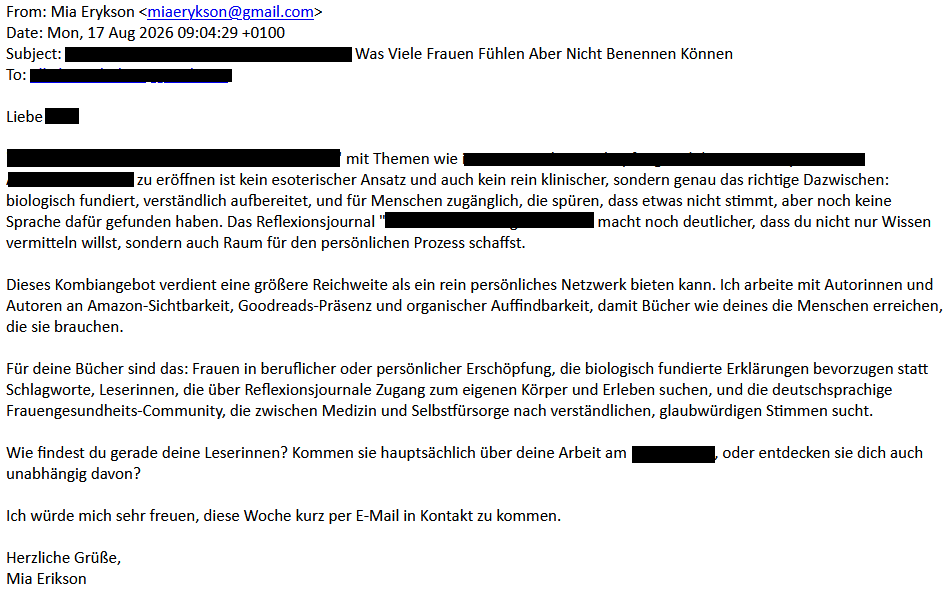
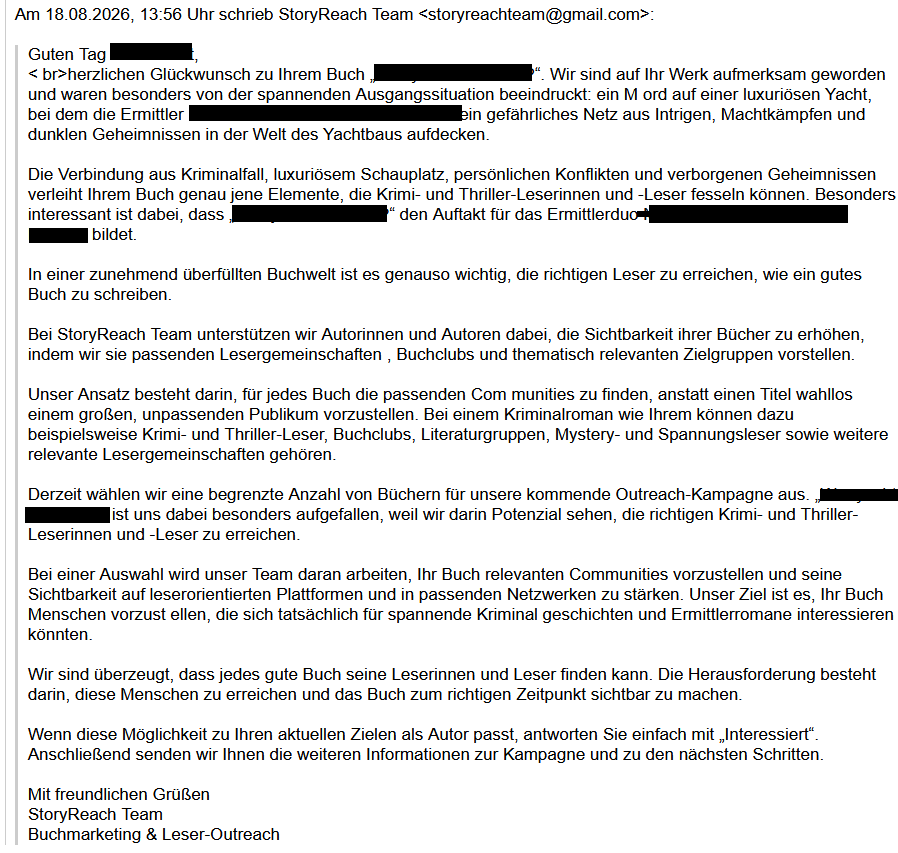
Just in the last couple of weeks, I’ve gotten several reports of marketing solicitations in German. Despite the language switch-up, they are clearly examples of the AI scam wave–Gmail addresses, personalization and praise, marketers who can’t be found online–and target authors in exactly the same way.
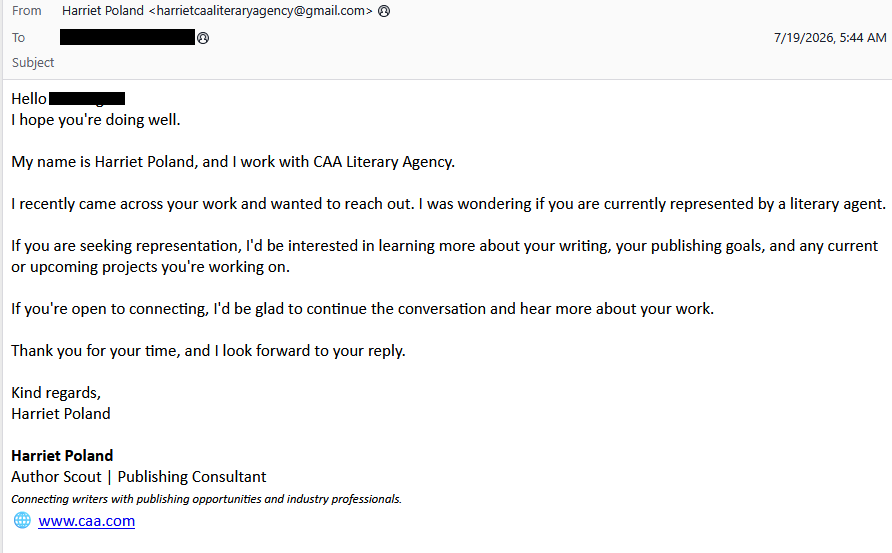
This one, whose Gmail address doesn’t quite match the name in the signature (Erikson vs. Erykson; such discrepancies are a common scam marker) is purportedly from a marketing expert who specializes in “Amazon visibility, Goodreads presence, and organic discoverability”–all offerings that will be very familiar to anyone who has been targeted by a Gmail marketing scam.
Note also the next to last paragraph, which invites the receipient to respond to a series of questions: “How do you find your readers? Do they primarily come through your work at the <redacted>, or do they discover you independently?” This kind of friendly, open-ended inquiry is a common ingredient of AI marketing solicitations: it’s intended to incentivize response, so that the scammer can draw the writer in over an often-lengthy series of email exchanges designed to make it harder to say “no” when the money ask finally arrives.
This one is also a highly personalized marketing pitch, with the scammer (whose “team” has zero web presence) claiming to “increase the visibility of [authors’] books by introducing them to relevant readership groups, book clubs, and thematically appropriate audiences.” It too closes with an invitation to respond, but makes it super-easy: “If this opportunity aligns with your current goals as an author, simply reply with “Interested.” We will then send you further information about the campaign and the next steps.”
Additional AI-Driven Email Scam-Spotting Tips
As AI-driven scams continue to change and evolve, writers need to be ever more on their guard. We live now in a world where all writers are fair game, and any out-of-the-blue email or phone call related to your creative work has to be suspect, at least until you can determine that it’s not.
In addition to the specific warnings above and in my other posts, watch out for these:
Non-typical salutations. Using myself as an example: Dear Victoria Strauss, rather than the more normal Dear Victoria or Dear Ms. Strauss. Ditto for Dear Author. Or no salutation at all. (First name/last name is the one I see most often.)
Extended and apparently accurate discussions of your book’s theme and plot points, coupled with effusive praise. A genuine contact won’t necessarily not include these–but both are established scam M.O.s, and should always prompt extra caution.
Emojis. When I first started getting reports of AI-driven marketing scams in the summer of last year, many of the emails were littered with emojis (you can see an example toward the end of this post). Marketing professionals communicate professionally, which means not writing emails that look like social media posts. I’m not seeing this so often nowadays, but it is still something to watch for, and a big caution sign.
Interminable email exchanges. As noted above, AI-driven marketing scams, especially, employ a boiled-frog approach, where they ease you gently toward the actual money ask over the course of multiple emails, with each email re-emphasizing how great they think you are and how excellently they can help you. It’s classic emotional manipulation: the deeper you’re drawn into the interaction, the more invested you become, the more plausible the scammer’s promises start to seem, and the harder it will ultimately be (the scammer hopes) for you to say no.
Insistent nudging. Scammers want to close the deal as fast as possible, so if you don’t respond right away (especially to payment requests) they may repeatedly check back in with “just following up on my last email” or “wondering if you’ve had a chance to evaluate my offer” communications–sometimes within hours of when they last contacted you.
Fees where they aren’t normally charged.This is always a warning sign. For example, real book clubs, radio shows, and conferences don’t charge fees to invited guests. The process of rights acquiition–such as optioning your movie rights–should never involve a fee or purchase requirement.
Non-reversible payment methods. Instead of credit card transactions, scammers will often require payment by methods that are difficult or impossible to dispute or reverse: wire transfers, Upwork or Fiverr invoices, Paypal Friends and Family, apps like Zelle or CashApp.
Invoices that lack vital information like names, addresses, and phone numbers. Scammers want to avoid accountability. Never pay an invoice that doesn’t offer full disclosure of the provider, their business, and how to contact the person.

Dear Victoria! Your work is invaluable, thank you so much. You’ve saved my life more than once. Thanks to your information, I’m more attentive and careful. Thank you so much!
Thanks for the informative updates on this. Just one thought – you might want to be clearer about what you mean by the terms ‘overseas’ and ‘foreign’. I’d like more specificity. Since I grew up English-speaking in Africa, overseas for me means the UK, and I’m pretty sure that’s not what you intend. It might be more helpful to name actual regions or countries (as you do later in the article) so that we can better map the sources of the problem.
Point taken. My primary readership is from the US (as am I), so I sometimes am guilty of writing in a US-centric way. Also, while it’s factually correct that certain types of scams operate from specific parts of the world, I don’t want to talk about that in a way that labels entire countries and their residents as frauds. So I try to be careful, but I can see that that sometimes results in confusing or vague language.
Thanks for a very thorough annd complete article. I have received all of the above and start every day deleting six or more solicitations. Some persist with second and third attempts.
Then there is “I see you’re an author. I am too. Could you tell me about your writing process?”
I hope every new writer reads your article.
Thanks again
I started self-publishing in 2009 and have released 20 books. I took a five-year hiatus and just released a new book on August 1. My inbox has since been filled with scam emails. Book clubs, marketing, so-called publishing companies. Today, someone actually telephoned me and left a long message about how they could market one of my short stories. How in the world did they get my personal phone number? I’m just flabbergasted at this change.
Thank you for everything you do, Victoria. So glad you have become the font of all scammer knowledge! 🙂 Not only did I get one that was meant for PJ Mahoney, but I received a suspect gmail address from a supposed tech recruiter “leading a confidential retained search for a Member Board Of Directors with an established organization in the Technology Ethics sector.” Yeah, right. I was surprised they used my personal gmail address, so that was new, but they were copying the rest of the letter off my LinkedIn. So I can only imagine how many people in industry sectors are getting similar come-ons.
For the past few weeks I have gotten several invites to online literary “festivals”. They always have a catch; money. At first they sounded like a free event, then a second email arrives with the details. I tell them I’m not interested. But they write back and want to know why. They want my money. I don’t even bother to answer the new emails.
Keep up the good work. The scammers found me here, in Thailand. Just waiting for a message written in Thai.
I receive these everyday. Today it was from SimonShuster@gmail.com are there any legitimate marketers?
nice and very informative material. I gained much from this valuable information.
Thank you so much for your work on this. Great to have you on our side!
Yesterday I saw that a predatory vanity press (She Writes Press) has on its website a warning that it and their staff are being impersonated online. That just cracks me up.
Just received a few today. I told Marcy of Crooked Road that we first must meet for lunch at the Grand Budapest Hotel, but she deferred as she is so busy (but still wants me to send the synopsis for my next novel). Daniel of London Fun Bookclub (that’s how it’s spelled) is only asking for a donation of 500 pounds when my book is “showcased” to support the club’s charity (an orphanage in Dublin). I told him would be happy to be showcased but I to relieve of the administrative burden I am will donate directly the orphanage. Oy!
The one thing these scammers are not willing to do is to buy your book and read it. Like many writers, I often get approached by scammers. The emails are gushing with flattery, which almost seems like they actually read the book. At the minimum AI is reading the reviews. I’ll ask an easy question to test a person’s knowledge of my story. The answers are hilarious but tell me right off the bat the writer did not read the book.
From: Daniel
Subject: Invitation to London’s Friendly Book Club — September 30
Date: August 27, 2026 at 7:07:53 AM PDT
To: marlo.faulkner@gmail.com
Hi Marlo,
I hope you’re doing well.
My name is Daniel, and I’m the organizer of London’s Friendly 20- and 30-Somethings Book Club.
I came across The Second Mrs. London, and what caught my attention was the decision to bring Charmian Kittredge into focus alongside such a well-known literary figure as Jack London.
I particularly liked the opportunity to look beyond the famous author and explore the woman beside him — her own life, ambitions, relationships, and the world she inhabited. That kind of perspective can make a familiar historical figure feel much more human and give readers a very different way into the past.
We’re putting together a book club event on September 30, and I’d love to invite you to join us for a conversation about The Second Mrs. London.
Why you, specifically?
Because you can give our readers something the book alone can’t — the thinking and research behind the story. I’d love to hear what drew you to Charmian’s life, how you approached writing about her relationship with Jack London, and what you discovered while bringing her story into the foreground.
And what would you get from saying yes?
You’d have the opportunity to speak directly with readers who genuinely enjoy historical fiction and stories about the people behind well-known historical figures. You’d also get to hear their questions and interpretations and introduce your work to readers who may be discovering it for the first time.
It would be a chance to discuss the creative process behind The Second Mrs. London and explore how historical research can become an intimate, character-driven story.
We’d keep the event informal and conversational. No long presentation or formal lecture — just you, curious readers, and a relaxed discussion about the book, Charmian’s story, and the ideas behind it.
If September 30 might work for you, I’d be happy to send you more information about the format.
Would you be open to joining us?
Warmly,
Daniel
Organizer
London’s Friendly 20- and 30-Somethings Book Club
Thank you for this full explanation. I’ve been recommending folks online to check with Writer Beware and commenting on many of the writers groups I belong to online with the hint to”first look at the email – if it ends in gmail it’s likely a scam’. And also reminding readers that agents, and publishers seldom IF EVER reach out to writers. Keep up the good work.
I have to say, as one of the many who receive these scam emails daily, it’s pretty great to know you’re out there closely tracking these trends, Victoria. It’s very affirming to have you acknowledge the very things zi observe almost daily.
Yes, they continue to evolve. The scams I got this week included one from a literary scout in a British TV and movie agency. I wrote them directly and they confirmed it was a scam. And one asking if my website URL was for sale. That one I forwarded to the Author’s Guild.
I receive a couple dozen of most of these types of scams on a daily basis. I report as phishing and block every single time. One I didn’t see you mention are the emails from so-called BookBub agents. Have you heard about those, where someone emails an author claiming to be an agent with BookBub.
Thank you so much for the work that you do on this important subject.
Thank you, Victoria. You have taught me much. I’m now down to half a dozen email scammers each day, but no more do I spend a waste of my time. I either click on “block” or “phishing” or “scam.” I appreciate what you taught me to immediately recognize the impersonators and obvious scammers. Other “authors” email to say lovely things about my books and simply want to be “friends.” The second or third time around, they have a “marketer friend” who would love to help me sell more books. That’s become very clear from the get-go. Thanks, Victoria, for being an excellent teacher for all of us. Warm regards, Janet
If your email program/service supports adding custom Sieve code, adding it is worth investigating.
Proton Mail, Fastmail, Purelymail, and Runbox support it.
Over the last few months with the help of Claude Code, I’ve pared these down from five per day to maybe one per week.
Here’s the code and how Claude Code generated it.
https://bit.ly/3SAzUb6
Just click on the button on this page, copy the code, put it in your email client, and voilà!
I’m getting them almost daily, from supposed “literary agents”, social media “influencers” and people posing as “agents” of BookBub.
I agree that Dear Victoria Strauss sounds odd, because I’m from a generation that used Dear Ms. Strauss, but it’s today’s common salutation, at least for us authors querying agents, because Gen X and younger wants to avoid salutations that may not match with the person’s gender identity (such as “Ms.”). The full name salutation will always sound awkward to me, but I use it because one must keep in step with the times.
I receive from everyone. Just had my first one today as a literary agent. I receive over 100 emails a day unfortunately the good ones get lost in the crap. Very sad and such a waste of time.
http://www.SisterhoodSleuths.net
Since making my own gmail address harder to find, the scammers are now using the Jetpack forms of my website instead. They’re claiming to be from American companies… but have a Nigerian IP address.
I got this – what do you think?
From: readerlink.procurement.dept1@gmail.com
To: dbhmsc@aol.com
Aug 26, 2026, 8:31 PM
Good day,
Thank you for confirming your account details.
I am David Barker, Executive Vice President & Chief Marketing Officer at Readerlink Distribution Services [1.1.1, 1.1.5].
During our quarterly catalog evaluation for mass-merchant and big-box store allocations (including major retail partners like Target and Walmart)the 36 watchers , was selected by my curation review committee for our upcoming regional retail placement cycle.
Based on our store count and initial sales projections, my committee has designated your title for an initial distribution allocation of 3,000 to 4,000 physical copies across our regional retail network.
This is a scam.
I haven’t seen anything quite like this, but it’s clearly a scam. Readerlink is a real distributor, but it works with publishers (not individual authors). That’s a fake email address; a real contact from them would come from @readerlink.com. And the fake address includes elements that Gmail scammers use a lot: lots of periods and a number.
I’ve also been getting quite a few from “reading groups.” Same crap.
Your information is so true. I get at least three to four offers of some kind every day. Some are very professional looking, but I’ve started to notice how the sources are gmail, not a company source.
I had four in today’s mail alone. Thanks for keeping us informed, Victoria.