

A Hellacious Mess: Unbound
Established in 2011, UK-based crowdfunded publisher Unbound styled itself the Kickstarter for books and was widely heralded as the next big idea in publishing. Heady words like “disruption” and “paradigm” were tossed around, and the company’s launch garnered substantial positive media coverage. (This blog post from Nail Your Novel provides an overview of how it all worked).
To all appearances, Unbound had a good run, publishing hundreds of books over more than a decade, gaining both critical and sales success. By some accounts, though, a lot of it was smoke and mirrors, and in 2024 cracks began to show, with authors reporting royalties delayed or unpaid and books unavailable for sale.
In December 2024, Unbound informed its authors that what they suspected was true: it didn’t have the money to pay royalties. It claimed to be re-structuring, bringing on a new CEO, Archna Sharma, who promised to stabilize the company. But just three months later, Unbound went into administration–and almost at once was sold, with all its assets, in a pre-pack deal (a kind of bankruptcy deal where the sale of a company is negotiated with a buyer before an administrator is appointed) to a new company called Boundless Publishing, at a fire-sale price of £50,000.
Boundless was helmed by one of Unbound’s founders, John Mitchinson, and Unbound CEO Sharma. That’s right: Unbound was sold, in effect, to Unbound.
The new Boundless Publishing promised to move forward with “most” of the Unbound book projects already scheduled. But not all–and in April, Boundless announced that supporters who’d pledged money for the dropped projects would not be refunded. Boundless also committed to paying all the money owed to authors and other creditors…but it appears that will mostly not be happening either, at least for now.
Per the payment plan Boundless created in the wake of the sale, authors were to receive a partial payment in April (which apparently they did), and were expecting another installment on May 30. Instead, they received a lengthy email from Boundless CEO Sharma, disclaiming any legal obligation to make good on Unbound’s debts and describing the disbursement of unpaid royalties and invoices as “goodwill payments”–which, by the way, would not be paid.
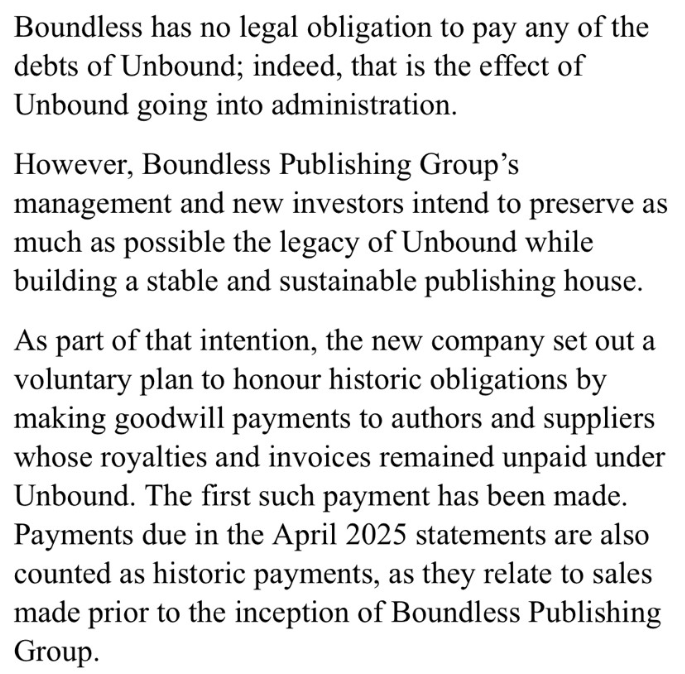
“We simply do not have the cash at the moment to make further historic goodwill payments,” Sharma wrote. “I cannot emphasize enough that we can pay you the goodwill payments covering Unbound’s historic liabilities only if Boundless Publishing Group survives and thrives….Unfortunately, I can’t answer immediately when you are likely to be paid.”
Sucks to be you, Unbound authors.
The same day, Unbound and Boundless co-founder John Mitchinson resigned, taking a number of Boundless staffers with him. In a statement posted to X on June 5, he attributed his departure to the missed payments and described Boundless’s current position as “morally and financially unacceptable.”
The wreckage is indeed substantial. Here’s Print Week on the latest report from Unbound’s administrators, confirming longstanding financial and logistical mismanagement (the report can be seen in its entirety on the Companies House website):

(According to Publishers Weekly, that £30.4 million shareholder loss has been revised down to £9.05 million.) As for creditors, there’s a hole of £2.4 million, with 238 authors and agents and 7,984 website customers affected:

A June 3 meeting of creditors affirmed the unlikelihood of unsecured creditors (creditors who are owed a debt that’s not secured by collateral from the debtor–authors are always unsecured creditors in bankruptcy cases) receiving any distributions as a result of the administration process. Between the lack of assets (just £200,000, per administrators’ estimates) and administrators’ fees (currently estimated to be £134,366), it doesn’t seem all that likely that secured creditors, which have priority, will get much either.
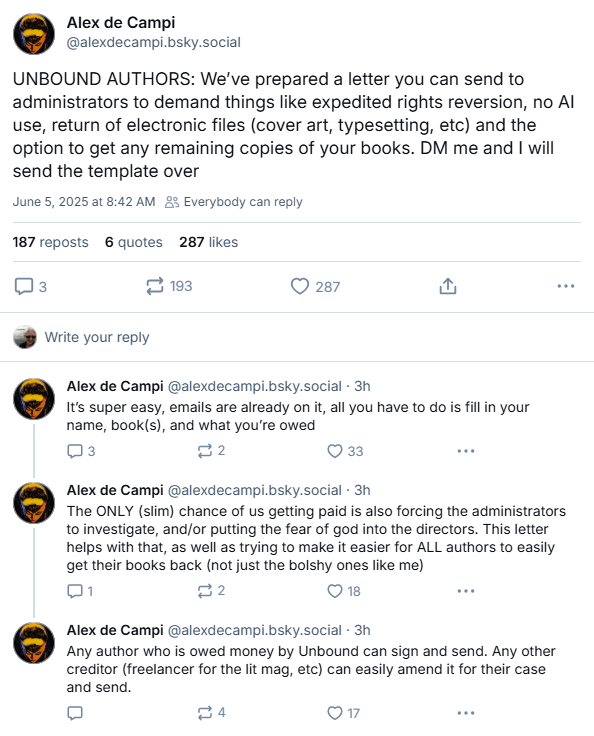
The concerns for authors go beyond unpaid royalties: there are unanswered questions about the status of authors’ rights, how they can request reversion, whether they can obtain unsold inventory, and more. Unbound author Alex de Campi is offering a letter template writers can use to contact administrators about these matters:
That’s the story so far. I’ll be updating this post as news comes in.
Many of the links above lead to social media posts by affected authors. More reading/watching:
– Steven Goodwin (filed suit for unpaid royalties only to learn that Unbound was no more)
– YouTuber NerdCubed (says he is owed an estimated £40,000 in unpaid royalties–if you don’t want to watch a video, he has posted a thread on Bluesky)
– Tom Cox (has reverted rights to his seven Unbound books)
– Thomas Heasman-Hunt (owed money for subsidiary rights)
– Mona Eltahwy (created an anthology, for which several contributors haven’t been paid)
– Jordan Shiveley (owed more than $15,000 for a debut novel)
– Crowdfunding consultant Lisa Ferland’s review of Unbound (several years old, but poses some prescient questions about its business model)
– Publishers Weekly (on Boundless’s “uphill battle to rebuild trust”, in which Sharma describes the Unbound crowdfunding model as “fundamentally flawed” and says that the company was “very badly mismanaged”)
UPDATE 8/1/25: The Bookseller reports that Boundless has gone into administration.
This effectively means that authors and suppliers who were owed money by Unbound when it went into administration will no longer receive any historic payments, as any existing cash will go to the adminstrator.
In an email seen by The Bookseller, understood to have been only sent to authors published by Neem Tree Press, CEO Archna Sharma said that she had been unable to rescue Neem Tree Press due to the situation with Boundless.
The Bookseller understands that both Boundless and Neem Tree Press will be closing down entirely, with no rescue. It is unknown whether Boundless authors have been informed of the administration.
A Longtime Offender: Albert Whitman & Co
Albert Whitman (AW) has long been the focus of author complaints about delayed or missing royalties, with agents and authors having to struggle to get responses from the company.
Writer Beware has complaints going back to 2019. Publishers Weekly published an article about the complaints in 2020, and another in 2024 when reports of payment delays again bubbled up into the public eye. With each eruption of reports, the company’s execs acknowledged the problems and promised to do better…only for the same issues to re-emerge. (Authors weren’t the only ones making noise: in July 2024, Library Journal’s parent company filed suit against AW for failing to pay over $17,000 in advertising invoices.)
In a statement published on the AW website in December 2024, publisher Tom MacDonald attributed the company’s troubles to the general challenges faced by children’s publishing (slow sales, the book banning frenzy), revealed a number of company responses (including staff reductions, office downsizing, and a pause on acquisitions–although, per Publishers Marketplace, at least one book was acquired in February 2025), and pledged that “We are confident that our proactive measures will enable us to weather this period of instability and emerge stronger than ever.”
Despite these assurances, few people were surprised when, in April 2025, AW announced that it was entering Chapter 11 bankruptcy (the kind that allows a company to restructure).
You can get a sense of the size of AW’s debt to authors and agents (and others) from the Schedule of Creditors filed as part of the bankruptcy proceedings (this PDF, hosted on the Authors Guild’s website, includes creditors’ names but redacts addresses). A May 29 meeting of creditors revealed additional details, such as an expensive lawsuit by a former employee and the fact that some authors and intellectual property owners are owed royalties in excess of $60,000. According to the Authors Guild, which has retained bankruptcy attorneys to represent Authors Guild members who are creditors, AW “did not provide direct notice [of the meeting] to authors with active contracts or outstanding royalty claims, leaving them in the dark about a critical moment in the bankruptcy process.”
The Authors Guild offers advice and instruction on steps authors and illustrators should be taking, including signing up for e-notices from the court and verifying their information on the Schedule of Creditors.
I’ll be following the the case and posting updates as developments happen.
UPDATE 3/24/26: The Authors Guild reports that there is now a plan of reorganization, and it’s projected that unsecured creditors (i.e., writers) will receive 40% of their claim–though that depends on a number of factors, including whether income projections pan out and how many claims are ultimately received.
If you’re an author affected by the bankruptcy and didn’t file a claim, the AG has this advice:
If you are an author who did not receive the legally required notice from Albert Whitman to file a proof of claim, we urge you to contact Albert Whitman attorney William Factor at wfactor@wfactorlaw.com and Bankruptcy Trustee Robert Handler at rhandler@com-rec.com with a request to file a late claim. You may also intervene in the case with your own counsel (we can provide referrals if you need representation).
Authors Guild members can also contact the AG, or submit a legal help form.

So how does a first time author find a reputable Publisher to submit to, without an agent? Or is an agent always recommended?
You do need an agent if you want to sell fiction to a major publisher, but there are many reputable smaller publishers that deal directly with authors, no agent required. There’s information on Writer Beware’s Small Presses page to help.
I wonder if you could talk about changing distribution or publishing houses. I published with Page publishing many years ago and have renewed it a couple times and have not had any sales. It is time to renew for a couple more years and I am contemplating whether to renew it again or try another distribution house. I would love to know your thoughts.
Page Publishing provides what’s really a self-publishing service similar to what you can get from many other, similar providers–but Page charges exorbitant fees. (If you plug “Page Publishing” into the search box, you’ll see the post I’ve written about it). It doesn’t do anything in the way of meaningful marketing or promotion (the marketing services it sells are largely junk). Unfortunately that’s typical of self-publishing service providers: they provide the publishing service but no real support. That’s on the author.
Writer Beware’s Self-Publishing page offers a lot of helpful information, including general info about self-publishing, scam warnings, and links to trustworthy resources to help you research an appropriate (and reputable) new platform or publishing service. The Alliance of Independent Authors is a good resource also.
Seems Unbound/Boundless isn’t responding to customers through the customer service email.
According to one of the Unbound authors on Bluesky, their royalties were used to fund a digital-only literary magazine side project ‘Boundless Magazine’ – that planned to have a paid subscription and an accompanying podcast. Unbound ‘believed; they had an investor backer and utilized authors royalties to get the site set up quicker – then the backer pulled out.
Suffice to say, this is yet another case of a publisher believing that authors royalties are their pin money to play with. It’s tricky to find the site because no one at Unbound/Boundless checked if there was another magazine with the same name – there is, its a travel magazine and it’s the top in all searches.
This is the site set up by Unbound/Boundless. https://www.boundlessmagazine.com/
I imagine authors who are owed money will be even more gutted to see this pretentious vanity project was paid for with their hard-earned book sales.
As you can see – even though Unbound isn’t supposed to be trading anymore their retail website is still up, they’re still selling books and still getting a monthly income from a lot of wide book retail sites. Not a cent of any sale will go to the authors. Shocking stuff.
This is a good jolt to remind people to think carefully before joining any Kickstarter campaign. The creator if it always retains the right to give you the middle finger and not send promised “rewards.”
I know of one sci fi anthology financed through Kickstarter last October. The main “reward” being a hardcover version of an anthology that was previously already available only in paperback.
They raised the required humble amount of $3K, and were successfully “funded.” We are in the sixth month of 2025 and that book has yet to be shipped.
I queried the sci fi club associated with that yearly anthology and they too are in the dark about when the book will ship. The organizer has been stingy with updates.
This doesn’t feel like a scam. It just feels poorly planned. I have no dog in the fight, but came across this particular old Kickstarter while looking at markets.
Nobody wants to go through “The Final Dangerous Visions” syndrome and literally physically dying before a book is finally shipped.
There are many successful Kickstarter stories, but maybe everyone should just step away from all that pie on the sky crap fest and quit funding people’s projects who are legally allowed to not follow through.
Stop electronically sending them money and let them “fund for themselves.”
That is, they should act like a business and invest THEIR OWN money into starting their dream of being a publisher, and stop begging for donors via Kickstarter.
“Once successfully funded past blah blah blah we will add blah blah blah as an option / reward and blah blah blah we hope to have all items shipped by blah blah blah.”
I think I’m just really sick and tired of people expecting donations.
Panhandlers hate me — because I just drive on by.
Okay, but Unbound wasn’t Kickstarter. Different rules.
I totally misread this article. Doh!
Unbound was ITS OWN Kickstarter….
Life is too short for this kind of crap. It’s not only the money losses, but all that wasted time and future wasted time by Boundless (nee Unbound) kicking that can down the road.
I had a story accepted recently by a legacy magazine. It has helped me retain some sanity in this whole shooting arcade of madness.
If it were not for that acceptance, I might be tempted to just hang up my guns.
Of course that’s foolish talk. I imagine almost anyone reading this column is pulled toward writing no mater what happens.
You might as well claim you’re hanging up your lungs.
I wish authors would learn to cease submissions to publishers with continuing complaints about nonpayments (especially with Cricket Media LLC. They don’t pay; avoid them!) Lack of content may be the only way to pressure a publisher into giving up royalties . . though I imagine some would just turn to AI at that point.
By “cease submissions” I mean boycott. Should have clarified. yep, i iz a writter
Wow. Those companies had to work really hard to get that far into debt! My company is completely debt-free and we have never made a late royalty payment to our authors. In fact, most months, we pay them early (like we did this week). I never understand how companies just keep digging themselves deeper and deeper instead of doing something at the first sign of trouble.
I wanted to add that they were getting money from book sales and, instead of putting that money into an escrow account for their authors’ future royalty payments, they were SPENDING IT.
Thanks, Victoria. I’m one of the Unbound authors concerned. I started life at Orion, with a starry agent but screwed up and failed to deliver my third contemporary. Unbound seems like a safe option when I was looking for a place for a very different, scifi, pen-named novel. I funded within a month, but there my happiness with Unbound ended, and I’m now only indie, having rejected, on the Society of Authors’ advice perfectly reputable but too minor publishers for my multi-award-winning historical series. You live and learn and – as YOU know better than all the rest of us – if it sounds too great to be true, it probably is!!!! Yours gratefully, Alice (McVeigh)
I am a self published author with a bad taste in my mouth. My advise to self published authors is to demand that your ISBN should be assigned to you with IngramSpark and Amazon and have royalties come to you directly.
Do not believe all the promises to display your book at bookfairs or other publicity outlet. They do not work. If you list your book in Amazon, if the book sells it sells. If not, so be it. You are better off. I have spent several thousand dollars and received less than $500 in royalties.
Someone on Bluesky made the point that all the money Unbound had at any point was what *author’s fans* had put in there, since every project/book was crowdfunded mostly through each author’s efforts to publicize it to their fans. It makes this whole thing all the more egregious, I think–including the fact that donors aren’t getting things they paid for in full, some of which apparently exist (or existed at some point) in warehouses somewhere.
(And I don’t care much about the previous CEO’s “mea culpa” that actually just shift blame for decisions made while he was in charge–the names of ALL the people making decisions at Unbound over the past decade need to be engraved in people’s minds, with large “DANGER!” banners.)
The attempted re-launch of Unbound is what is known euphemistically as a “phoenix” move. File BK, dump most or all of the liabilities, open a new business with just the assets.
The “phoenix” term is something I learned only while researching this blog post…a couple of articles about the collapse refer to Boundless as “Phoenix publisher Boundless” and when I first saw this I was like “What? Boundless is a UK publisher, how can it be in Phoenix?”. Oh.