
Latest Posts

Army of Clones: Author Solutions Spawns a Legion of Copycats

I don't think there's much dispute that the many "imprints" under the Author Solutions umbrella are among the most negatively regarded of all the author services companies.

From the predatory business practices that gave rise to two class action lawsuits, to the huge number of customer complaints, to the relentless sales calls and deceptive recruitment methods, to the dubious and overpriced "marketing" services that are one of the company's main profit sources, AS's poor reputation is widely known. Along with other factors, such as the competition from free and low-cost self-publishing platforms, this has pushed AS in recent years into steady decline.

Unfortunately, whatever gap AS's contraction has created has been filled by a slew of imitators. Why not, when hoodwinking authors is as easy as setting up a website and opening an account with Ingram? In some cases, the imitators have first-hand experience: they've been founded and/or staffed by former employees of AS's call centers in the Philippines (as well as ex-employees of other disreputable companies with operations in the Philippines, such as Tate Publishing and BookWhirl.)

Solicitation Alert: Book-Art Press Solutions / Window Press Club / Booktimes

NOTE: Book-Art Press and Window Press Club are aware of this post, and have made changes to their websites, so some of the links below may not work--however, all were fully verified by me at the time of writing.

Note that there are a number of updates at the bottom of this post, including a new business name (Booktimes).

Book-Art Press's website dangles the carrot of free publishing ("Why spend thousands when you can publish your book for free?"), but this is less a yummy vegetable than a poison pill. BAP's publishing packages are really just a way to steer writers toward a smorgasbord of junk marketing services (book trailers, paid review packages, press releases), questionable editing services ("A thorough editing...is applied for the material to be professional written, yet retaining the author’s voice"), and add-on services of dubious value (illustrations, data entry, and more).

Alert: Copyright Infringement By the Internet Archive (and What You Can Do About It)

The Science Fiction and Fantasy Writers of America has issued an alert on copyright infringement by the Internet Archive. Other professional writers' groups taking notice include the UK's Society of Authors, which has posted an alert on its website, and the USA's Authors Guild and National Writers Union, which have alerted their members.

I've reproduced SFWA's alert below. Although this seems to be the first time widespread attention has been paid to it, IA's massive scanning project is not a new endeavor. See this 2013 article from Teleread's Chris Meadows.

I've commented on my own experience at the bottom of this post.

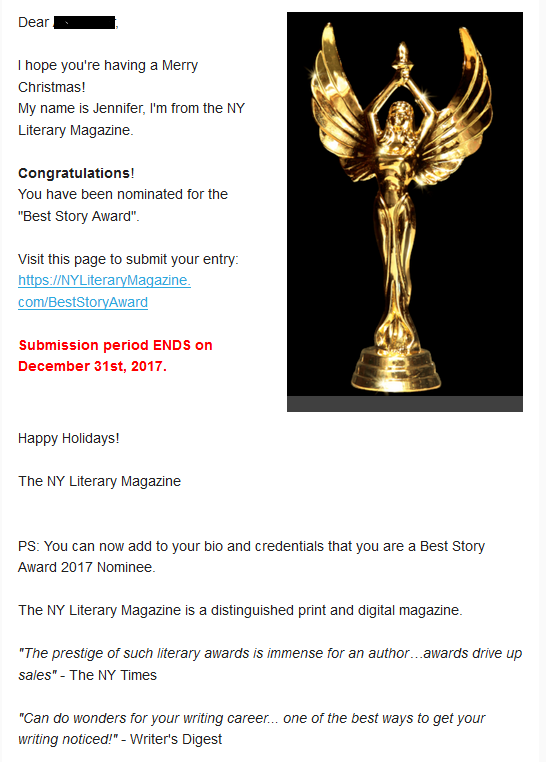
How Not To Promote a Writing Contest: The NY Literary Magazine

That's the message some writers found in their inboxes on Christmas Day, from a publication called The NY Literary Magazine:

Could there be a better Christmas gift? Recognition by a "distinguished print and digital magazine"! The chance to "add to your bio and credentials that you are a Best Story Award 2017 Nominee"! An award recognized by the New York Times and Writer's Digest!

Well...not exactly.

Author-Agent Handshake Agreements: Should You Be Wary?

I've recently gotten a number of reports about a literary agent with a major agency who is offering representation with a "handshake" deal: representation based on a verbal commitment, rather than a binding author-agent agreement or contract.

There are a number of reasons why authors should be wary of such offers.

1. A handshake is not today's professional standard.

Decades ago, so-called handshake deals were common in the agenting business. You and your agent agreed that the agent would represent your work to publishers; once your work sold, the agent's right to receive commissions and to act on your behalf was formalized in the agency clause of your book contract. Before publisher consolidation created the mega-houses, before the digital revolution and the array of new rights and markets it has spawned, before authors' backlists became valuable, most authors, agents, and publishers deemed this to be enough.